
How to Check Tire Tread Depth
Last updated: September 21, 2026 · Reading time: 8 min
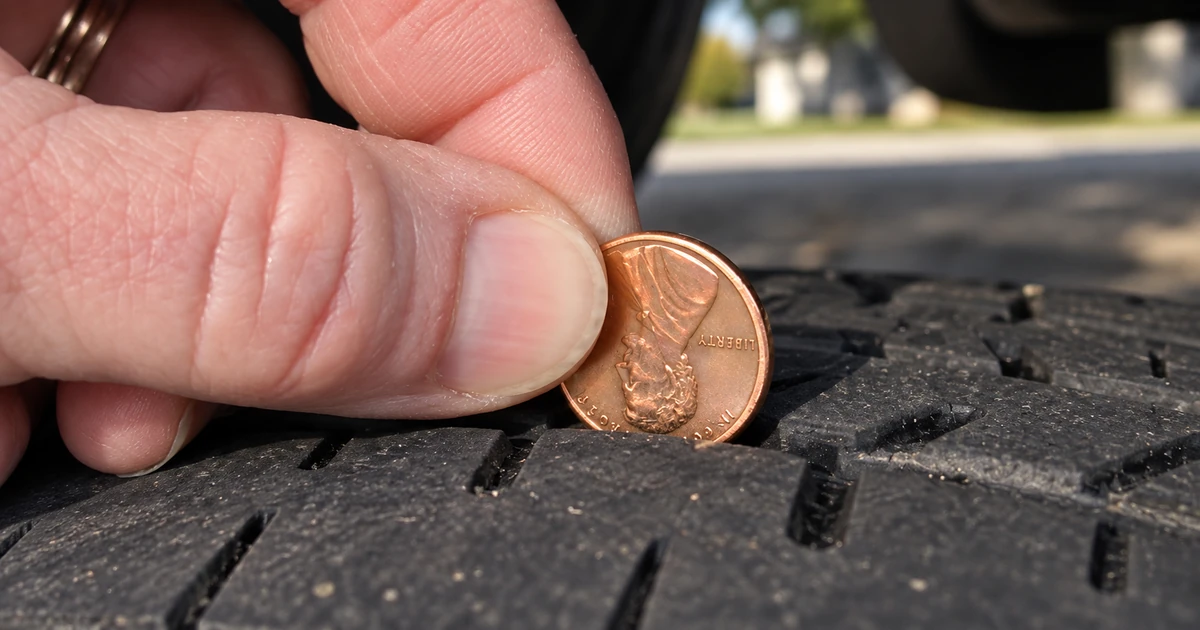
To check tire tread: insert a penny into a tread groove with Lincoln's head pointing down. If you can see the top of his head, your tread is at or below 2/32 inch and the tire needs replacing now. For a stricter safety check, use a quarter — seeing Washington's head means 4/32 inch or less.
Tread depth determines how well your tires grip wet roads, resist hydroplaning, and stop in an emergency. The good news: checking it takes two minutes and costs nothing. This guide covers all four methods — the penny test, the quarter test, wear bars, and a tread depth gauge — plus a depth chart that tells you exactly when to replace your tires, and how to read uneven wear patterns that signal pressure or alignment problems.
Quick Summary
- New tires start at 10/32–11/32 inch; the legal minimum is 2/32 inch
- Penny test: see all of Lincoln's head → at or below 2/32, replace now
- Quarter test: see all of Washington's head → at or below 4/32, replace soon
- Tread flush with the molded wear bars → at the legal limit
- Check several grooves on each tire and go by the lowest reading
Tire Tread Depth Chart: What the Numbers Mean
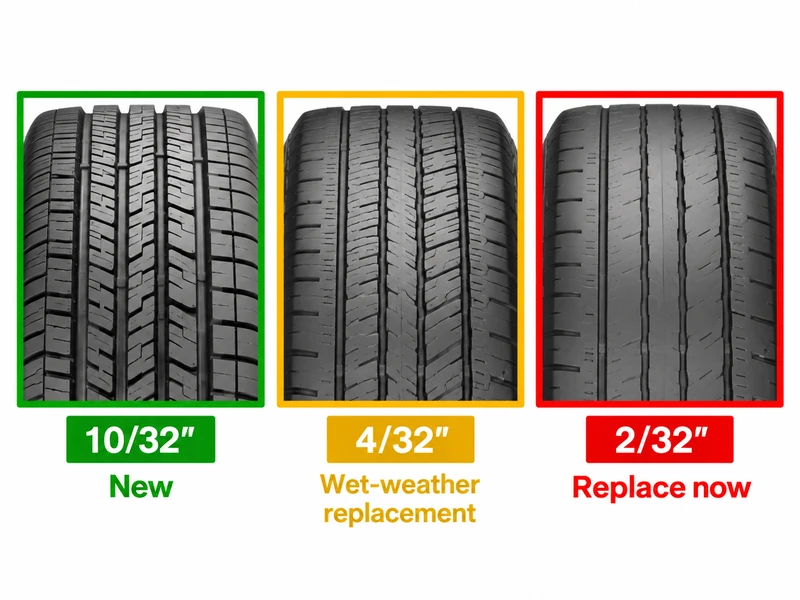
Tread depth in the US is measured in 32nds of an inch. New all-season tires start around 10/32–11/32 inch, and every 32nd you lose chips away at wet grip. Here is what each reading means in practice:
| Tread depth | In mm | Status | What to do |
|---|---|---|---|
| 8/32" or more | 6.4 mm+ | Good | Nothing — recheck monthly |
| 6/32"–7/32" | 4.8–5.6 mm | Acceptable | Fine for dry and wet; if you drive in snow, start shopping |
| 4/32"–5/32" | 3.2–4.0 mm | Replace soon | Wet grip significantly degraded — AAA recommends replacing at 4/32" |
| 3/32" | 2.4 mm | Nearly worn out | Dangerous in rain — replace immediately |
| 2/32" or less | 1.6 mm | Legal limit | Replace today — bald tires hydroplane and can fail inspection |
Why Tread Depth Matters More Than You Think
Tread grooves exist to pump water out from under the tire. As they wear shallow, the tire rides up on the water film instead of cutting through it — that is hydroplaning, and it can happen well before your tires look "bald."
AAA put numbers on it. In AAA's wet-braking test, tires worn to just 4/32 inch — still legal everywhere — needed an average of 43% more distance to stop from 60 mph on wet pavement (87 extra feet for a sedan, roughly the length of a semi-truck). At the point where the car on new tires had stopped completely, the car on worn tires was still traveling nearly 40 mph. Wet handling dropped by about a third. And price made no difference: expensive tires degraded just as much as budget ones once worn.
4 Ways to Check Tire Tread (Compared)
There are four reliable ways to check tread depth — two free coin tests, one built into the tire itself, and one cheap tool. Pick based on how precise you need to be:
| Method | Cost | Measures | Accuracy |
|---|---|---|---|
| Penny test | Free | 2/32" (legal limit) | Pass/fail only |
| Quarter test | Free | 4/32" (replace-soon line) | Pass/fail only |
| Wear bars | Free — built into the tire | 2/32" (legal limit) | Pass/fail only |
| Tread depth gauge | $3–$10 | Any depth, in 32nds | Exact number |
Method 1: The Penny Test (Checks 2/32")
The penny test is the classic check because the distance from the edge of a US penny to the top of Lincoln's head is almost exactly 2/32 inch — the legal minimum tread depth in most states. It will outlive the coin itself: the US Mint struck its last penny on November 12, 2025, but the 300 billion pennies still in circulation work fine — and the test is worth remembering either way.
Point Lincoln's head down
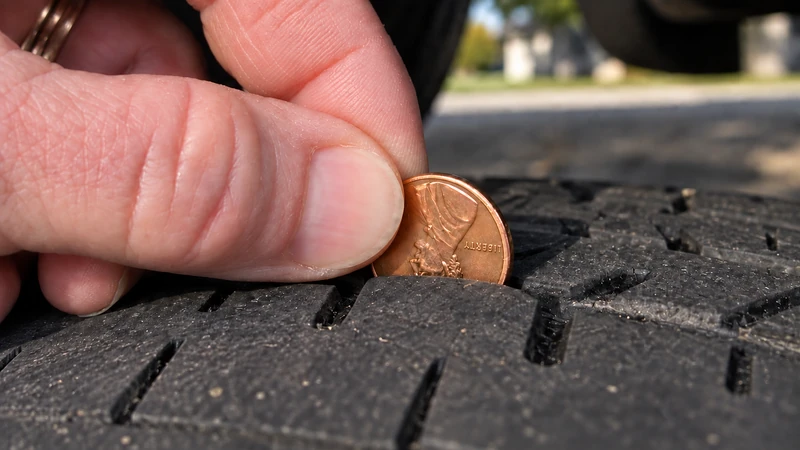
Hold a penny so Lincoln's head points toward the tire, and insert it into one of the main tread grooves — the deep channels running around the tire.
Read the result
If the groove covers the top of Lincoln's head, you have more than 2/32 inch left. If you can see all of his head, the tread is at or below 2/32 inch — the tire is legally worn out and needs replacing now.
Repeat across the tire
Test several grooves and several spots around each tire. Tires rarely wear evenly — the inside edge can be bald while the center looks fine. Go by the shallowest reading you find, on any of the four tires.
Method 2: The Quarter Test (Checks 4/32")
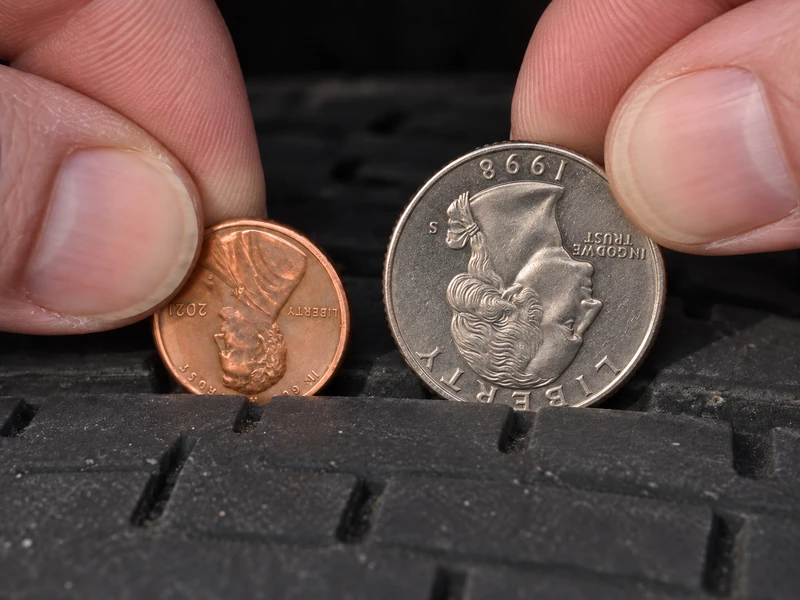
The quarter test works the same way but measures a safer threshold: the distance from a quarter's edge to the top of Washington's head is about 4/32 inch. Insert it head-down into a groove — if you can see all of Washington's head, you are at or below 4/32 inch, which is where AAA recommends replacing tires because wet grip is already seriously compromised.
Use the quarter test as your real decision point and the penny test as the legal dead line: quarter says "start shopping," penny says "stop driving on these in the rain."
Method 3: Check the Wear Bars
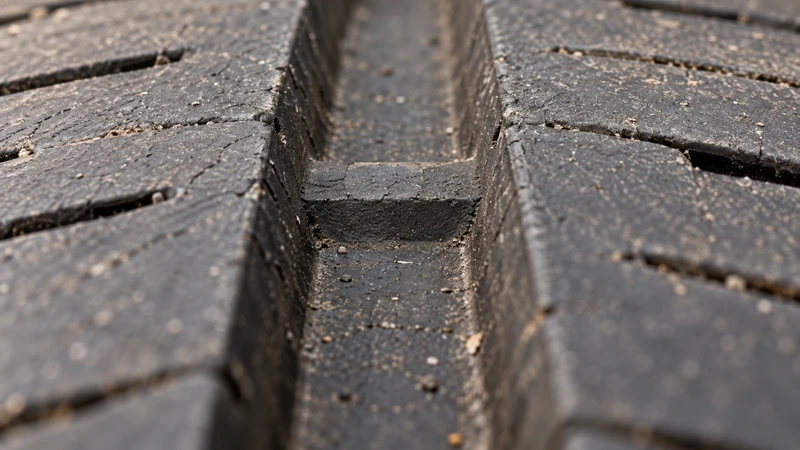
You don't even need a coin. Almost every tire sold in the US has tread wear indicator bars molded into the grooves — small raised bridges of rubber running across the groove at exactly 2/32 inch. You may see a small triangle or the letters "TWI" on the sidewall marking where each bar sits.
Run your eyes along the groove. If the tread surface on either side is flush with the bar — so the groove looks like it has a smooth rubber bridge across it — the tire is at the legal limit. If the bar still sits noticeably below the surrounding tread, you have life left.
Method 4: Use a Tread Depth Gauge
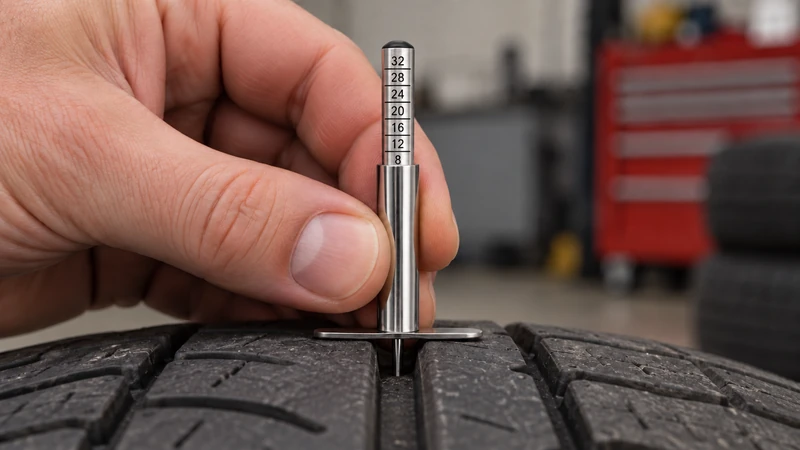
A tread depth gauge gives you the exact number instead of a pass/fail. It costs a few dollars and reads in 32nds of an inch (and usually millimeters too). Push the probe into the groove until the base sits flat on the tread blocks, then read the scale: 10/32 or more is healthy, 4/32 is the replace-soon line, 2/32 is the limit.
Whatever tool you use, the measurement rules are the same: measure the main grooves (not the small sipes or shoulder lugs), check at least three spots around each tire, measure both the inner and outer grooves — and always go by the lowest reading. A tire is only as good as its most worn point.
Reading Uneven Wear: What Your Tires Are Telling You
While you are down there checking depth, look at where the tread is wearing. The pattern is a diagnostic tool — and two of the four common patterns are caused by wrong tire pressure:
Both edges worn, center fine → under-inflation
A soft tire flexes too much and rides on its shoulders. Fix the pressure and it stops getting worse — see how to check tire pressure and inflate to your door jamb sticker.
Center worn, edges fine → over-inflation
A hard tire bulges in the middle and wears the center strip. Bleed down to the recommended PSI — more air is not better.
One side worn more than the other → alignment
Usually a camber or toe problem. No pressure adjustment will fix this — get a wheel alignment before the new tires go on, or they will wear the same way.
Scalloped dips around the tire (cupping) → suspension
Worn shocks or struts let the tire bounce as it rolls, carving scoops into the tread. Have the suspension inspected; rotating the tires will not stop it.
Caught it early? Uneven wear from pressure is preventable. A monthly pressure check costs nothing and doubles as your tread check — see how often to check tire pressure.
When to Replace Your Tires
Pulling it all together, the replacement rule is simple:
- ✕2/32 inch — replace immediately. Legal minimum in most states, bald in the rain, and tread flush with the wear bars.
- !4/32 inch — replace soon. AAA's recommended threshold. Wet braking is already 43% worse than new.
- ✓6/32 inch or more — keep driving. Recheck monthly; the rate of wear often speeds up in the second half of a tire's life.
Depth is not the only retirement trigger: replace any tire with visible cords or bulges, cracks deep enough to see fabric, a puncture in the sidewall or shoulder, or uneven wear severe enough that any point hits 2/32 inch. Age matters too — most manufacturers recommend replacing tires after six to ten years regardless of tread.
Frequently Asked Questions
What is the minimum legal tire tread depth?
2/32 of an inch in most US states. Tires have wear bars molded into the grooves at exactly this height — when the tread surface is flush with the wear bars, the tire is at the legal limit and must be replaced. A few states have no numeric requirement, and some require 2/32 only at inspection, but 2/32 is the practical floor everywhere.
Is 4/32 tire tread good or bad?
Legal, but marginal — plan to replace soon. AAA testing found that tires worn to 4/32 inch needed an average of 43% more distance to stop on wet pavement from 60 mph compared with new tires, and passenger cars lost about a third of their wet handling ability. In dry conditions 4/32 still performs acceptably, but wet and winter grip is already significantly degraded.
What is the tread depth of a new tire?
Most new all-season passenger tires start at 10/32 to 11/32 inch. Winter tires and all-terrain truck tires often start deeper — 12/32 to 16/32 inch — because they rely on deep grooves for snow and mud evacuation. High-performance summer tires can start shallower, around 8/32 to 10/32 inch.
How do I check tire tread with a penny?
Insert a penny into a tread groove with Lincoln's head pointing down toward the tire. If the top of Lincoln's head disappears into the groove, you have more than 2/32 inch of tread. If you can see all of his head, your tread is at or below 2/32 inch and the tire needs to be replaced. Test several grooves across each tire and use the shallowest reading.
What is the difference between the penny test and the quarter test?
They measure different thresholds. The penny test checks 2/32 inch — the legal minimum — using the distance from the edge of the coin to the top of Lincoln's head. The quarter test checks 4/32 inch using Washington's head. The quarter test is the better safety check: AAA recommends replacing tires at 4/32 inch rather than waiting for the 2/32 legal limit.
How often should I check my tire tread?
Once a month, at the same time you check tire pressure, and before any long road trip. Tread wear accelerates as tires age, so check more frequently once tires pass 4/32 inch. Also check after an alignment issue, suspension work, or if you notice the car pulling to one side — these cause rapid uneven wear that can ruin a tire in a few thousand miles.
Can I drive on 2/32 tread?
It is technically legal in most states, but it is not safe in the wet. At 2/32 inch the grooves can no longer evacuate water effectively, so hydroplaning risk rises sharply and wet braking distances grow dramatically. Treat 2/32 as 'replace today,' not 'still fine' — and if you drive in rain or snow regularly, replace at 4/32 instead.
Sources
- AAA Newsroom — Tread Lightly: Worn Tires Put Drivers at Risk (43% longer wet stopping distance at 4/32"; recommendation to replace at 4/32" rather than the 2/32" legal minimum)
- Discount Tire — How to Check Tire Tread Depth (new tires start at 10/32–11/32 inch; penny test for 2/32", quarter test for 4/32", wear bars at 2/32"; measure multiple grooves and use the lowest reading)
- ABC News — US Mints Final 1-Cent Coins After Over 230 Years (last penny struck November 12, 2025; pennies remain legal tender with 300+ billion in circulation)
Related Guides
- → Penny Test for Tires: Check Tread Depth in 10 Seconds
- → Tire Tread Depth Chart: When to Replace (32nds + mm)
- → New Tire Tread Depth: How Much Is Normal? (By Type)
- → Tire Wear Bars: What They Are & How to Read Them
- → When to Replace Tires: 5 Signs That Mean It's Time
- → Tire Date Code: How to Read It & When Tires Are Too Old
- → How to Check Tire Pressure: Step-by-Step Guide
- → How Often to Check Tire Pressure
- → Why Does My Tire Pressure Keep Dropping?
- → Tire Pressure Warning Light: What It Means & What to Do
- → How to Change a Flat Tire: Step-by-Step Guide