How to Check Tire Pressure Without a Gauge: 4 Methods That Work
Last updated: July 13, 2026 · Reading time: 7 min
Yes — you can roughly assess tire pressure without a gauge using four proven methods: visual inspection, the thumb press test, the thump test, and driving symptoms. These are screening tools, not exact measurements, but they reliably flag a tire that is dangerously low (typically 5–10 PSI or more below the recommended level).
You're on the road. Your tire looks a little soft. Or the TPMS light just came on. And you don't have a tire pressure gauge. This situation is common — but it doesn't mean you're helpless. The four methods below help you assess whether a tire is dangerously low. They are rough screening tools, not replacements for a real gauge. But when it's 10 PM at a rest stop, or you're borrowing a friend's car, or you simply forgot your gauge at home — these techniques can tell you whether it's safe to keep driving or whether you need to stop and add air immediately.
Important: None of these methods tells you your exact PSI. They only help you identify a tire that is significantly under-inflated. Always verify with a real gauge as soon as possible. A quality pencil gauge costs under $10 and fits in your glove box — buy one and you'll never need these workarounds.
1. Visual Inspection: Compare All Four Tires
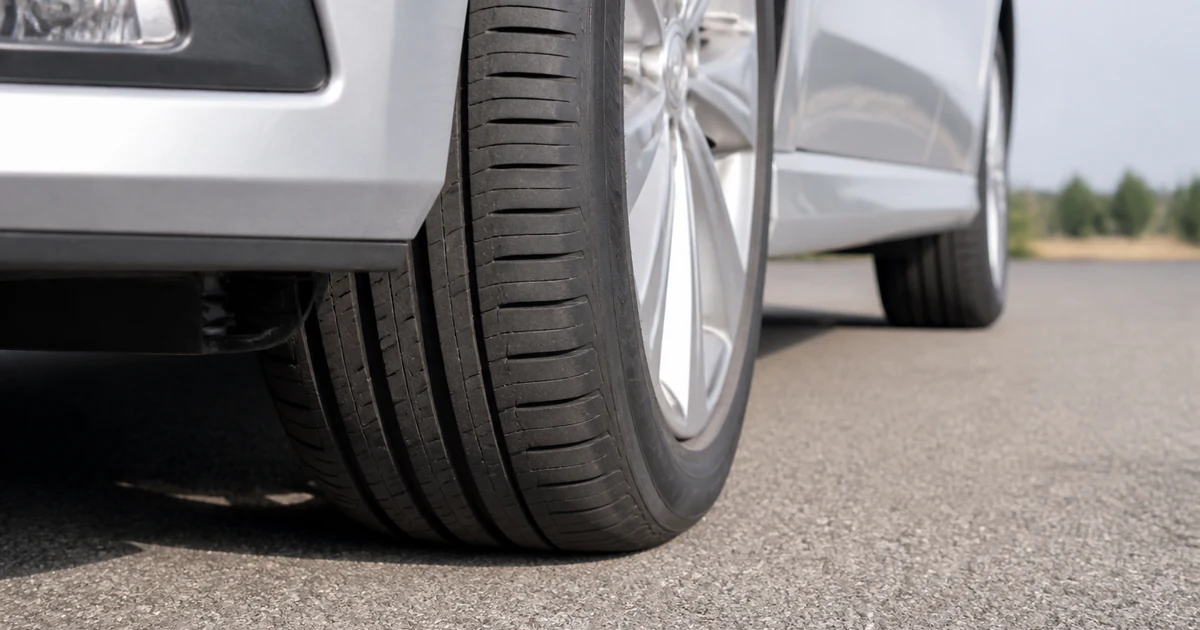
Park on a flat, level surface — a parking lot, driveway, or level street. Walk around your vehicle and look at each tire head-on, comparing the left and right sides.
An under-inflated tire will show these signs:
- Flatter at the bottom — the contact patch (the part touching the ground) looks wider or more squished than the other tires
- Bulging sidewall — the side of the tire near the ground protrudes outward more than normal
- Slightly shorter — the top of the tire sits noticeably lower than the opposite-side tire
Stand about 10-15 feet away and compare the two front tires side by side, then the two rear tires. If one looks different, it's worth a closer check.
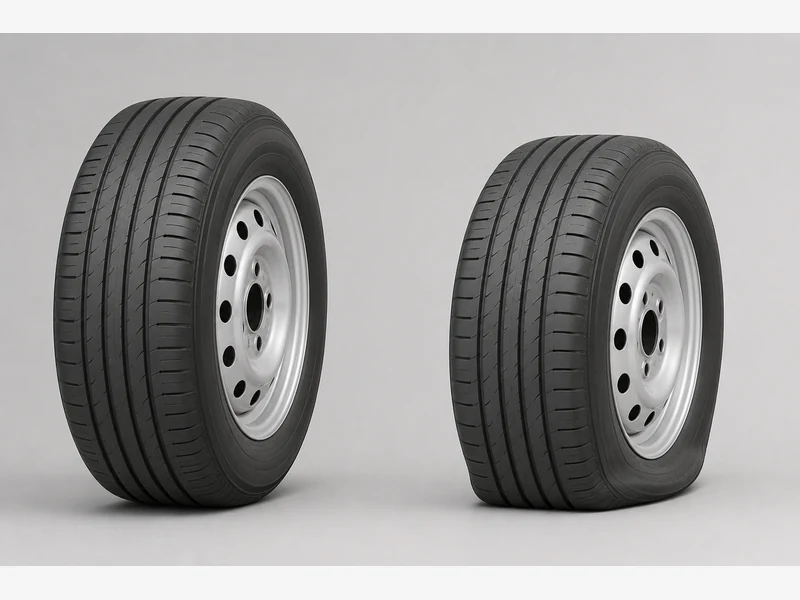
Limitation: Modern radial tires can be 5-10 PSI low and still look normal. This method works best for spotting significant under-inflation of 10+ PSI. If your tire looks visibly flat, it's already dangerously low — stop and inflate it before driving further.
2. Thumb Press Test: Check the Firmness
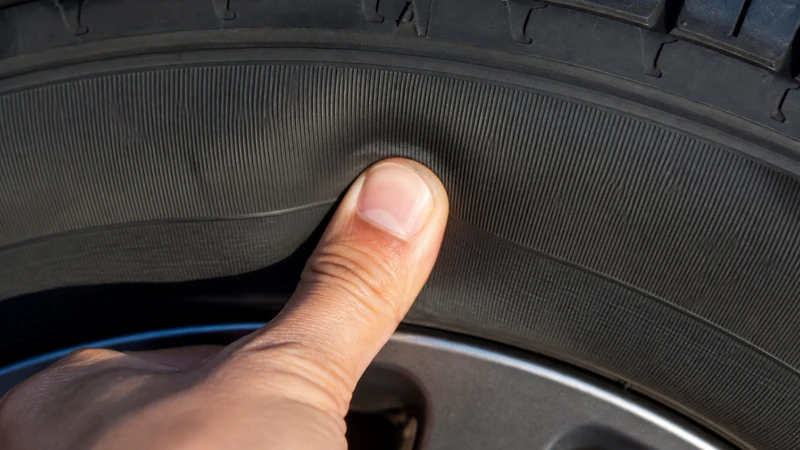
Press your thumb firmly into the center of the tire's sidewall — not the tread. A properly inflated passenger tire (30-35 PSI) feels very firm with minimal give, like pressing on a fully inflated basketball.
What you're feeling for
- Firm, slight give = OK — The sidewall resists your thumb; you feel pushback almost immediately
- Soft, easily compresses = Low — Your thumb sinks in noticeably; the rubber feels mushy. The tire is likely 5-10 PSI or more below the correct pressure
- Rock hard, zero give = Over-inflated — No flex at all; the sidewall feels like a solid object
For best results, compare all four tires with equal thumb pressure. Press the same spot on each tire — the middle of the sidewall, halfway between the rim and the tread. If one tire feels noticeably softer than the others, it's low.
Limitation: This is subjective and varies by tire type. Low-profile performance tires (common on sports cars and many sedans today) feel stiffer than tall-sidewall SUV and truck tires, even when both are correctly inflated. If you don't have a baseline — you've never pressed this type of tire before — the absolute firmness won't mean much. Cross-comparing tires on the same vehicle is more reliable.
3. The Thump Test: Listen to the Sound
Kick the tire firmly with the toe of your shoe — or tap the tread with a solid object like a tire iron, a stick, or the handle of a screwdriver. Listen to the sound and feel the rebound.
Good tire: Sharp, resonant thwack
A properly inflated tire produces a crisp, high-pitched “thwack” sound. The impact bounces back sharply — your foot or the tool rebounds quickly. This is the sound of a properly tensioned drum.
Low tire: Dull, flat thud
An under-inflated tire absorbs the impact and produces a dull, low-pitched “thud” with noticeably less rebound. The tire feels dead on impact — like kicking a heavy bag of sand.
This technique is widely used by truck drivers for quick pre-trip inspections. It works best on higher-pressure truck tires (80-100 PSI) where the sound difference between properly inflated and low is dramatic. On passenger car tires at 30-35 PSI, the difference is subtler and takes practice to hear reliably.
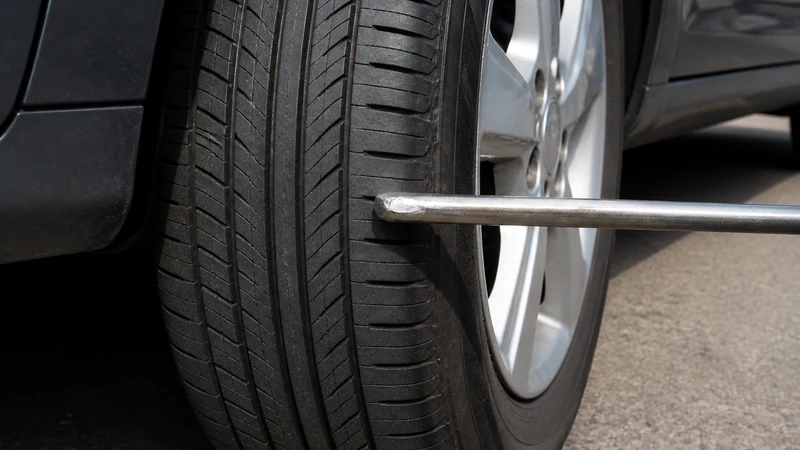
Limitation: Works poorly on low-profile tires, which are inherently stiff. Requires some baseline — if you've never tested a properly inflated version of your tire this way, you won't know what “right” sounds like. Best used for comparing tires on the same vehicle.
4. Driving Symptoms: How the Car Feels
A significantly under-inflated tire changes how your car drives. If you notice any of these symptoms while moving, pull over when safe and check your tires:
Heavier or sluggish steering
An under-inflated front tire increases rolling resistance, making the steering feel heavier and less responsive — especially noticeable when turning. The car may feel like it's fighting you.
Vehicle pulls to one side
One low tire creates uneven drag, causing the car to drift or pull toward the low tire side. If you're constantly correcting the steering wheel to stay straight, a low tire is one of the most common causes.
Flapping or thumping noise at speed
A significantly under-inflated tire produces a rhythmic flapping or thumping sound that changes with vehicle speed. This is the sound of the tire sidewall flexing excessively each rotation — it's a warning that the tire is dangerously low.
Bouncier or softer ride than usual
An under-inflated tire absorbs more shock, which can actually make the ride feel softer over bumps. This may sound like a good thing, but it's a sign of dangerously low pressure that provides less control in emergency maneuvers.
Important: These symptoms can also indicate alignment problems, worn suspension components, or brake issues. But tire pressure is the easiest thing to check first — and the most likely cause. If the symptoms persist after correcting tire pressure, have your vehicle inspected.
If Your Car Has TPMS, Check the Display First
Before using any of the manual methods above, check if your vehicle already tells you the tire pressure. There are two types of TPMS:
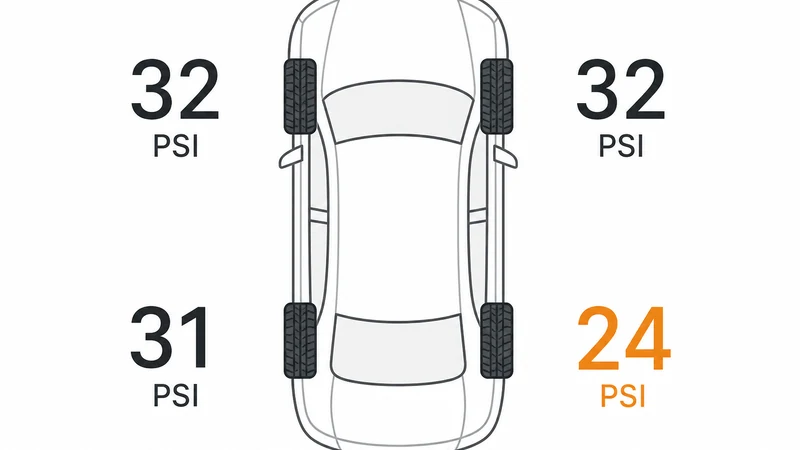
Direct TPMS — Shows Numbers
Many newer vehicles display individual tire pressures — typically to the nearest 1 PSI — on the dashboard, infotainment screen, or a dedicated information display. You can cycle through the display and see each tire's current PSI. If your car has this, you already have a built-in gauge.
Indirect TPMS — Light Only
Many vehicles use a simple warning light that illuminates when one or more tires drop approximately 25% below the recommended pressure. This system does not show individual PSI numbers — it only tells you something is wrong. If your car has this type, you still need a manual check.
Some Honda models (Pilot, Ridgeline, Odyssey, Passport) with Tire Fill Assist take this a step further: when you're adding air with the ignition on, the horn chirps once every 5 seconds while the tire is still low, then sounds a continuous 5-second blast when you reach the correct PSI — effectively telling you to stop without needing a gauge. Check your owner's manual to see if your vehicle has a similar feature.
What to Do After a Manual Check
If any of the methods above suggest your tire is low, here's the action plan:
Drive carefully to the nearest air pump
If the tire is visibly low but not completely flat, drive at reduced speed to the nearest gas station, tire shop, or service station — ideally within 1-2 miles. If the tire is sitting on the rim or nearly flat, do not drive on it. Change to the spare or call roadside assistance.
Inflate to the recommended PSI
Use the station's air pump to inflate. The recommended PSI is on the driver-side door jamb sticker. If the pump has a digital gauge, set your target PSI and it'll auto-stop. If it's an older pump, use short bursts and check with the pump's gauge between each burst.
Buy a tire pressure gauge
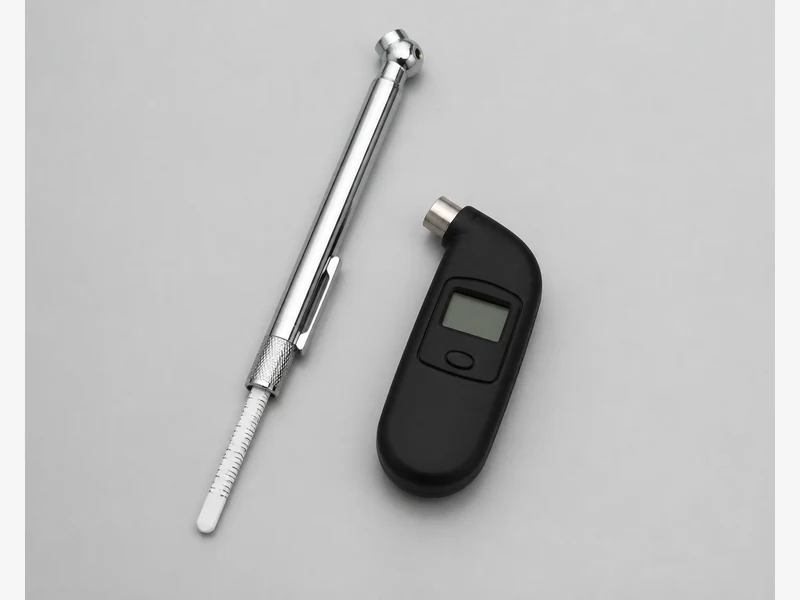
Once you're at a gas station or auto parts store, buy a tire pressure gauge. A quality pencil gauge costs $6-10. A digital gauge with backlit display costs $12-30. Keep it in your glove box and you'll never need the methods in this article again.
Watch for recurrence
If the same tire is low again within a few days, you likely have a slow leak — a nail, damaged valve stem, or corroded wheel bead. Take the tire to a shop for inspection. Slow leaks don't fix themselves and get worse over time.
Frequently Asked Questions
Can I really check tire pressure without a gauge?
You can roughly assess whether a tire is dangerously low, but you cannot determine the exact PSI. The four methods in this article — visual inspection, thumb press, thump test, and driving symptoms — are screening tools. They can tell you something is wrong, but they won't tell you whether your tire is at 28 PSI or 33 PSI. For accurate readings, use a real tire pressure gauge.
How accurate is the thumb press test?
The thumb press test is subjective and only detects significant under-inflation — typically 5-10 PSI or more below the recommended level. Results vary widely based on tire type: low-profile tires feel inherently stiffer, while tall-sidewall SUV tires feel softer even when correctly inflated. Cross-comparing tires on the same vehicle is more reliable than an absolute firmness check.
Can I drive to a gas station with a low tire?
If the tire is visibly low but not completely flat, you can carefully drive to the nearest station within 1-2 miles at reduced speed. If the tire is completely flat and sitting on the rim or nearly so, do not drive on it. Driving even a few hundred yards on a fully flat tire destroys the sidewall internally, making the tire unrepairable, and can bend or crack the wheel.
Does my car show me the exact tire pressure?
It depends on your vehicle's TPMS type. Direct TPMS systems — common on newer cars — display individual tire pressures on the dashboard or infotainment screen. Indirect TPMS systems use a simple warning light that illuminates when pressure drops 25% below the recommended level, with no numerical display. Some Honda models with Tire Fill Assist even honk the horn to signal when you've reached the correct PSI while inflating. Check your owner's manual to see which system your car uses.
What should I do after checking tire pressure without a gauge?
If any manual method suggests your tire is low, inflate to the recommended PSI at the nearest air pump or tire shop as soon as possible. Then buy a tire pressure gauge — a quality pencil gauge costs under $10, and a digital gauge under $15. Keep one in your glove box so you never have to guess again. If the same tire loses pressure again within days, have it inspected for a slow leak.
Why is my TPMS light on but my tires look fine?
TPMS warning lights typically activate when pressure drops 25% below the recommended PSI. At that level, your tire can be significantly under-inflated and unsafe — yet look completely normal to the naked eye, especially on modern low-profile tires. This is the most common scenario where drivers are caught without a gauge: the light is on, but nothing looks wrong. Natural air loss of 1-2 PSI per month and temperature drops of 1 PSI per 10°F can trigger the light without any puncture.