
How to Check Tire Pressure at a Gas Station
Last updated: September 2, 2026 · Reading time: 7 min
Yes — you can check tire pressure at any gas station with an air pump. It usually costs $1–2 (free at chains like Wawa, Sheetz, and QuikTrip), and most pumps have a built-in gauge — but that gauge is often off by 4–5 PSI, so always verify the final reading with your own gauge.
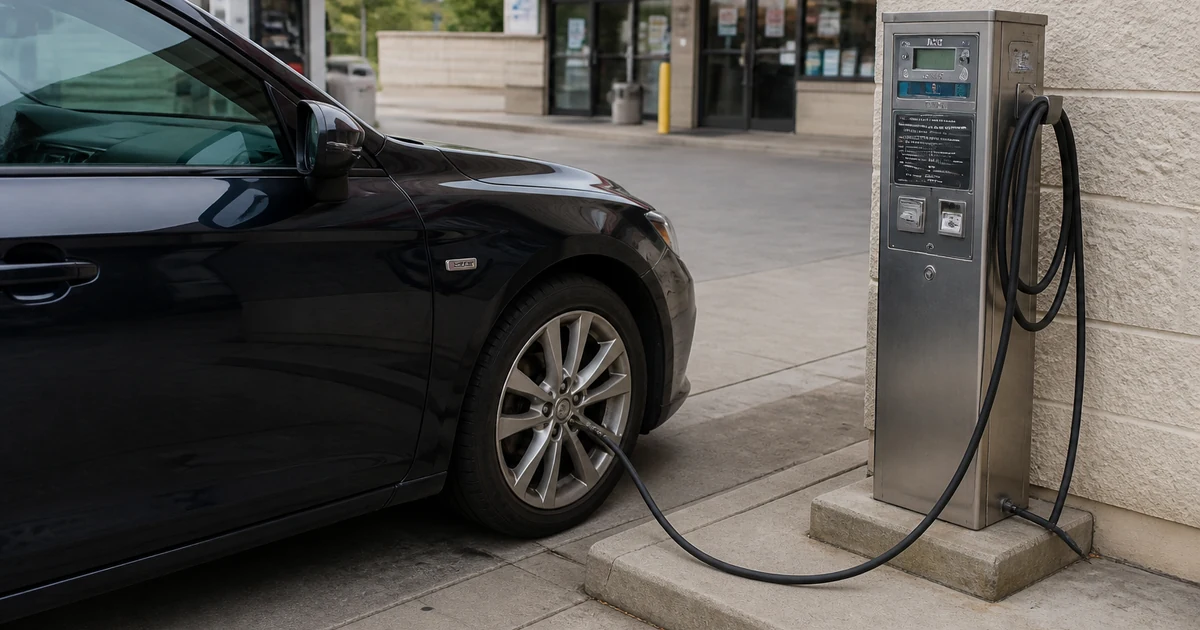
Gas station air pumps are everywhere — but the process isn't always obvious, especially if you're standing in front of a machine you've never used before. Some have digital keypads and auto-stop. Others are coin-operated relics with barely readable gauges.
This guide covers exactly what to do: how to find your target PSI, how to arrive on cold tires, how to use both digital and old-school pumps, what can go wrong, and why the station's own gauge should never be the one you trust.
Before You Leave the House
1. Know your target PSI
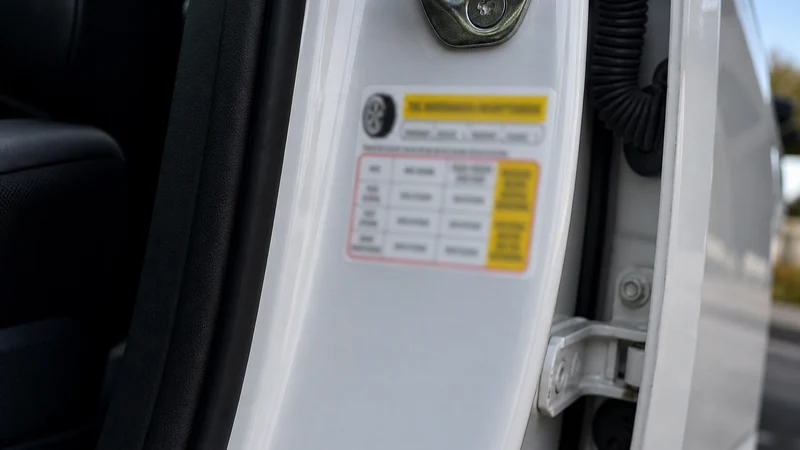
Open the driver-side door and look at the sticker on the door jamb. It lists the manufacturer-recommended cold PSI for your front and rear tires. Some vehicles list separate values for normal and full-load conditions. Write this number down or take a photo — you'll need it at the pump.
The number on your tire sidewall is the maximum pressure limit, not your target. Never inflate to that number.
2. Try to arrive on cold tires
Cold tires give the most accurate reading. Ideally, the station is a short drive from your starting point — under 1 mile at moderate speed. If the nearest station is farther, drive gently and plan to adjust for warm-tire readings (see below).
3. Bring your own gauge
Gas station gauges are handled roughly by hundreds of users and are rarely calibrated. A Mastercraft Tires survey found approximately 20% of station gauges are off by 4+ PSI. Bring your own tire pressure gauge — a quality pencil gauge costs $6, a digital gauge $12-30. Use the station pump for air, your gauge for measurement.
Step-by-Step at the Pump
Park so the hose reaches all four tires
Position your car so the air hose can reach every wheel. The hose is typically 15-20 feet long. If the pump is on the driver's side, you may need to position the car so the hose stretches to the passenger-side tires. Walk the hose around before inserting money to make sure it reaches.
Remove all four valve caps first
Unscrew the caps from all four valve stems and put them in your pocket — never on the ground. Removing them all at once saves time once the pump timer starts (most pumps run 3-5 minutes per payment).
Pay and start the pump
Most pumps accept quarters or credit cards. Some require exact change. Cost is typically $1-$2. If the pump has a digital keypad, enter your target PSI now — the pump will auto-stop at that number. If it's an older pump without this feature, you'll need to check manually with your gauge after each burst.
Check current pressure with your own gauge first
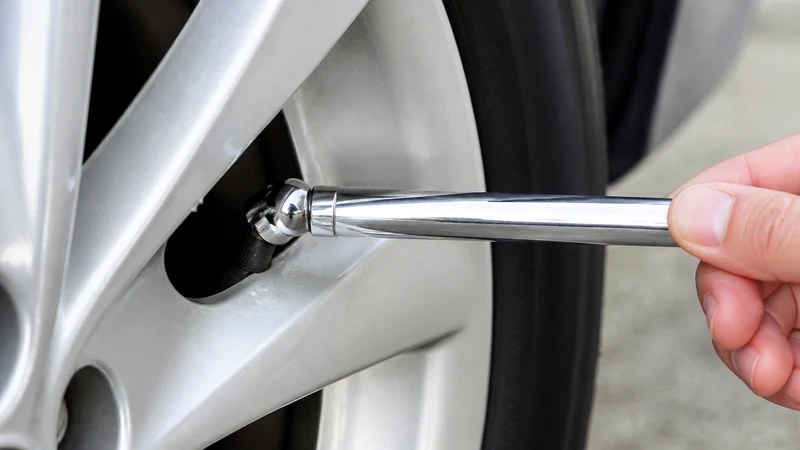
Before adding any air, press your gauge firmly onto the first valve stem. Get a clean reading — no hissing means a good seal. Note the current PSI. This tells you how much air each tire actually needs.
Inflate in short bursts of 3-5 seconds
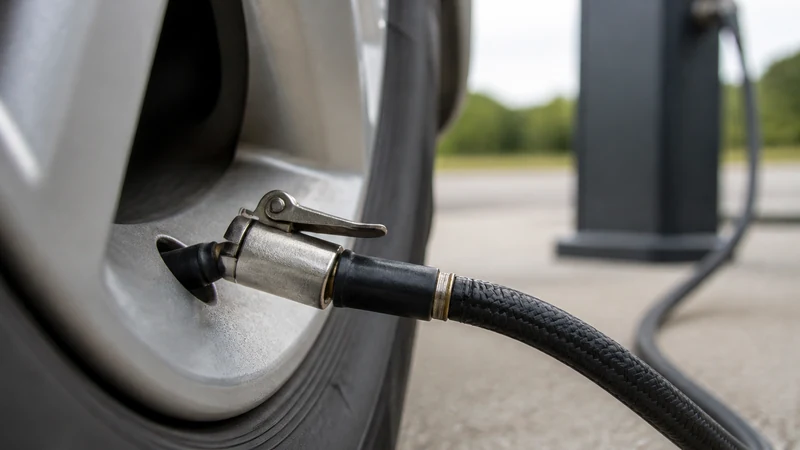
Press the air hose nozzle firmly onto the valve stem. Squeeze the trigger for a few seconds, then remove the nozzle and re-check with your gauge. Repeat until you reach your target PSI. Do not hold the trigger continuously — it's too easy to overshoot. If you overshoot by 1-2 PSI, press the small pin in the center of the valve stem to release a small amount of air.
Replace valve caps and repeat for all tires
Screw the valve cap back on finger-tight once each tire is at the correct pressure. Move around the car in order — driver front, passenger front, passenger rear, driver rear — so you don't lose track. Don't forget the spare tire if it's accessible.
Digital Pumps vs. Old-School Pumps
Not all gas station air pumps are created equal. Knowing which type you're dealing with changes how you approach the process:
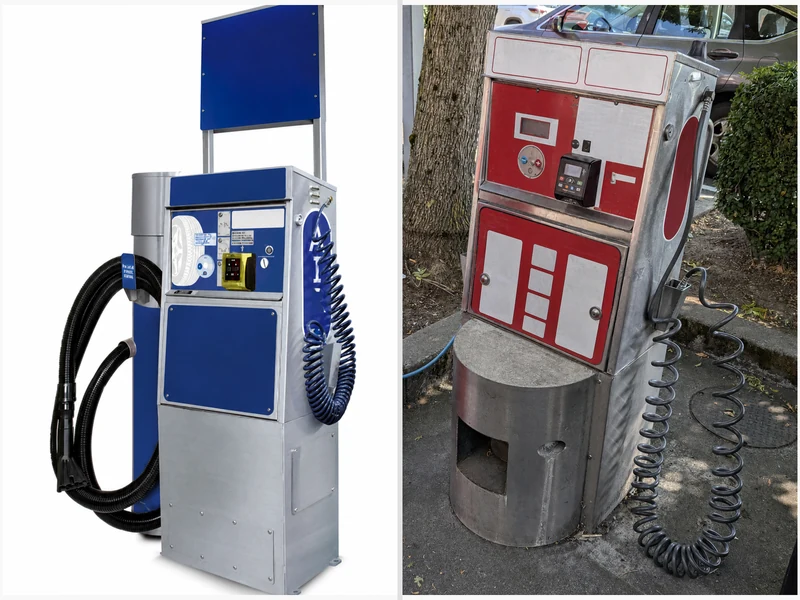
Modern Digital Pumps
- Keypad — enter your target PSI before starting
- Reads current pressure automatically on contact
- Auto-inflates or deflates to match target
- Beeps or displays a message when done
- Often accepts credit cards and contactless payment
- Common at Wawa, Sheetz, QuikTrip, and newer stations
Older Manual Pumps
- Coin-operated, mechanical dial on the pump body
- No auto-stop — you must check manually as you go
- Onboard gauge is often inaccurate from years of abuse
- Timer-based — pump runs for 3-5 minutes, then stops
- You must bring and rely on your own gauge
- Common at older, independently owned gas stations
Do Gas Station Air Pumps Have Pressure Gauges?
Most do — but you shouldn't rely on them. Whether the pump has a usable gauge depends on which type you're standing in front of:
| Pump type | Built-in gauge? | Can you trust it? |
|---|---|---|
| Digital (keypad, auto-stop) | Yes — reads current PSI on contact | Mostly — still verify with your own gauge |
| Old-school manual (coin-op) | Usually — mechanical dial on the body | No — often off by 4–5 PSI from years of abuse |
| Your own gauge | — (you bring it) | Yes — the only reading to trust |
The pattern is simple: use the station pump for air, and your own gauge for the measurement. A digital pump's display is fine for a rough check, but the only number worth driving on is the one from a gauge you control and know is accurate.
The Gas Station Gauge Problem
Here's why you should never trust a gas station's built-in gauge:
- Hundreds of users handle it — dropped on concrete, yanked by the hose, left in the rain
- Almost never calibrated — unlike a shop gauge, there's no maintenance schedule for a station air pump
- Can be off by 4-5 PSI — enough to turn a properly inflated tire into an under-inflated or over-inflated one
- No accountability — if the gauge is wrong and your tires end up over-inflated, the gas station isn't responsible
The rule: Use the station pump for the air. Use your own gauge for the measurement. Never let a gas station gauge be the final word on your tire pressure.
What to Do If You Drove Far to Get There
If the nearest gas station is more than a couple of miles away, your tires will be warm by the time you arrive. Warm air expands, so your gauge will read 4-8 PSI higher than the true cold pressure.
If your tires are warm: Add 3-5 PSI to your door jamb recommendation and inflate to that number. For example, if your door jamb says 35 PSI and you've been driving for 15 minutes, aim for 38-40 PSI on the gauge. Re-check the next morning when tires are cold and release air if needed.
This is an approximation — the exact PSI increase varies by tire type, ambient temperature, and driving speed. The only way to get a truly accurate reading is to check on cold tires.
When the Pump Is Broken, Frozen, or Missing
Gas station air pumps are outdoor equipment — they break, freeze, and sometimes get removed entirely. Here's what to do:
In winter
Air hoses can freeze internally in sub-zero temperatures. Even if the pump powers on, the hose may be blocked. Before driving out, call the station and ask if the air pump is working. Have a backup plan — a different station or a portable inflator.
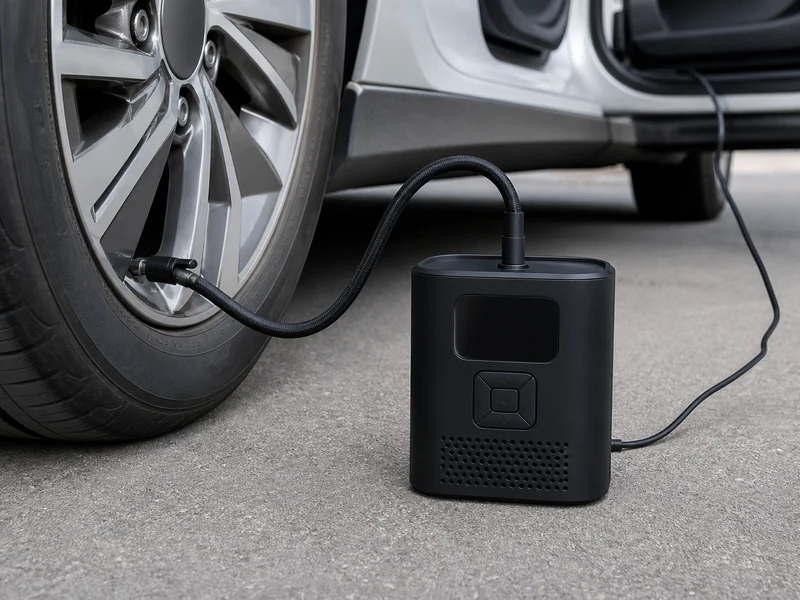
Get a portable 12V inflator ($25-$40)
A portable tire inflator plugs into your car's 12V power outlet (cigarette lighter) and lets you inflate tires anywhere — your driveway, a parking lot, or the side of the road. Most have digital displays, auto-stop, and built-in LED lights. It pays for itself after about 20 gas station visits, and you never have to hunt for a working pump again.
Tire shops are a free backup
Discount Tire, America's Tire, and most independent tire shops check and inflate tires for free — no appointment needed, no purchase required. They use calibrated shop gauges and will inflate all four tires plus the spare while you wait.
Where to Find Free Air
You don't always have to pay. Here's where free air lives:
- ✓Discount Tire / America's Tire — free pressure check and inflation. Drive up to the service bay, they come to you.
- ✓Wawa / Sheetz / QuikTrip — many locations offer free air with digital pumps and auto-stop.
- ✓Costco Tire Center — free nitrogen or regular air inflation for members.
- ✓Local tire shops — most independent shops provide free checks hoping to earn your business for future tire purchases.
Free air note: Some stations still offer free compressed air — but the pump may be older and the built-in gauge less reliable. If the air is free but the gauge looks beat up, your own gauge becomes even more important.
Frequently Asked Questions
How much does it cost to use a gas station air pump?
Most gas station air pumps cost $1-$2 per use and accept quarters or credit cards. Some accept contactless payment. The pump typically runs for 3-5 minutes per payment — long enough to check and adjust all four tires if you're efficient. Some stations, including larger chains like Wawa, Sheetz, and QuikTrip, offer free air. Tire shops like Discount Tire and America's Tire provide free checks and inflation with no purchase required.
Are the pressure gauges at gas stations accurate?
Generally no — they can be off by 4-5 PSI. Gas station gauges see hundreds of users, are rarely if ever calibrated, and spend their lives outdoors in all weather conditions. Always bring your own gauge to verify the final pressure. Use the station pump to deliver the air, your gauge to confirm the result.
Can I check tire pressure right after driving to the gas station?
You can, but the reading won't be your true cold pressure. Driving heats the air inside your tires, raising pressure by 4-8 PSI. If you've driven less than 1 mile gently, the effect is minimal. If you've driven 10-15 minutes or more, inflate 3-5 PSI above your door jamb recommendation and re-check the next morning when the tires are cold.
How do digital air pumps work at gas stations?
Digital pumps let you enter your desired PSI on a keypad. Press the nozzle onto the valve stem — the pump reads the current pressure, then automatically inflates or deflates to match your target. It signals completion with a beep. This eliminates the need to repeatedly check with a gauge during the process, but you should still verify the final pressure with your own gauge.
What do I do if the gas station air pump is out of order?
Try another station nearby, or visit a tire shop like Discount Tire or America's Tire — they inflate tires for free with no appointment. In winter, call ahead to confirm the pump is working. A portable 12V tire inflator ($25-$40) eliminates this problem entirely by letting you inflate at home or anywhere your car is parked.
Can I check the spare tire at a gas station pump?
Yes, if it's accessible. Compact spares require about 60 PSI — check the sidewall for the exact number. Many station pumps can reach this pressure, though you may need to select a high-pressure mode if available. Spares stored under the vehicle may be difficult to reach with a standard air hose; check these at a tire shop or at home.