
Valve Stem Guide: Types, Replacement & Leaks
Last updated: September 1, 2026 · Reading time: 9 min
Yes — a valve stem is the small rubber or metal tube sticking out of your wheel that lets air in and keeps it sealed inside the tire. Most cars use a Schrader (American-style) valve costing $2-5 to replace, with five main types across passenger vehicles. Replace it whenever you install new tires, or sooner if it leaks.
This guide covers the five types of valve stems on cars, how to tell when yours is leaking, how to replace it (or just the valve core), and the special considerations when your car has a TPMS sensor integrated into the stem.
Quick Summary
- Most cars use rubber snap-in Schrader valves — cheap ($2-5) and replaced at every tire change
- 5 types total: rubber snap-in, metal clamp-in, TPMS-integrated, high-pressure, and short rubber (for spares)
- Test for leaks with soapy water — bubbles at the stem mean air is escaping
- Cost: $20-50 per tire for basic replacement, up to $200 per tire with TPMS sensor
- Presta valves are for bicycles — not used on cars
What Is a Valve Stem?
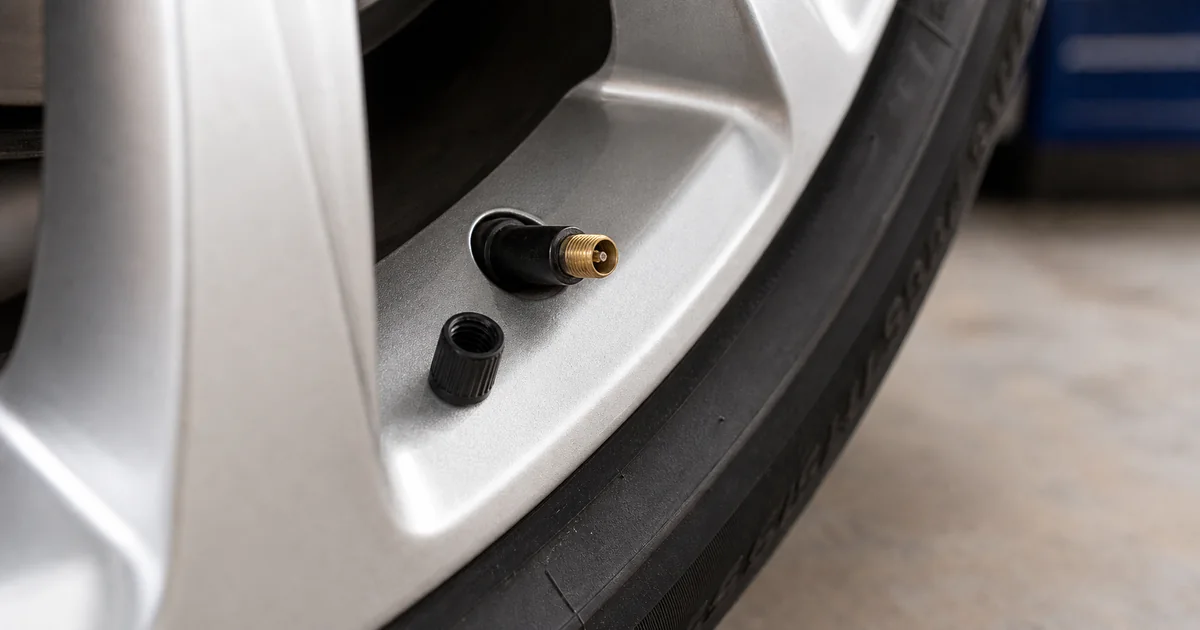
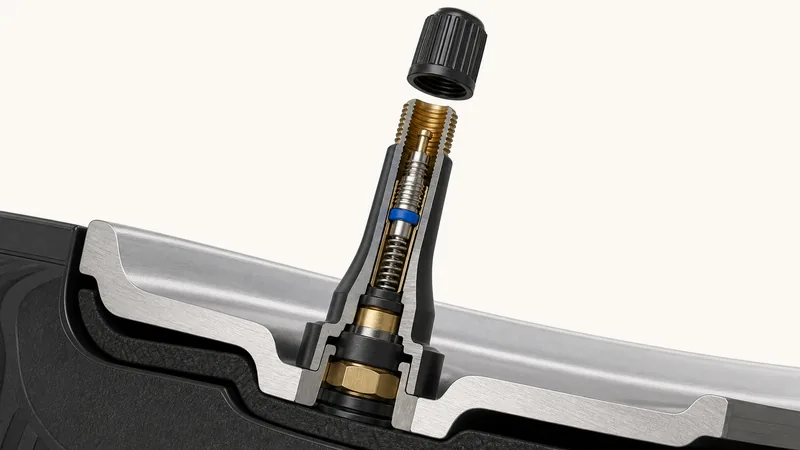
A valve stem is a one-way valve mounted through the wheel rim that lets you add compressed air to the tire while preventing air from escaping. It consists of three parts:
- The stem body — the rubber or metal tube visible from the outside of the wheel
- The valve core — a small threaded insert inside the stem with a spring-loaded pin that seals air inside
- The cap — a plastic or metal screw-on cover that keeps dirt and moisture out (always replace it after checking pressure)
When you press a tire pressure gauge onto the stem, you push the pin down briefly. Air escapes into the gauge, giving you a reading. When you remove the gauge, the spring closes the pin and seals the air back inside the tire.
5 Types of Tire Valve Stems
Different vehicles use different valve stems. Here are the five you'll encounter:
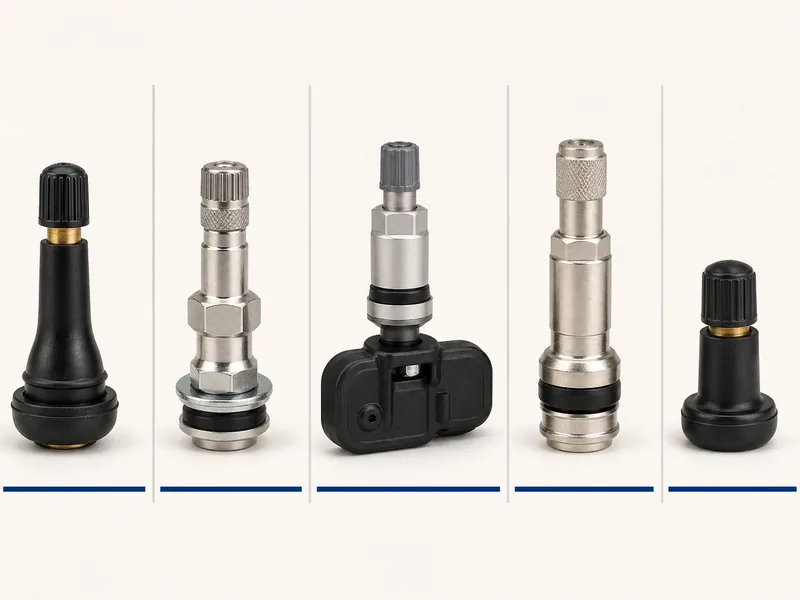
| Type | Material | Used On | Cost | Lifespan |
|---|---|---|---|---|
| Rubber snap-in Schrader | EPDM rubber | Most passenger cars (Honda, Toyota, Ford, etc.) | $2-5 | Every tire change (~3-5 yr) |
| Metal clamp-in Schrader | Brass or nickel-plated steel | Performance cars, high-pressure applications | $10-40 | 5-10 years |
| TPMS-integrated | Metal stem + electronic pressure sensor | Cars with direct TPMS (most 2008+ models) | $50-150 (aftermarket) / $100-250 (OEM) | 5-10 years (battery limited) |
| High-pressure | Reinforced metal | Light trucks, EVs (Tesla at 42+ PSI), heavy-duty | $5-15 | 5-7 years |
| Short rubber (spare) | Short rubber | Compact spare tires (“donuts”) | $2 | Check each use |
Note on Presta valves: Presta valves (slimmer, with a threaded locknut) are used on bicycles and some motorcycles. They are not used on cars. If you see a Presta-style valve, you're looking at a bike tube, not a tire.
Are All Valve Stems the Same? (Universal Fit Guide)
Short answer: the valve core is almost always universal, but the valve stem itself is not. All car valve stems share the same standard Schrader thread, so the small replaceable core inside swaps freely between virtually every car on the road. The stem body, however, comes in different types and pressure ratings — and fitting the wrong one can cause a leak or a failed TPMS sensor.
| Component | Universal? | What to know |
|---|---|---|
| Valve core (inner insert) | Yes — almost all cars | Standard Schrader thread fits nearly every car, truck, and motorcycle stem. A $3 core fits a Honda and a Tesla alike. |
| Valve stem body | No | Snap-in, clamp-in, and TPMS-integrated stems are not interchangeable — the rim hole and seal differ. |
| Pressure rating | No | Standard TR413 rubber stems are rated to 65 PSI. High-pressure TR600HP metal stems are required above that (EVs, light trucks). |
| Valve cap | Yes | Caps share the same Schrader thread as the core — any cap fits any car stem. |
Practical rule: if you just have a slow leak, a universal $3 valve core fixes it on almost any car. But if the stem body is cracked or corroded, match the replacement to your vehicle's type (snap-in vs. clamp-in vs. TPMS) and pressure rating — don't assume any stem off the shelf will seal correctly.
How to Tell If Your Valve Stem Is Leaking
A leaking valve stem is one of the most common causes of slow tire pressure loss. Three reliable ways to confirm:
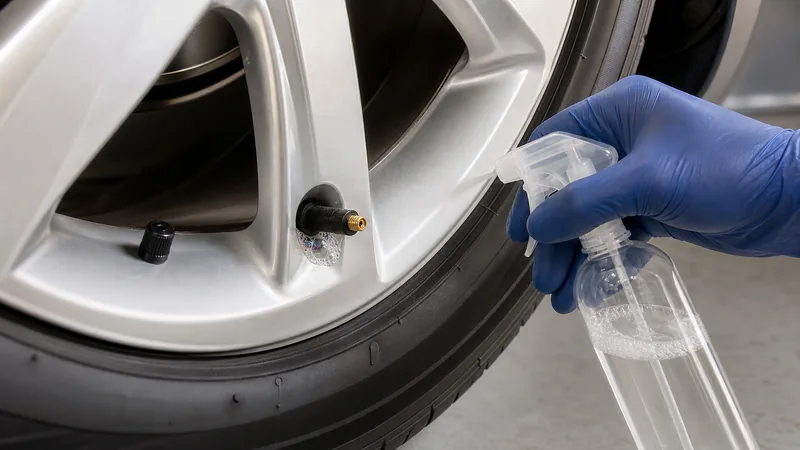
Soapy water test (most reliable)
Mix dish soap with water (roughly 1 part soap to 3 parts water) in a spray bottle. Spray the mixture on the valve stem — body, cap area, and the base where it meets the wheel. Slowly forming bubbles (even tiny ones) indicate escaping air. The bigger the bubbles, the faster the leak.
Listen for hissing
In a quiet garage, place your ear near each valve stem. A steady, faint hiss means air is escaping. This method catches faster leaks but misses slow ones.
Visual inspection
Look at the rubber stem. Cracking, blistering, cuts, or dried-out patches mean the rubber has deteriorated and needs replacement. On metal stems, look for green or white corrosion around the base.
How fast does a leaking valve stem lose pressure? Typically 1-3 PSI per week — faster when it's hot, slower when cold. If a tire drops more than 5 PSI per week, the valve core alone may be the issue (replaceable for $3-5 without removing the tire).
How to Replace a Valve Stem (or Just the Core)
You have two repair options. Replacing just the valve core is the quick fix that handles most slow leaks. Replacing the whole stem is for damaged or corroded stems.
Replace just the valve core (DIY, 5 minutes)
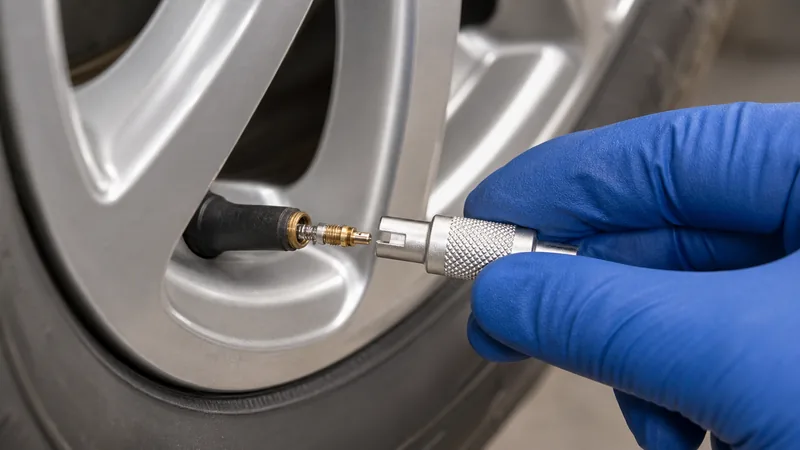
Best for slow leaks with no visible damage. Unscrew the valve cap, then use a $3 valve core tool (or needle-nose pliers carefully) to unscrew the core counterclockwise. The tire will hiss as air escapes — deflate it fully. Screw the new core in clockwise by hand, then snug with the tool. Inflate to recommended PSI.
Replace the entire valve stem (shop recommended)
Required if the stem body is cracked, corroded, or if you have a TPMS sensor that needs replacement. The tire must be removed from the rim. Most tire shops do this for $20-50 per tire (without TPMS) or $75-200 per tire (with TPMS sensor + programming). Always replace rubber stems when installing new tires.
Warning — TPMS valve stems: On cars with direct TPMS (most 2008+ models), the pressure sensor is built into the valve stem. Replacing the stem means replacing the sensor. The new sensor must be programmed to your vehicle using a TPMS scan tool — most tire shops and dealers have these, but it adds $50-100 to the cost on top of the sensor itself.
Valve Stem Replacement Cost (Broken Stem)
A broken valve stem costs $20-50 to replace at a shop — or as little as $3 if only the core needs replacing and you do it yourself. The price jumps sharply if your car has a TPMS sensor built into the stem. Here's the full breakdown:
| Situation | Part | Labor | Total |
|---|---|---|---|
| Valve core only (DIY) | $3-5 | $0 (5 min yourself) | $3-5 |
| Rubber snap-in stem | $2-5 | $15-45 | $20-50 |
| Metal clamp-in stem | $10-40 | $15-35 | $25-75 |
| TPMS-integrated stem | $50-150 (aftermarket) / $100-250 (OEM) | $25-50 + programming | $75-200 |
When you can get away with just the $3 core: if the stem body looks intact (no cracks, no corrosion) and the leak is a slow hiss from the pin, a new core usually solves it. If the rubber is cracked, the metal is corroded, or the leak is at the base where the stem meets the rim, the whole stem has to come out — and on a TPMS car, that means a new sensor too.
Valve Stems and TPMS — What You Need to Know
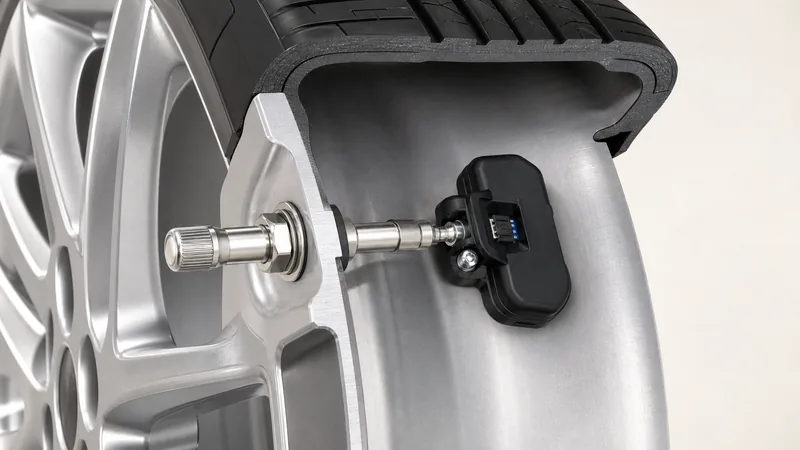
Since 2008, all new cars sold in the US have been required to have a Tire Pressure Monitoring System (TPMS). There are two types, and only one integrates with the valve stem:
Direct TPMS — uses valve stem
A pressure sensor is mounted inside the valve stem on each wheel. The sensor reports live pressure to your dashboard. If your car shows individual tire pressures (like Honda Tire-Fill-Assist models that beep when you reach the correct PSI), you have direct TPMS.
Indirect TPMS — no sensor
Uses ABS wheel-speed sensors to detect under-inflation by comparing tire rotation speeds. No valve stem sensor. Cheaper to maintain but only triggers a warning light (no live readings).
If your car has direct TPMS, every time the valve stem is replaced you're also replacing the sensor. Don't try to save money by reusing an old sensor on a new stem — the seal will leak. For more on what to do when the TPMS light comes on, see our TPMS warning light guide.
Pro tip — Honda Tire Fill Assist: Some Honda models (Pilot, Ridgeline, Odyssey, Passport) take this further. When inflating with the ignition on, the horn chirps every 5 seconds while the tire is still low, then sounds a continuous 5-second blast when you reach the target PSI. The car effectively tells you when to stop, even if you don't have a gauge — and it relies on the valve stem sensor to do it.
Frequently Asked Questions
How much does a valve stem replacement cost?
A basic rubber snap-in valve stem costs $2-5 for the part, with installed cost $20-50 per tire. Metal clamp-in valve stems run $10-40 per part, $25-75 installed. If your car has a TPMS sensor integrated into the valve stem, the part alone costs $50-150 (aftermarket) or $100-250 (OEM), with total installed cost typically $75-200 per tire.
Can I drive with a leaking valve stem?
You can drive short distances, but a leaking valve stem will gradually lose 1-3 PSI per week. Tire pressure below 25% of the recommended level (about 26 PSI on a 35 PSI tire) will trigger your TPMS light and reduce safety. Replace the valve stem within a few days of noticing the leak — it's a low-cost, 30-minute repair.
How often should valve stems be replaced?
Rubber snap-in valve stems should be replaced every time you install new tires — most tire shops include this in the installation. Metal clamp-in valve stems last 5-10 years on passenger cars. TPMS-integrated valve stems should be replaced when the sensor battery dies, typically 5-10 years after the car was built.
Are rubber or metal valve stems better?
Both work fine for normal driving. Rubber snap-in stems are cheaper ($2-5) and easier to replace but deteriorate faster (heat, ozone, age). Metal clamp-in stems are more durable (5-10 years), provide a better seal at high pressures (35+ PSI), and are required for performance tires and many EVs. Tire shops default to rubber unless you specifically request metal.
Do all cars have the same valve stem?
Most passenger cars use the same Schrader valve (also called American valve) — a spring-loaded pin design standardized since the 1970s. Performance cars and high-pressure applications (light trucks, EVs like Tesla at 42+ PSI) often use metal clamp-in versions. Bicycles use a different valve type called Presta — never on cars.
Can I replace a valve stem myself?
Replacing a rubber snap-in valve stem requires removing the tire from the rim — most people leave this to a tire shop ($20-50 per tire). However, you can replace just the valve core (the small replaceable insert inside the stem) yourself with a $3 valve core tool — this fixes many slow leaks without removing the tire. Replacing a TPMS sensor requires reprogramming, which is best left to a dealer or tire shop with the right scan tool.
Are all valve stems universal?
The valve core is universal on almost all cars — every car uses the same standard Schrader thread, so a $3 replacement core fits a Honda and a Tesla alike. The valve stem body is not universal: snap-in, clamp-in, and TPMS-integrated stems are not interchangeable, and high-pressure applications (EVs, light trucks above 65 PSI) need a TR600HP metal stem instead of a standard TR413 rubber stem.
Are all valve stem cores the same?
Yes — virtually every car, truck, and motorcycle uses the same standard Schrader valve core with identical threading. A universal replacement core ($3-5 for a pack) fits almost any vehicle. The rare exceptions are high-pressure or TPMS-specific cores, which look the same but are rated for higher pressure; a standard core still physically fits and seals.
Related Guides
- → How to Check Tire Pressure: Step-by-Step Guide for Any Car
- → How to Check Tire Pressure Without a Gauge: 4 Methods
- → Tire Pressure Warning Light: What It Means & What to Do
- → Best Tire Pressure Gauges (How Gauges Connect to Valve Stems)
- → How to Fill Tires with Air (Before You Inflate, Check Your Valve Stem)
- → Why Does My Tire Pressure Keep Dropping? (Valve Stem Is One of 6 Causes)
- → Tire Pressure by Vehicle: 288+ Cars, SUVs & Trucks