
Best Tire Pressure Gauge 2026: Tested & Reviewed
Last updated: July 24, 2026 · Reading time: 10 min
You check your tire pressure every month. You know the gas station gauge is unreliable — handled roughly by hundreds of drivers and rarely calibrated. But walk into any auto parts store or open Amazon, and you'll find dozens of gauges ranging from $3 to $50. Which ones are actually accurate?
We dug into independent tests from Project Farm (who compared 23 gauges against calibrated laboratory equipment), recommendations from Car and Driver, Road & Track, Car Talk, and CNN Underscored, and cross-referenced with real-world user experiences. Here's what actually performs — and what's a waste of money.
Our Top Picks
What to Look For in a Tire Pressure Gauge
Before comparing specific models, here's what actually matters — and what doesn't.
1. Accuracy Standards: Look for ANSI Certification
The gold standard for gauge accuracy is ANSI B40.7 Grade 2A, which guarantees ±0.5% accuracy across the full pressure range. On a 100 PSI gauge, that means readings are within 0.5 PSI of true pressure — shop-grade precision.
| ANSI Grade | Accuracy | Typical Use | Example |
|---|---|---|---|
| B40.7 Grade 2A | ±0.5% | Professional / lab-grade | JACO ElitePro, ETENWOLF T300 |
| B40.1 Grade A | ±1-2% | Quality consumer gauges | Quality dial gauges |
| B40.1 Grade B | ±2-3% | Basic consumer gauges | Entry-level pencil gauges |
| No certification | Unknown — up to 20% off | Avoid for tire use | Generic no-name gauges |
Project Farm's testing confirmed this: some uncertified gauges were off by over 20%, which could lead to dangerously over-inflated tires. Look for a listed accuracy specification. If a manufacturer doesn't publish one, that's a red flag.
2. Digital vs. Dial vs. Pencil: Which Type Is Right for You?
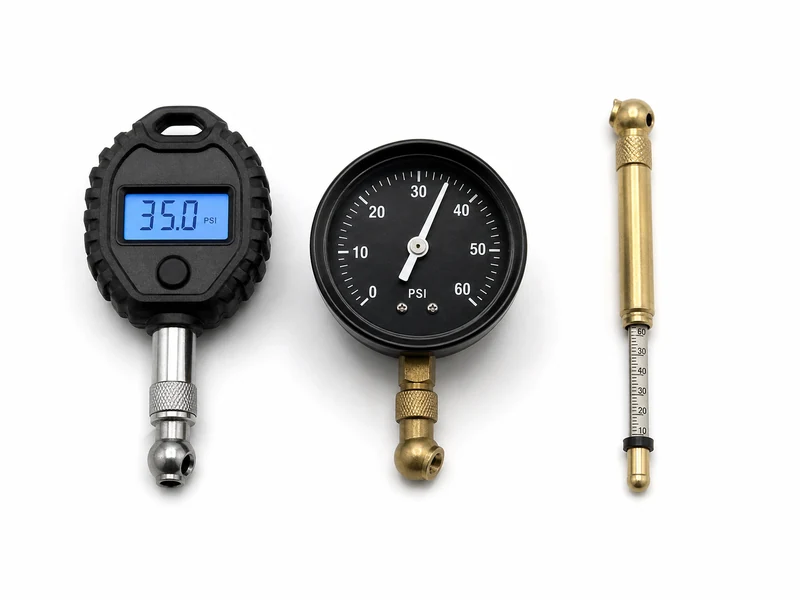
All three types can be accurate — the difference is in ease of use, durability, and features.
Digital Gauges — Easiest to Read
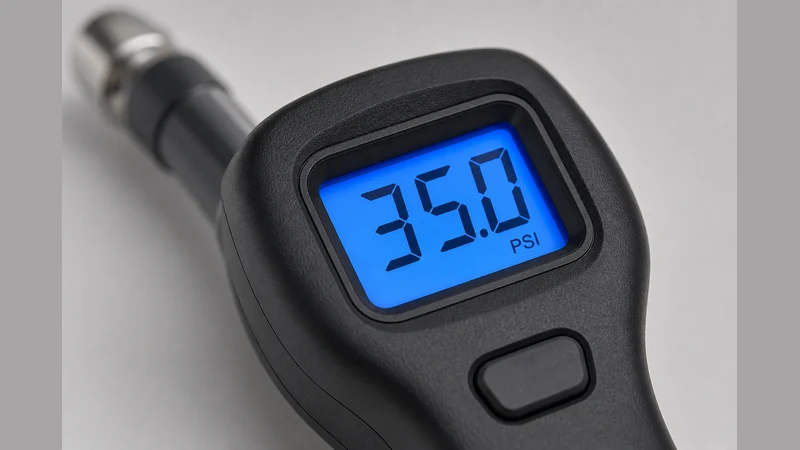
Show an exact number on an LCD screen, typically to 0.1 PSI resolution. Most have backlit displays — great for early mornings or poorly lit garages. Many include a built-in bleed valve to fine-tune pressure without removing the gauge. The trade-off: they require a battery (usually AAA or coin cell, lasts months to years with auto-shutoff).
Best for: Most drivers — easiest to use, hardest to misread
Dial (Analog) Gauges — No Batteries, Always Ready
A round dial face with a needle — like a clock. Good dials have glow-in-the-dark faces and a flexible hose that makes it easy to reach awkward valve stems. No batteries to die, and mechanical internals can last decades. Less precise than digital (±1-2% accuracy) but perfectly adequate for monthly checks.
Best for: Home garage, enthusiasts who prefer mechanical tools
Pencil (Stick) Gauges — Compact, Cheap, Nearly Indestructible
A small metal tube — press it on, a bar slides out, and you read the number off a printed scale. No moving parts, no battery, fits in a glove box or pocket. The downside: the markings are small and can be hard to read, especially in dim light. Accuracy varies — cheap ones are terrible, but quality ones (like the Milton S-921) hold their own.
Best for: Glove box backup, budget-conscious drivers, minimalists
3. Features That Actually Matter
Bleed valve
A small button that lets you release air in tiny increments without removing the gauge from the valve stem. This is the #1 most-praised feature across every review — it makes hitting exact PSI effortless. If you can get a gauge with a bleed valve, do it.
Backlit display (digital) / Glow dial (analog)
You'll check tire pressure early in the morning on cold tires. That means it's often dark. A backlit LCD or glow-in-the-dark dial means you won't need a flashlight.
Solid brass or steel construction
Plastic-bodied gauges crack when dropped on concrete. Look for brass, steel, or rubber-armored construction. A tire gauge lives in a glove box or toolbox — it takes abuse.
Replaceable batteries (digital)
Some cheap digital gauges have sealed-in batteries — when the battery dies, the gauge is trash. Look for models that use standard replaceable AAA or coin-cell batteries.
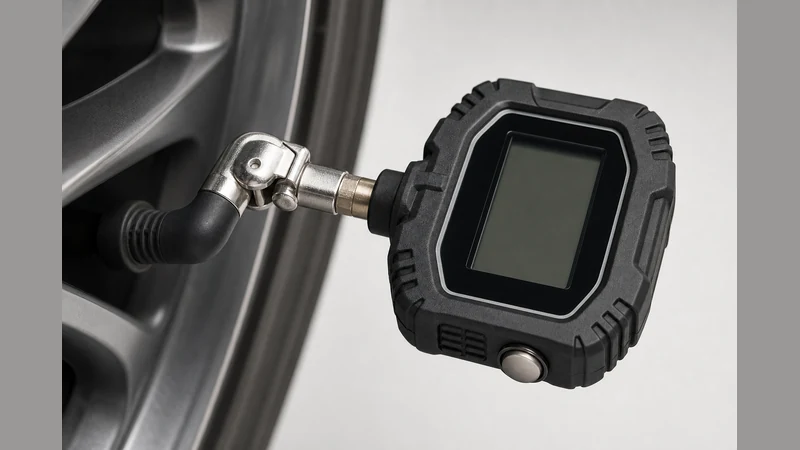
360° swivel chuck or flexible hose
Valve stems point in awkward directions, especially on dual-wheel trucks or wheels with small openings. A swiveling head or flexible hose makes connection much easier.
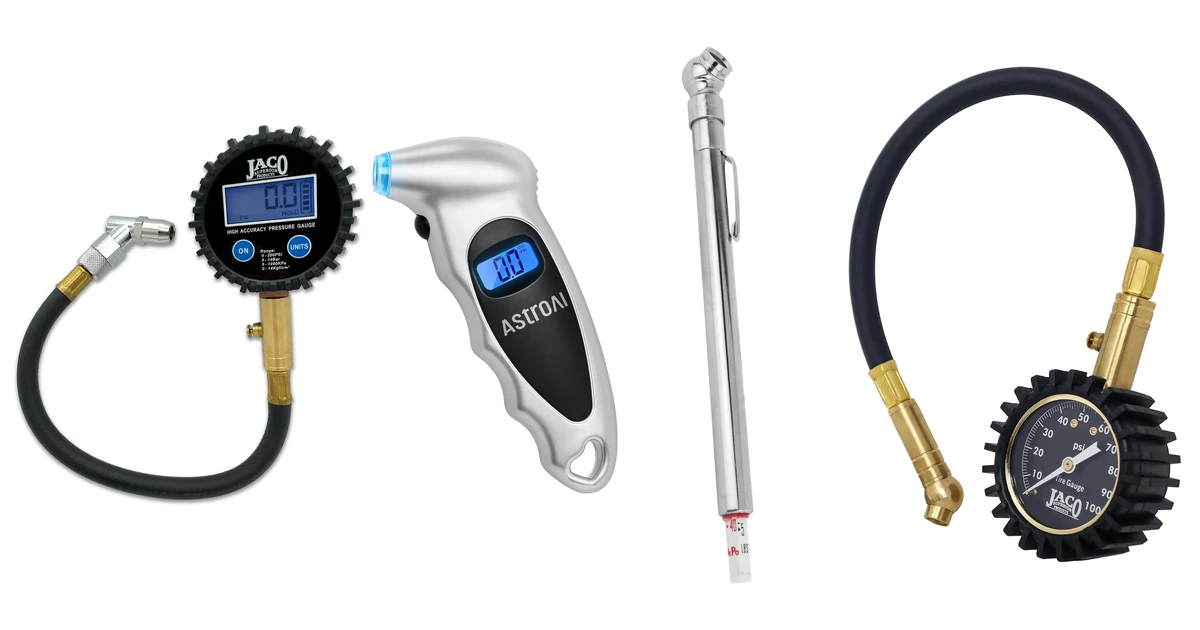
JACO ElitePro Digital Tire Pressure Gauge — 100 PSI
approximately $30 · ~4.7 stars · ~6,400+ · PrimePRIME
- •Accuracy: ±0.50% FS (ANSI B40.7 Grade 2A)
- •Range: 5–100 PSI (also bar, kPa, kg/cm²)
- •Resolution: 0.1 PSI on a 2.5" backlit LCD
- •Build: Solid brass and steel, rubber-armored
- •Bleed valve, 10" HybridFlex hose, 360° swivel
- •Locking readout — number stays on screen after removal
- •Battery: 2× AAA (replaceable), 150s auto-off
Pros
- Shop-grade accuracy at a consumer price
- Bleed valve for fine-tuning pressure
- Locking readout — number stays on screen after removal
- Flexible hose reaches awkward valve stems
- Lifetime warranty from a US-based company
Cons
- At ~$30, it is 2–3× the price of budget digitals
- Bulkier than a pencil gauge — won't fit in a small glove box
- 100 PSI max is fine for passenger cars but borderline for trucks
Best for: Drivers who want professional accuracy and long-term durability
As an Amazon Associate we earn from qualifying purchases. Prices and availability are approximate and may vary.
Verified by: Project Farm — #1 out of 23 gauges tested · Car and Driver — "Best Overall" · Road & Track — Top Pick · Car Talk — Recommended · CNN Underscored — Best Overall
AstroAI Digital Tire Pressure Gauge — 150 PSI
approximately $12 · ~4.5 stars · tens of thousands · PrimePRIME
- •Accuracy: ±1 PSI
- •Range: 0–150 PSI (also bar, kPa, kg/cm²)
- •Backlit LCD with lighted nozzle
- •Non-slip rubber grip
- •Battery: AAA or LR44 (replaceable), 30-40s auto-off
Pros
- Excellent value — solid performance under $12
- Backlit display and lighted nozzle for dark conditions
- 150 PSI range covers cars, SUVs, and most trucks
- Four-unit readout (PSI, bar, kPa, kg/cm²)
Cons
- Plastic body is less durable than all-metal gauges
- No ANSI certification listed on all models
- No bleed valve — must remove gauge to adjust
- Not suitable for Presta valves without an adapter
Best for: Budget-conscious drivers who want digital convenience
As an Amazon Associate we earn from qualifying purchases. Prices and availability are approximate and may vary.
Verified by: Multiple review sites consistently cite as best under $15 · High-volume seller with strong real-world feedback
Milton S-921 Single Chuck Pencil Tire Pressure Gauge
$6–$13 · ~4.6 stars · ~3,000+
- •Type: Pencil (stick) gauge, fully mechanical
- •Range: 5–50 PSI
- •Build: Nickel-plated brass
- •Made in USA since 1943
- •No batteries — works anytime, anywhere
Pros
- Dead reliable — no electronics, no batteries, nothing to fail
- Nickel-plated brass construction, built to last decades
- Made in the USA by a company that has made gauges since 1943
- Fits in any glove box, pocket, or center console
- At $6, buy two and keep one in each car
Cons
- 50 PSI max — fine for passenger cars, not for trucks
- Small markings can be hard to read in dim light
- No bleed valve
- Less precise than a quality digital gauge
Best for: Glove box backup that's always there when you need it
As an Amazon Associate we earn from qualifying purchases. Prices and availability are approximate and may vary.
Verified by: CNN Underscored — "Best Budget" pick · Road & Track — Recommended · Multiple independent reviewers — top pencil pick
JACO ElitePro Analog Tire Pressure Gauge — 100 PSI
approximately $23 · ~4.6 stars · ~3,000+ · PrimePRIME
- •Accuracy: ANSI B40.1 certified (±1-2%)
- •Range: 0–100 PSI (also 0–60 PSI model available)
- •Display: 2" glow-in-the-dark dial
- •Build: Solid brass and steel
- •Bleed valve, 10" flexible hose, 360° swivel chuck
- •No batteries — fully mechanical
Pros
- No batteries — always ready, even after months in storage
- Glow-in-the-dark dial for low-light conditions
- Solid brass/steel construction, built to last
- Bleed valve for fine-tuning without removing the gauge
- Flexible hose reaches awkward valve stems
Cons
- Less precise than a quality digital (±1-2% vs. ±0.5%)
- Larger and bulkier than a pencil gauge
- Dial can become inaccurate if dropped hard
Best for: Enthusiasts who prefer mechanical tools with no batteries
As an Amazon Associate we earn from qualifying purchases. Prices and availability are approximate and may vary.
Verified by: Car Talk — Recommended analog pick · Road & Track — Top analog choice · Same NIST/ANSI-certified facility as the ElitePro digital
Also Worth Considering: ETENWOLF T300
The ETENWOLF T300 deserves a mention — it's certified to the same ANSI B40.7 Grade 2A standard as the JACO ElitePro, and an independent review by GadgetReview found it measured within ±0.4 PSI of a calibrated reference gauge. Its 200 PSI range and AI thermal compensation make it a strong option for trucks, RVs, and fleet vehicles. We did not make it a top pick because its pricing is inconsistent across retailers, and the JACO ElitePro has broader consensus from independent testers — but it's a solid alternative in its category.
ETENWOLF T300 Digital Tire Pressure Gauge — 200 PSI
approximately $10–$25 · ~4.6 stars · ~8,200+
- •Accuracy: ANSI B40.7 Grade 2A (±0.5%)
- •Range: 3–200 PSI
- •AI thermal compensation (-4°F to 130°F)
- •Backlit LED display + lighted nozzle
- •Battery: AAA (replaceable), 30s auto-off
- •3-year warranty
Pros
- ANSI Grade 2A certified — same accuracy class as JACO
- Wide 200 PSI range — great for trucks and RVs
- Independent lab test: ±0.4 PSI variance (GadgetReview)
- Thermal compensation works in extreme temperatures
Cons
- Price varies widely across retailers ($8.99 to $28.99)
- Uses a standard chuck — no flexible hose
- Fewer independent testers have reviewed it vs. JACO
- Some users report display is dim in direct sunlight
Best for: Truck, RV, and fleet owners who need a wide pressure range
As an Amazon Associate we earn from qualifying purchases. Prices and availability are approximate and may vary.
Verified by: GadgetReview — lab-tested ±0.4 PSI accuracy · Jordi's Tire Shop — #1 pick · ANSI B40.7 Grade 2A certificate confirmed
How to Use a Tire Pressure Gauge
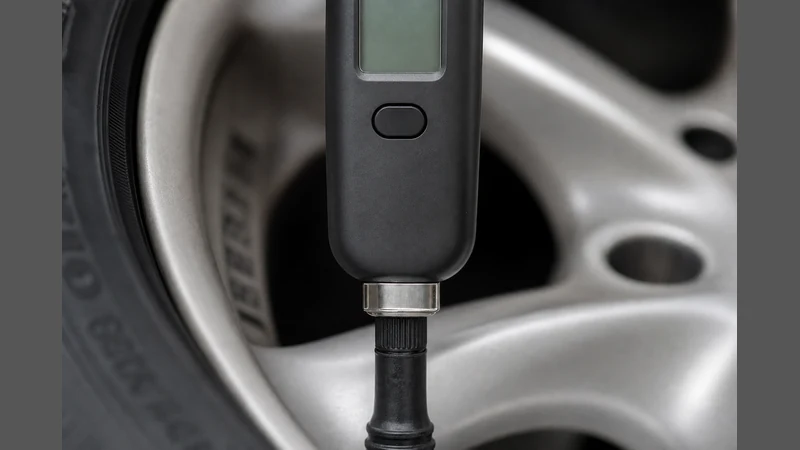
Even the best gauge gives bad readings if used incorrectly. The process is simple, but two things matter above all: cold tires and a good seal on the valve stem.
Check on cold tires
Always measure when the car has been parked for at least 3 hours. Driving heats the air inside the tire, raising pressure by 4-8 PSI. A reading taken on warm tires will be falsely high, and you may accidentally under-inflate.
Find your target PSI
Look at the sticker on your driver-side door jamb — not the number on the tire sidewall. The sidewall number is the tire's maximum structural pressure limit, not your vehicle's recommended PSI. If you're not sure, see our vehicle tire pressure database.
Press the gauge firmly onto the valve stem
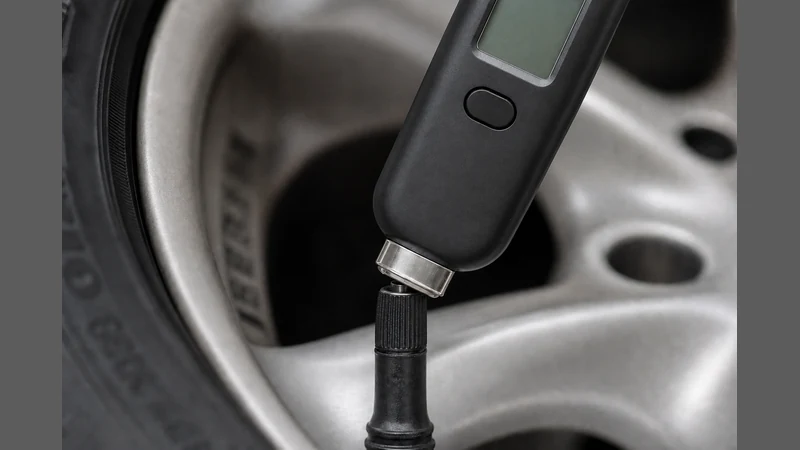
Unscrew the valve cap. Push the gauge straight onto the valve stem with firm, even pressure. A brief hiss of air means the seal isn't perfect — reposition and try again. You should hear no air escaping when seated correctly. Read the number, then remove the gauge.
Add or release air as needed
If the reading is below your target, add air in short bursts using an air pump, checking with the gauge after each burst. If above, use the gauge's bleed valve (or press the valve stem pin) to release small amounts. Re-check after each adjustment. Replace the valve cap when done.
Common mistake: Pressing the gauge at an angle. This lets air escape around the seal and gives a falsely low reading. Press straight on, perpendicular to the valve stem. If your gauge has a rubber seal, inspect it periodically — a worn or cracked seal will leak and produce inaccurate readings.
Frequently Asked Questions
What type of tire pressure gauge is most accurate?
Digital gauges with ANSI B40.7 Grade 2A certification are the most accurate, achieving ±0.5% of true pressure. Quality dial gauges follow at ±1-2%. However, a well-made pencil gauge from a reputable brand like Milton is more trustworthy than a cheap uncertified digital gauge — Project Farm testing found some uncertified gauges were off by over 20%.
How much should I spend on a tire pressure gauge?
You can get a reliable pencil gauge for $6-$10 and a good digital gauge for $12-$30. There is no need to spend more than $30 — the top-ranked gauges in independent testing all fall in this range. The most expensive gauge tested by Project Farm (over $35) ranked 10th out of 23. Price does not equal accuracy.
Are gas station air pump gauges accurate?
No. Gas station gauges are handled roughly by hundreds of users, rarely if ever calibrated, and can be off by 4-5 PSI — enough to under-inflate or over-inflate your tires significantly. Always use your own gauge to verify. Use the station pump for air, not for measurement.
How long do digital tire pressure gauges last?
A quality digital gauge with replaceable batteries (like the JACO ElitePro or AstroAI) should last several years with normal use. The battery typically lasts 1-2 years with auto-shutoff. The most common failure point is the rubber valve seal, not the electronics — inspect it periodically and replace the gauge if readings become inconsistent.
Can I use the same gauge for my car and my bicycle?
Most car tire gauges use a Schrader valve chuck — the same type found on most car tires and many bicycle inner tubes. However, road bikes often use Presta valves (narrower, with a locking nut), which require a gauge with a Presta-compatible head or a separate adapter. If you need a gauge for both, look for a dual-valve model or buy a Presta adapter (~$2).
What PSI range do I need?
For passenger cars and SUVs (typically 30-40 PSI), a gauge rated to 60-100 PSI is sufficient. For trucks, RVs, and towing — where tire pressures can reach 80-110 PSI — choose a gauge rated to at least 150 PSI. Always buy a gauge with headroom: measuring at the extreme top of a gauge's range is less accurate than measuring in the middle.