How to Fill Tires with Air: Step-by-Step Guide
Last updated: July 28, 2026 · Reading time: 6 min
Putting air in your tires takes less than five minutes and costs $1–$2 at a gas station — or nothing at a tire shop. It is one of the few car maintenance tasks anyone can do with zero tools.
This guide covers how to fill tires at a gas station, at home with a portable inflator, how to know when to stop, and what to do if you overfill.
Quick Summary
- Find your target PSI on the driver-side door jamb sticker
- Unscrew the valve cap and attach the air hose firmly
- Inflate in short bursts, checking with a gauge after each burst
- Stop when the gauge reads your target PSI
- Screw the valve cap back on and repeat for all four tires
Before You Start: Know Your Target PSI
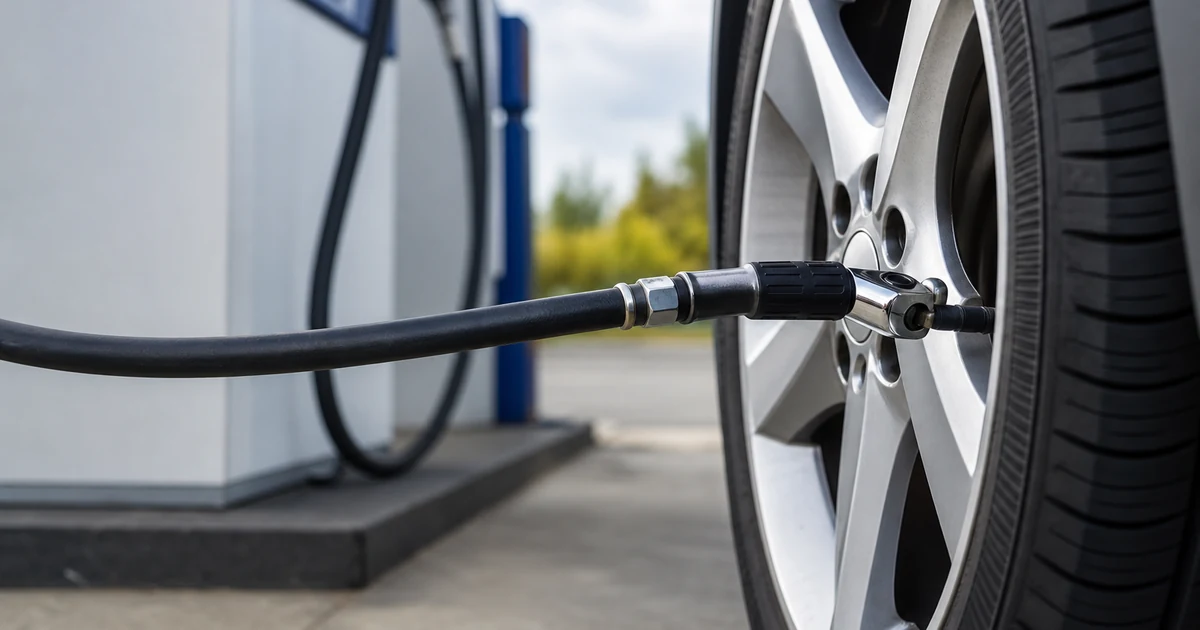
The number printed on your tire sidewall is not your target. That is the tire's maximum structural pressure — the most it can safely hold, not what it should be inflated to for daily driving.
Your target PSI is on a sticker in one of three places:
- Driver-side door jamb — open the door and look at the frame. This is the most reliable source.
- Owner's manual — in the "Tires" or "Specifications" section.
- Our vehicle database — see tire pressure by vehicle.
Cold tires only. Check and fill when the car has been parked at least 3 hours. Driving heats the air inside and raises pressure by 4–8 PSI. If you fill on warm tires, the pressure will read too low once they cool — and you will be under-inflated.
Option 1: Fill Tires at a Gas Station
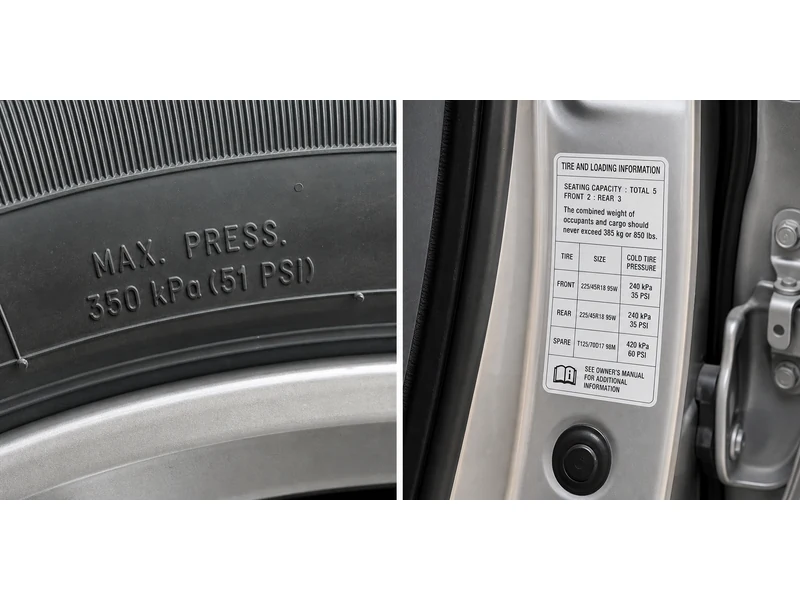
This is the most common method and works almost anywhere. Most gas station air pumps are self-service coin-operated machines ($1–$2). Some stations still offer free air — look for a sign or ask the cashier to turn on the pump.
Park near the air pump
Position your car so the air hose can reach all four tires. The hose is usually 15–20 feet long. If the pump is on the driver's side, you may need to pull in so the hose reaches the passenger side tires.
Unscrew the valve cap
Remove the cap from the first tire's valve stem and put it in your pocket. Never set it on the ground — it disappears almost instantly and a missing cap lets dirt into the valve.
Insert coins or pay at the machine
Most pumps accept quarters or credit cards. The pump runs for a set time (usually 3–5 minutes), so be efficient. Have your gauge ready before starting.
Press the air hose nozzle firmly onto the valve stem
Push the nozzle straight onto the valve stem. You should hear little to no hissing — a hiss means air is escaping around the seal. Reposition and try again. Press and hold the trigger to inflate.
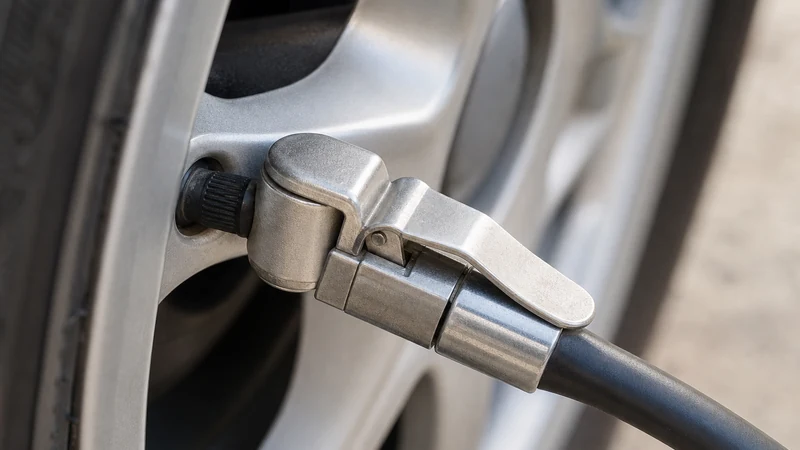
Inflate in short bursts of 3–5 seconds
Do not hold the trigger continuously. Inflate for a few seconds, then check with your gauge. Most gas station pump gauges are inaccurate — use your own gauge to verify. Repeat until the gauge shows your target PSI.
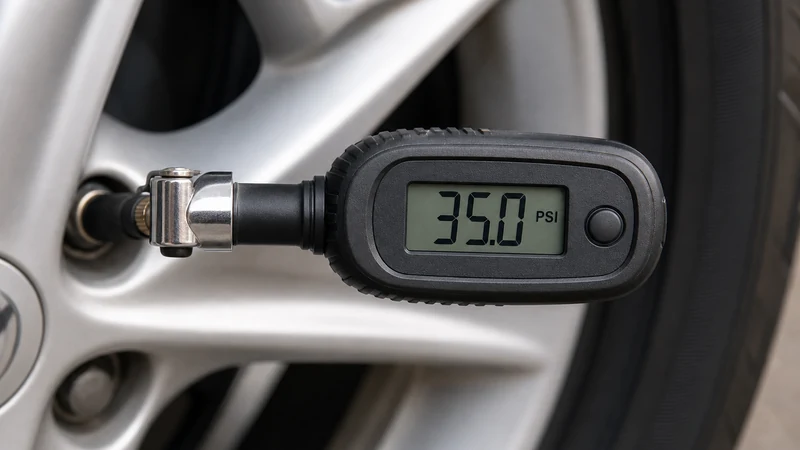
Replace the valve cap and move to the next tire
Screw the cap back on finger-tight. Move to the next tire and repeat. Work around the car in a circle so you do not forget any tire.
Do not trust the gas station pump gauge. They are handled roughly, rarely calibrated, and can be off by 4–5 PSI. Always use your own gauge to check. Inflate using the pump, verify with your gauge.
Option 2: Fill Tires at Home
A portable tire inflator plugs into your car's 12V outlet (cigarette lighter) and costs $25–$60. It pays for itself quickly — no more driving to a gas station every time a tire is low.
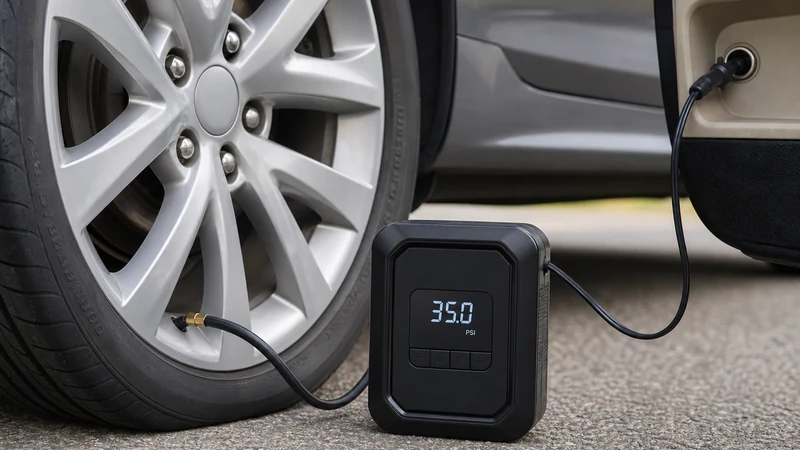
There are two types of home inflators:
12V portable inflator ($25–$60)
Plugs into your car's power outlet. Most have a digital screen where you set the target PSI — it stops automatically when reached. Compact enough to keep in the trunk. Works anywhere.
Air compressor with tire chuck ($60–$200+)
A standalone air compressor plugs into a wall outlet. Useful if you already own one for tools or if you have multiple vehicles. Overkill for just tires, but faster and more powerful.
Steps are similar to the gas station method, with one key advantage:
- Plug the inflator into your car's 12V outlet. Start the engine so you do not drain the battery.
- Set the target PSI on the digital display (if your inflator has one).
- Attach the hose to the valve stem — most portable inflators have a screw-on connector that seals automatically.
- Turn it on. The inflator runs until the target PSI is reached, then stops.
- Unscrew the hose, replace the valve cap, and move to the next tire.
How Much Air to Add
You do not fill to a fixed number every time. You fill based on what your gauge currently reads:
- Check current PSI with your gauge
- Subtract from your target PSI (on the door jamb sticker)
- That difference is how much you need to add
Example: Your door jamb says 35 PSI. Your gauge reads 28 PSI. You need to add about 7 PSI. Inflate in short bursts, checking after each burst, until the gauge shows 35.
| Vehicle type | Typical recommended PSI |
|---|---|
| Passenger cars (sedans, hatchbacks) | 30–35 PSI |
| SUVs and crossovers | 33–40 PSI |
| Pickup trucks | 35–44 PSI |
| Electric vehicles (Tesla, etc.) | 40–45 PSI |
| Compact spare (donut) | 60 PSI |
What If I Overfill?
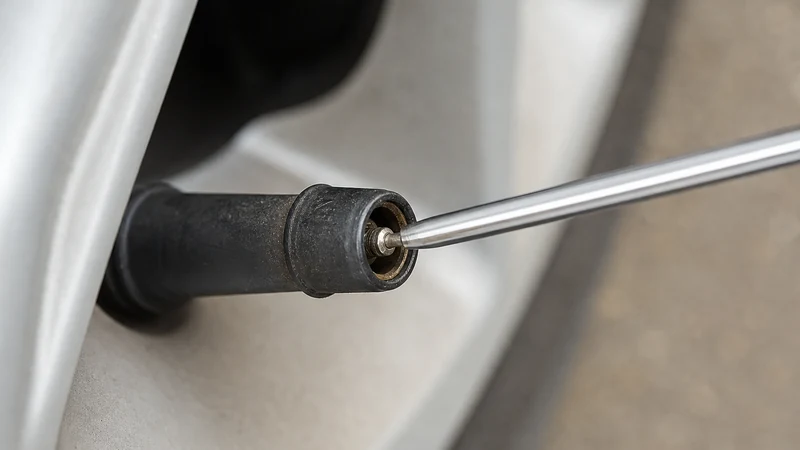
It is easy to add too much — especially at a gas station with a fast pump. Over-inflating by 2–3 PSI is not a crisis. Over-inflating by 10+ PSI needs correcting.
To release air:
- Find the small metal pin in the center of the valve stem.
- Press it with the tip of your tire gauge, a pen cap, or a key. Air releases immediately.
- Release in short taps — do not hold it down. Check with your gauge after each tap.
- When the gauge reads your target PSI, stop and replace the valve cap.
Pro tip: It is easier to add a little more than to release too much. If you are unsure, aim slightly below your target (1–2 PSI low). You can always add a short burst, but you cannot put air back once released.
Do Not Forget the Spare Tire
A flat spare tire is useless. Compact spares (donuts) typically require 60 PSI — far higher than regular tires. Because they are small, they lose pressure faster. Check your spare every time you check your four main tires.
Frequently Asked Questions
How much does it cost to put air in tires?
Gas station air pumps typically cost $1–$2. Some stations still offer free air — ask the cashier. Tire shops like Discount Tire and America's Tire check and inflate tires for free, no appointment needed. A portable inflator for home use costs $25–$60 one-time.
How do I know when to stop putting air in?
Check your gauge after each burst of inflation. Stop when it matches the recommended PSI on your driver-side door jamb sticker. Never use the max pressure on the tire sidewall. If your inflator has a digital target setting, it stops automatically.
How much air should I put in my tires?
Check the door jamb sticker. Passenger cars are typically 30–35 PSI, SUVs 33–40 PSI, trucks 35–44 PSI. For exact numbers, look up your vehicle in our tire pressure database.
Can I overfill my tires?
Yes. Over-inflated tires wear faster in the center, reduce traction, and make the ride harsher. A couple PSI over is fine. More than 5 PSI over — release some air.
Should I fill tires when hot or cold?
Cold. Always inflate when the car has been parked at least 3 hours. Warm tires read 4–8 PSI higher than cold ones. If you fill on warm tires, you will be under-inflated once they cool down.
Where can I fill my tires for free?
Discount Tire and America's Tire inflate for free, no appointment needed. Walmart Auto Care Centers also offer free checks and inflation. Some gas stations have free pumps — look for a sign or ask the cashier.