
The Penny Test: How to Check Tire Tread with a Penny
Last updated: September 22, 2026 · Reading time: 6 min
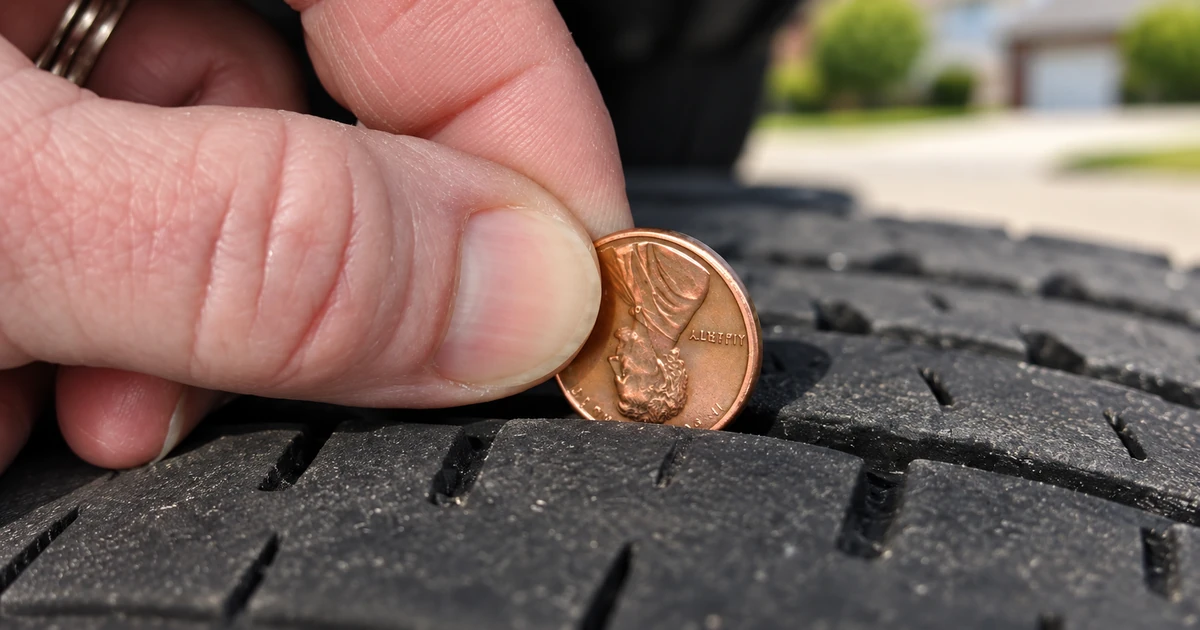
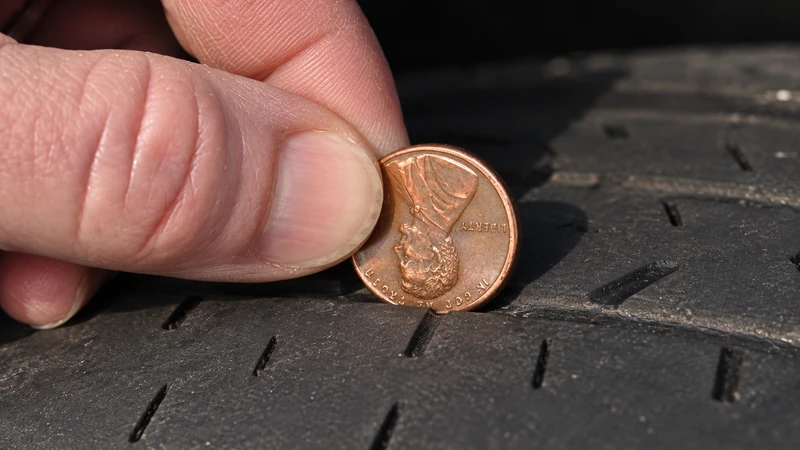
To do the penny test: insert a penny into a tire tread groove with Lincoln's head pointing down. If you can see all of his head, your tread is at or below 2/32 inch — the legal minimum — and the tire needs replacing. If his head is covered, you have more than 2/32 inch left.
What the Penny Test Actually Measures
The penny test works because of a lucky coincidence of geometry: the distance from the edge of a US penny to the top of Abraham Lincoln's head is almost exactly 2/32 of an inch (about 1.6 mm) — which happens to be the minimum legal tread depth in most US states. The coin is a free, pocket-sized gauge for that one threshold.
That's also its limitation. The penny test answers exactly one question — "am I at the legal limit?" — with a pass or fail. It can't tell you whether you have 8/32 inch or 3/32 inch left, and it says nothing about cracks, bulges, or uneven wear. Think of it as a smoke detector, not a full inspection.
How to Do the Penny Test
Grab a penny, head down
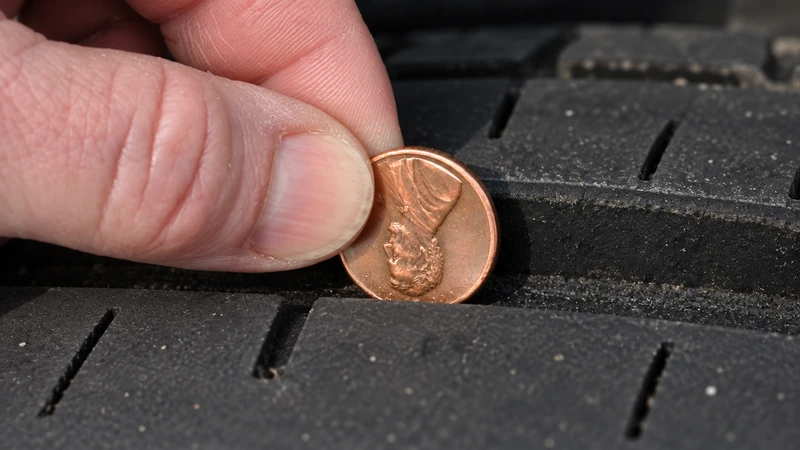
Hold the penny so Lincoln's head points toward the tire. The mnemonic is 'head into the tread.' This orientation is what makes the measurement work — the 2/32 inch is measured from the coin's edge to the top of his head.
Insert it into a main tread groove
Push the penny into one of the deep grooves that run around the tire — not the thin slits (sipes) on the tread blocks, and not the shoulder lugs. The groove floor is what you're measuring from.
Read Lincoln's head
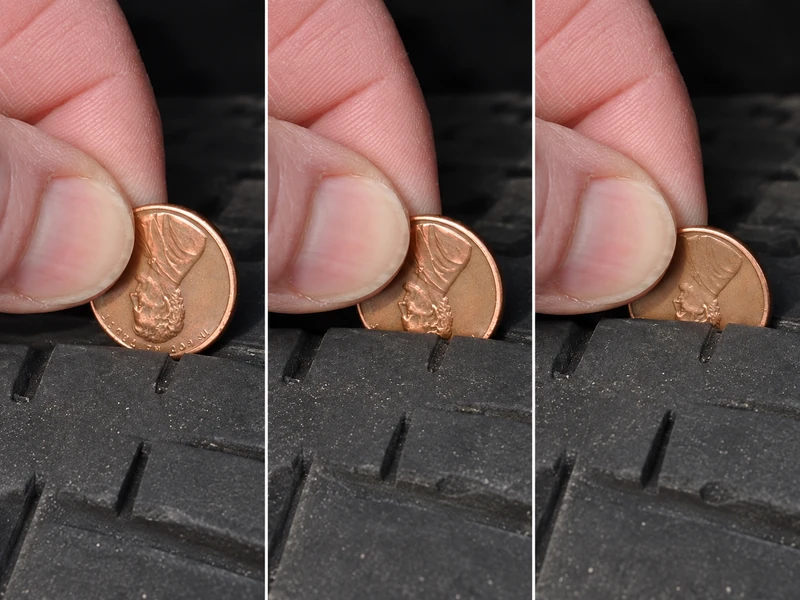
Look at how much of the head is visible above the tread. All of it visible = fail (at or below 2/32 inch). Top covered = pass for now. In between = borderline. The next section breaks down all three outcomes.
Repeat on every tire, in several grooves
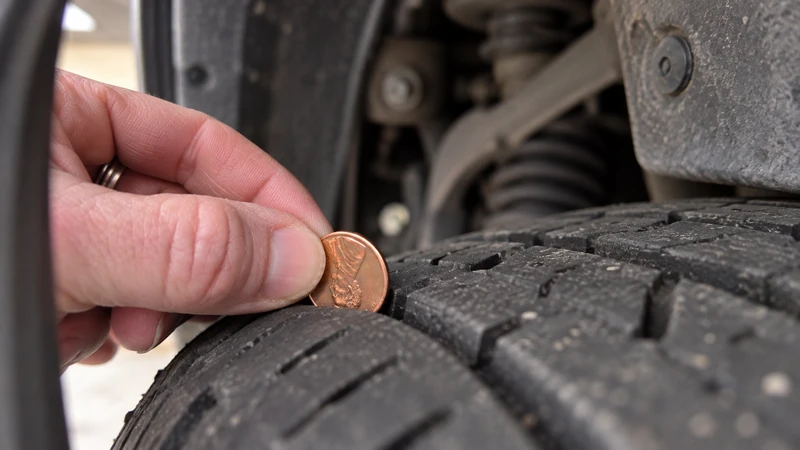
Tires almost never wear evenly. Test the inner, center, and outer grooves of all four tires — the inner shoulder often wears first and is the hardest to see. Your true tread depth is the lowest reading you find anywhere, on any tire.
Reading the Results: All Three Outcomes
Most guides treat the penny test as binary, but there are really three outcomes — and the middle one is where most drivers actually are:
| What you see | Approx. depth | Verdict |
|---|---|---|
| Lincoln's whole head is visible | At or below 2/32" | Fail — replace now |
| Top of head covered, hairline visible | Roughly 2/32"–4/32" | Borderline — replace soon |
| Top of Lincoln's head is covered | Above 2/32" | Pass — recheck monthly |
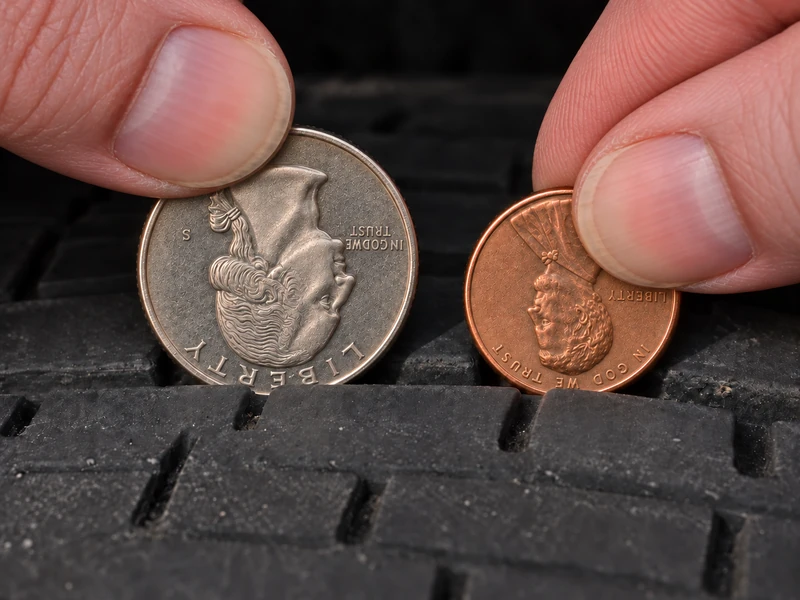
The borderline zone deserves respect. A tire that shows Lincoln's hairline is somewhere around 2/32–4/32 inch — legal, but already in the range where wet grip falls off a cliff. If you land here, don't wait for a clean "fail." Confirm with the quarter test below and start shopping.
The Quarter Test: The Safer Version
Same technique, bigger coin, safer threshold. The distance from a quarter's edge to the top of Washington's head is about 4/32 inch. Insert it head-down: if you can see all of Washington's head, you're at or below 4/32 inch — the point where AAA recommends replacing tires.
Why treat 4/32 as the real deadline? In AAA's wet-pavement testing, tires worn to 4/32 inch needed an average of 43% more distance to stop from 60 mph than new tires — 87 extra feet for a sedan. At 2/32 inch, where the penny test finally fails you, it's worse. The penny test tells you when a tire is legally dead; the quarter test tells you when it's no longer safe in the rain.
How Accurate Is the Penny Test?
For a free coin, remarkably good — at its one job. Its known weaknesses:
- •Single threshold. It checks 2/32 inch only. A tire at 3/32" passes the penny test while being nearly worn out — that's why the quarter test exists.
- •Single point. One groove on one tire proves nothing. Uneven wear means the inner shoulder can fail while the center passes. Always test multiple grooves on all four tires and go by the worst reading.
- •Depth only. It says nothing about tire age, sidewall cracks, bulges, or punctures — all of which can retire a tire with plenty of tread left.
Want an exact number instead of pass/fail? A tread depth gauge costs $3–$10, reads in 32nds of an inch, and settles arguments. Your tires also have a free built-in backup: molded wear bars sit in the grooves at exactly 2/32 inch — tread flush with the bars means the same thing as a failed penny test. Our complete guide to checking tire tread covers all four methods side by side.
The Penny Is Retired — the Test Isn't
On November 12, 2025, the US Mint struck its final penny, ending more than 230 years of production. The test survives the coin: over 300 billion pennies are still in circulation and remain legal tender, and the geometry that makes the test work hasn't changed. If loose change is genuinely scarce in your life, the quarter test and the molded wear bars cover the same ground — and a tread depth gauge never needed coins at all.
Failed the Test? What to Do Next
- Confirm the worst spot. Re-test the failing groove and its neighbors. One bad reading anywhere on the tire is enough — tires are judged by their most worn point.
- Check the other three tires. Tires on the same axle usually wear together, so budget for at least a pair, and ideally a matched set.
- Diagnose why it wore. Edges worn but center fine points to under-inflation; center worn but edges fine points to over-inflation; one side worn points to alignment; scalloped dips point to suspension. Fix the cause before mounting new tires, or the new set wears the same way. Start with checking your tire pressure — it's the most common cause and the cheapest fix.
- Don't stretch it "one more month." At 2/32 inch the tire can't clear water — the first heavy rain becomes a hydroplaning coin flip, and it's a coin you already failed once.
Key takeaways
- ✓Penny test: Lincoln's head down into a main groove — all of his head visible means 2/32" or less, replace now
- ✓Hairline visible but top covered is borderline (roughly 2/32"–4/32") — confirm with the quarter test and plan replacement
- ✓The quarter test (4/32") is the better safety check: AAA found wet stopping distances 43% longer at that depth
- ✓Test multiple grooves on all four tires — your true depth is the lowest reading anywhere
- ✓Pennies left production in November 2025, but 300+ billion remain in circulation — the test still works
- ✓If a tire fails, find out why it wore — pressure, alignment, or suspension — before buying the next set
Frequently Asked Questions
What does the penny test actually measure?
One thing only: whether your tread depth is above or below 2/32 of an inch, the legal minimum in most US states. The distance from the edge of a penny to the top of Lincoln's head is almost exactly 2/32 inch, so the coin works as a pass/fail gauge for that single threshold. It cannot tell you the exact depth — for that you need a tread depth gauge.
What if I can only see part of Lincoln's head?
You're borderline. If the top of the head is covered but the forehead or hairline is visible, your tread is above 2/32 inch but not by much — roughly in the 2/32 to 4/32 inch range. Don't celebrate: that's the zone where wet grip is already fading. Confirm with the quarter test or a gauge, and start planning for replacement.
Is the penny test accurate?
It's accurate for what it is — a free pass/fail check at the 2/32 inch legal limit. Its weaknesses are precision and coverage: it measures only one threshold, and only at the groove you test. Tires wear unevenly, so a tire can pass in the center groove and fail on the inner shoulder. Test several grooves on every tire, and use a tread depth gauge if you want an exact number.
Can I still do the penny test now that pennies are discontinued?
Yes. The US Mint struck its last penny on November 12, 2025, but over 300 billion pennies remain in circulation and are still legal tender. The geometry of the coin hasn't changed — edge to the top of Lincoln's head is still 2/32 inch. If you genuinely can't find a penny, use a quarter (checks 4/32 inch) or a $3 tread depth gauge.
What's better, the penny test or the quarter test?
The quarter test, for safety. The penny test only tells you when you've hit the 2/32 inch legal minimum — by then, wet braking is already severely degraded. The quarter test checks 4/32 inch, the depth where AAA recommends replacing tires because wet stopping distances are about 43% longer than on new tires. Use the quarter as your decision point and the penny as the final deadline.
How often should I do the penny test?
Once a month, at the same time you check tire pressure, and before long road trips. It takes under a minute for all four tires. If your tires are already below 5/32 inch, check more often — wear tends to accelerate in the second half of a tire's life, and catching the crossover into the danger zone early is the whole point of the test.
References
- Discount Tire — How to Check Tire Tread Depth (penny test = 2/32", quarter test = 4/32", wear bars at 2/32"; measure multiple grooves and use the lowest reading)
- AAA Newsroom — Tread Lightly: Worn Tires Put Drivers at Risk (wet stopping distance +43% at 4/32"; replace at 4/32", not 2/32")
- ABC News — US Mints Final 1-Cent Coins After Over 230 Years (last penny struck November 12, 2025; pennies remain legal tender)