
Tire Treadwear Rating Explained: The Number, the Trap, and How to Use It
Last updated: October 26, 2026 · Reading time: 8 min
A tire treadwear rating is a relative wear index, not a mileage promise: a 400-grade tire lasted four times longer than the reference tire on the government's 7,200-mile test. Brands grade their own tires, so compare within one brand only — and never convert the number into miles.
What the Rating Actually Measures
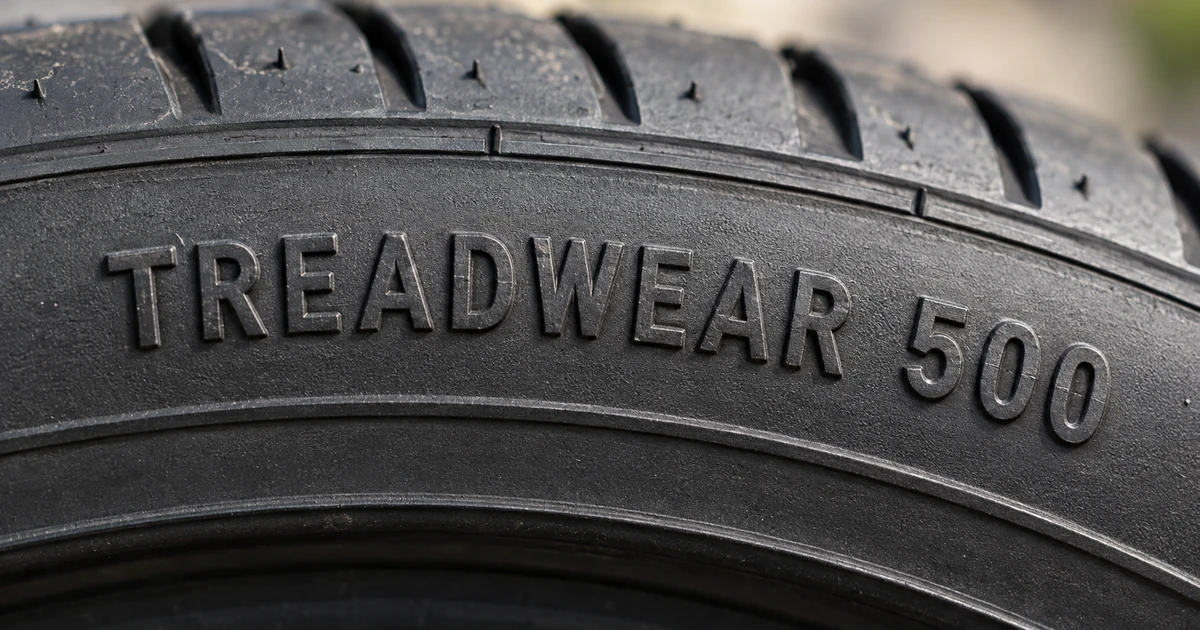
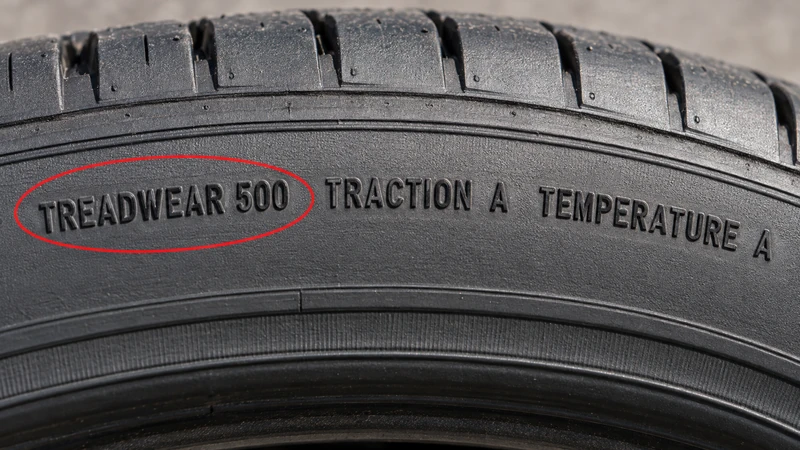
The treadwear rating is one of three UTQG (Uniform Tire Quality Grading) marks molded into every passenger-car tire's sidewall, set by federal regulation 49 CFR 575.104. (The other two — traction and temperature — are safety grades we cover in the sidewall guide; this article goes deep on treadwear alone.)
The number is a ratio, not a distance. On the test course, candidate tires run in the same convoy as reference tires (called course-monitoring tires), and the grade expresses how the candidate's wear compares. A tire graded 400 wore four times slower than the reference; a 200, twice as slow. Because the reference itself isn't a fixed "100 = X miles" anchor — modern course-monitoring tires grade above 100 — the honest comparison is between two grades: a 400 should outlast a 200 by about 2× under test conditions.
Grades are assigned in multiples of 20, so you'll see 340, 500, 720 — never 511.
How the Government Test Works
This is the part most explanations skip, and it's the key to trusting (or discounting) the number:
- The course is real public road — an approximately 400-mile loop near Goodfellow Air Force Base in San Angelo, Texas, driven by convoys of two or four vehicles.
- Total distance is about 7,200 miles — an 800-mile break-in, then sixteen 400-mile circuits, with tires rotated every circuit and alignment checked every 800 miles.
- Reference tires ride along — course-monitoring tires in the same convoy correct for weather and road-severity differences between test runs, so a grade earned in a July heat wave is comparable to one from a mild October run.
- It's a wear test, nothing else — no potholes, no track days, no burnt-rubber launches. Controlled, steady, legal-speed driving.

So the grade genuinely measures what it claims: relative tread wear under controlled conditions. The problems start after the test.
The Self-Grading Trap
Here's what the regulation actually says: each manufacturer (or brand owner) assigns its own grades. NHTSA runs the course for its own spot-check compliance testing but does not approve grades before they hit the sidewall. Consumer Reports' verdict is blunt — the self-scoring "isn't precise, enabling companies to approach this strategically according to their marketing plans," and it makes cross-brand comparison "difficult for shoppers."
It's even legal to understate: a tire that could justify a 480 can be sold as a 400, and manufacturers sometimes do exactly that to position a tire in a lower, sportier category. The practical rule: a Michelin 500 and a competitor's 500 are not guaranteed to wear the same — but within one brand's lineup, the grades share a ruler and are genuinely useful.
Why You Can't Convert It to Miles
Search "treadwear 400 to miles" and you'll find charts claiming 40,000 or 60,000 miles. They're invented. The grade comes from one specific 7,200-mile test under controlled conditions; your tire's actual life depends on at least eight variables the test holds constant: driving style, climate, road surface, rotation discipline, alignment, load, speed, and inflation. Run a tire 10 PSI low and you can halve its life regardless of grade — underinflation wears the shoulders, overinflation the center (wear patterns explained).
Two identical tires on two different cars can wear out years apart. Any single "grade × 100 = miles" formula hides more than it reveals.
Grade vs Mileage Warranty: Two Different Promises
The treadwear grade is a lab ratio. The mileage warranty (e.g., "70,000-mile limited warranty") is a contractual promise the manufacturer pays out on — prorated, and only if you kept rotation records and the wear was even. Consumer Reports calls the warranty "a better barometer because the manufacturer has to pay if the tire doesn't achieve the miles promised."
Use both, weighted differently: the grade for within-brand comparisons, the warranty for cross-brand reality checks. A brand confidently stamping 80,000 miles on the warranty line is putting money behind the claim; a grade is just ink.
Don't Confuse: Rating vs Tread Depth vs Wear Bars
A common mix-up: the treadwear rating describes how the tire model performed on a test when new — it says nothing about how much rubber is left on your tire today. A five-year-old tire graded 800 can be bald; the 800 didn't change, the tread did. Three different things, three different tools:
- Treadwear rating (sidewall number) — relative wear life of the model, for shopping.
- Tread depth (measured) — how much life your actual tires have left: tread depth chart and the penny test.
- Wear bars (molded bridges) — the built-in 2/32" red line: how to read wear bars.
Typical Ranges by Tire Type
Grades cluster by tire category — useful as a sanity check when shopping:
| Tire type | Typical treadwear | What it tells you |
|---|---|---|
| Touring / long-mileage all-season | 500–800 | Daily-driver sweet spot; highest observed grades reach 800+ |
| Ultra-high-performance (UHP) | 300–500 | Grip-focused but streetable; most sports sedans land here |
| Extreme-performance summer | ~200 | Track-day capable street tires; soft compound, short life |
| R-compound / competition | Under 100 | DOT-legal track tires; wear measured in weekends, not years |
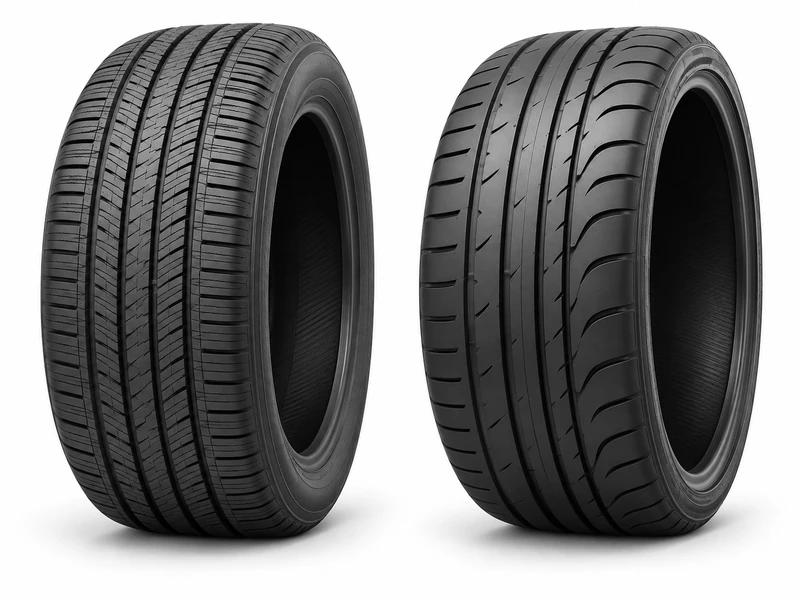
The pattern is physics: softer compounds grip better and wear faster. There's a measured trade-off between treadwear grade and friction coefficient — the 200-grade summer tire on a sports car isn't poorly made, it's optimized for stopping distance and cornering at the expense of longevity. The highest grades on record live in the touring aisle (some past 800). Neither extreme is "better" — they're different products.
How to Use the Number When Buying
- Pick your category first (touring, UHP, etc.) — cross-category grade comparisons are meaningless.
- Shortlist within one brand and compare grades there — that's where the numbers are honest.
- Cross-check the mileage warranty for the cross-brand reality check, and read its proration and rotation-record terms before trusting it.
- Sanity-check against the category table above — a "touring" tire graded 240 is wearing a costume.
- Check the exemptions: no grade on winter, LT, or spare tires — judge those by warranty and reviews instead.
- Protect whatever you buy: rotation, alignment, and correct pressure decide your real miles more than the grade does — start with a monthly pressure check and know when the tires are done.
Key takeaways
- ✓Treadwear is a relative index from a 7,200-mile government convoy test (400-mile loops near San Angelo, TX) — a 400 wore 4× slower than the reference tire, on that test.
- ✓It's a ratio, not miles. Any 'grade × 100 = mileage' chart is invented; real life depends on driving style, rotation, alignment, and inflation.
- ✓Manufacturers grade their own tires and can legally understate — compare grades within one brand only.
- ✓The mileage warranty is the enforceable number: prorated, rotation records required, but money-backed. Use it for cross-brand decisions.
- ✓Typical ranges: touring 500–800, UHP 300–500, extreme summer ~200, track tires under 100. Higher = longer wear, usually = less grip.
- ✓No UTQG on winter, LT, motorcycle, or spare tires — it's required on passenger-car tires only.
Frequently Asked Questions
What does a 500 treadwear rating mean?
A 500 treadwear rating means the tire lasted five times longer than the reference tire on the government's 7,200-mile test course. It's a relative wear index, not a mileage promise — it does not mean the tire will last 50,000 miles in your driving. Use it to compare tires within one brand's lineup, not to predict exact lifespan.
Is a higher treadwear rating always better?
Not automatically. Higher grades mean longer wear, but usually come from harder rubber compounds that trade away grip — lower-treadwear performance tires stop shorter and corner harder. A 700 touring tire and a 200 summer tire are built for different jobs. Match the grade to how you drive, and never chase the biggest number at the expense of traction.
Can I compare treadwear ratings between different brands?
Only loosely. Manufacturers assign their own grades — NHTSA doesn't pre-approve them, and grades can legally be understated. A Michelin 500 and a Goodyear 500 may not wear the same. The rating is genuinely useful within one brand's lineup; across brands, treat it as a rough hint and lean on the mileage warranty instead.
How many miles is a 400 treadwear rating?
There is no honest conversion. Charts claiming "400 = 40,000 miles" are fiction — the grade comes from a controlled 7,200-mile convoy test, and real-world life depends on driving style, climate, rotation, alignment, load, and inflation. Two identical tires on two different cars can wear out years apart. Use the mileage warranty for mile estimates, not the grade.
Do all tires have a treadwear rating?
No. UTQG grades are required only on passenger-car tires. Winter/snow tires, light-truck (LT) tires, temporary spares, and motorcycle tires are exempt. That's why your truck's LT tires and your winter set show no treadwear number — it's not missing, it was never required.
Where do I find the treadwear rating on my tire?
It's molded into the sidewall as part of the UTQG marking — look for the word TREADWEAR followed by a number (always a multiple of 20), next to TRACTION and TEMPERATURE grades. Online listings show it in the specs, and NHTSA runs a tire ratings lookup tool for checking a specific model. Full decoding of every sidewall marking is in our sidewall guide.
I drive very few miles a year — is a high treadwear rating worth paying for?
Usually not. Low-mileage drivers often age their tires out before they wear them out: rubber degrades with time, and most guidance calls for replacement around 6–10 years regardless of tread. If you drive 5,000 miles a year, a 400-grade tire may die of old age with half its tread left. Put your money into the right category and fresh production dates instead of the biggest wear number.
References
- 49 CFR 575.104 — the federal UTQG regulation (relative grading vs course-monitoring tire, convoy and course specs, manufacturers assign their own grades, exemption list)
- NHTSA Federal Register rule (2013) — 400-mile test course near San Angelo, Texas, run by two- or four-vehicle convoys
- Consumer Reports — Understanding the UTQG system (self-grading critique, strategic scoring, why the mileage warranty is the better barometer)
- Wikipedia — Uniform Tire Quality Grading (7,200-mile West Texas convoy, course-monitoring tire nuance, treadwear-vs-grip trade-off, exempt tire types)
- ThreePiece.us — treadwear ranges by tire category (track under 100 to touring 500–800) and the soft-compound trade-off
- Tire Agent — category-level treadwear data from 67,000+ tire records, plus the real-world factors that decide actual tire life