How to Read a Tire Sidewall: Every Marking, Decoded in Plain English
Last updated: September 22, 2026 · Reading time: 9 min
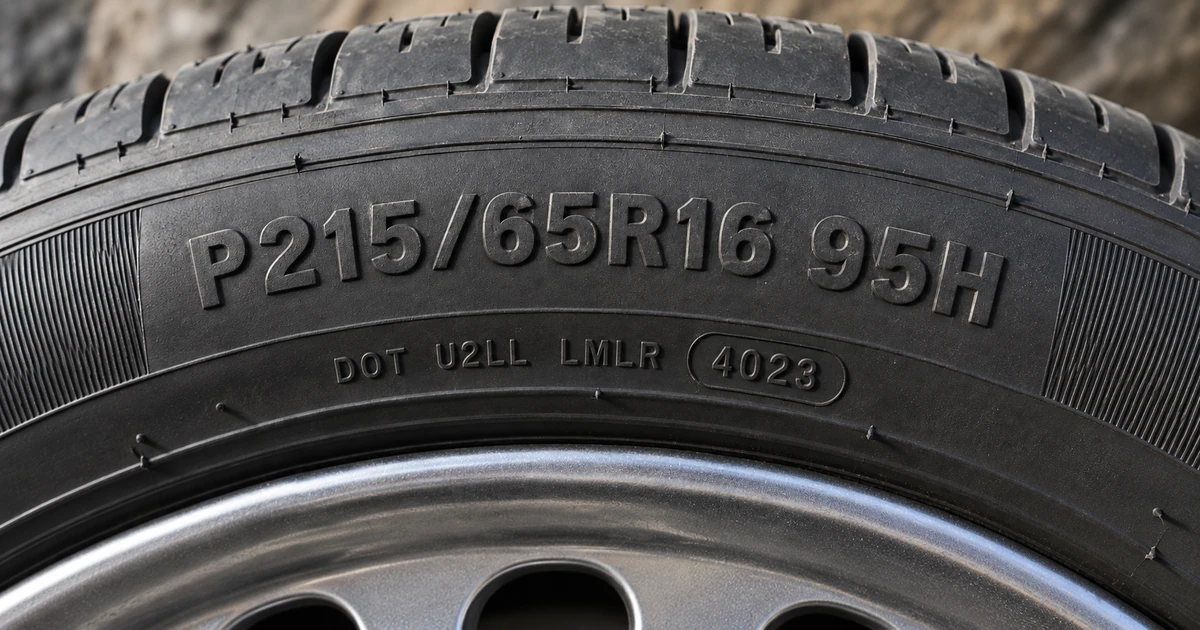
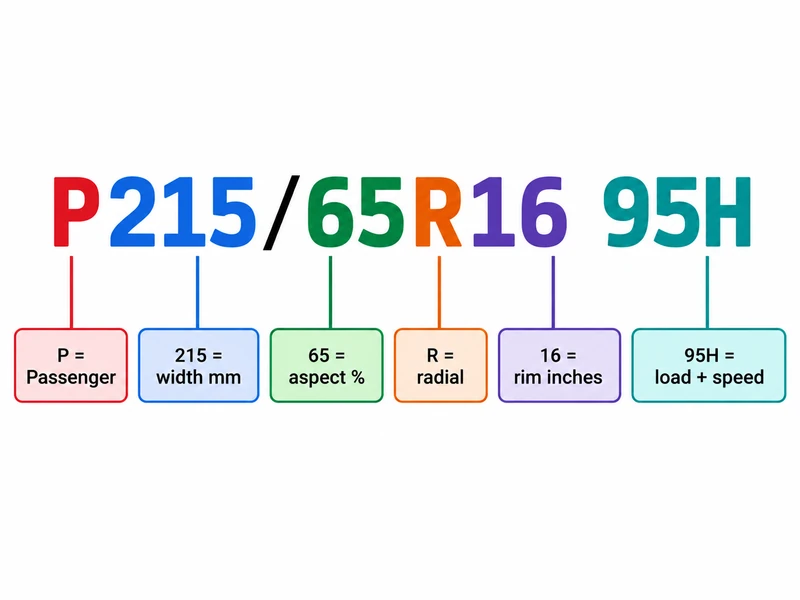
A tire sidewall is the tire's spec sheet. "P215/65R16 95H" means: passenger tire, 215 mm wide, sidewall height 65% of width, radial, fits a 16-inch rim, load index 95, speed rating H. The last 4 digits of the DOT code are the manufacture week and year. Sidewall "max pressure" is a limit, not your target.
The Sidewall Is a Spec Sheet — Here's the Layout
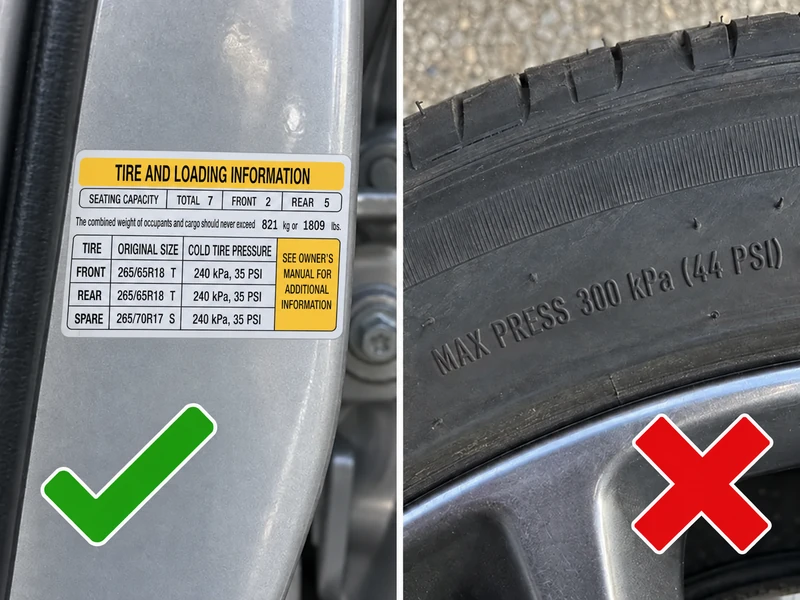
Every sidewall carries the same five groups of information: the size (the big characters), the service description (load + speed, right after the size), the DOT code (with the manufacture date inside it), the maximum load and pressure line, and the UTQG quality grades. Learn the five and no sidewall will ever look like alphabet soup again. The one thing you'll never find there: the pressure your car actually wants — that lives on your door jamb, and the difference matters (more below).
The Size: P215/65R16 Decoded
| Code | What it means |
|---|---|
| P | Service type: Passenger (LT = light truck, ST = trailer, T = temporary spare, no letter = Euro-metric) |
| 215 | Section width in millimeters — sidewall to sidewall at the widest point |
| 65 | Aspect ratio — sidewall height is 65% of the width (215 × 0.65 ≈ 140 mm) |
| R | Radial construction (~99% of modern tires; D/B = bias-ply variants) |
| 16 | Rim diameter in inches — must match the wheel exactly |
| 95H | Service description: load index 95 + speed rating H (next section) |
Two practical notes. The width is in millimeters but the rim diameter is in inches — the size system mixes units and always has. And the aspect ratio is a percentage, not a height: a 215/65 and a 245/65 have different sidewall heights, because 65% of 215 is not 65% of 245. That's why swapping only the width number changes your speedometer reading too.
Load Index & Speed Rating: What "95H" Buys You
The number-letter pair after the size is the service description. The load index (95) is a coded value you look up on a standardized chart — 95 means 1,521 lbs per tire — not a weight written in plain numbers. The speed rating (H) is the maximum sustained speed the tire is tested to handle:
| Letter | Tested max | Typical fitment |
|---|---|---|
| S | 112 mph | Family sedans, minivans |
| T | 118 mph | Sedans, SUVs, crossovers |
| H | 130 mph | Sport sedans, touring |
| V | 149 mph | Performance cars |
| W | 168 mph | Sports cars |
| Y | 186 mph | Supercars |
Two rules that aren't obvious. First, the letters aren't alphabetical: H sits between U and V for historical reasons, so H (130 mph) is faster than S and T, not slower. Second, both ratings are floors set by your vehicle's manufacturer: never install tires with a lower load index or speed rating than the factory spec — the one accepted exception is dedicated winter tires. Going higher is always fine.
The DOT Code: Your Tire's Birthday
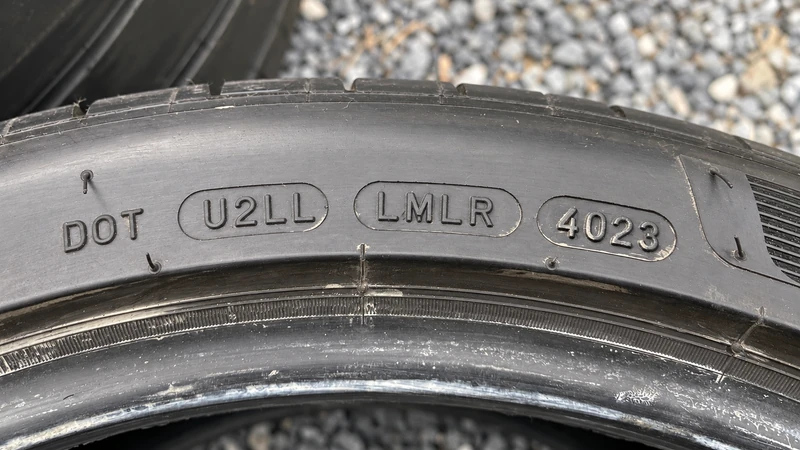
After the letters "DOT" comes the Tire Identification Number: plant, size, and manufacturer codes — and at the end, the 4 digits that matter: week + year of manufacture. "4023" = 40th week of 2023. The full code is often molded on only one sidewall, so check the inner side if you can't find 4 digits. This is the number that decides when a tire is too old (inspection after 5 years, hard replacement at 10) — the full decode, the pre-2000 3-digit trap, and the age rules are in tire date code.
"MAX PRESS 44 PSI" Is a Limit, Not a Target
The sidewall line reading something like "MAX LOAD 615 kg AT 300 kPa (44 PSI) COLD" describes the most the tire can safely hold — it says nothing about what your car wants. Your inflation target comes from the vehicle manufacturer's placard on the driver-side door jamb, and it's usually several PSI lower, because it's tuned to your car's weight, handling, and ride.
Inflate to the sidewall number and you're overinflated: harsher ride, faster center-tread wear, and a smaller contact patch with less grip. Underinflating is worse still — heat buildup is what kills tires. The placard splits the difference. (The full checking routine, or look up your car in the vehicle database.)
What Does PSI Stand For?
PSI = pounds per square inch — the force of one pound pressing on one square inch of area. Tire pressure is just how hard the air inside pushes outward on every square inch of the casing, which is why a few PSI either way changes how the tire carries the car.
You'll meet two other units on import manuals, gauges, and the sidewall's metric line: kPa (kilopascals — 1 PSI = 6.895 kPa, so 35 PSI ≈ 240 kPa) and bar(1 bar ≈ 14.5 PSI, so 35 PSI ≈ 2.4 bar). The sidewall's "MAX LOAD ... AT 300 kPa (44 PSI) COLD" line is the same number in two units — nothing is being doubled.
UTQG: Treadwear, Traction, Temperature
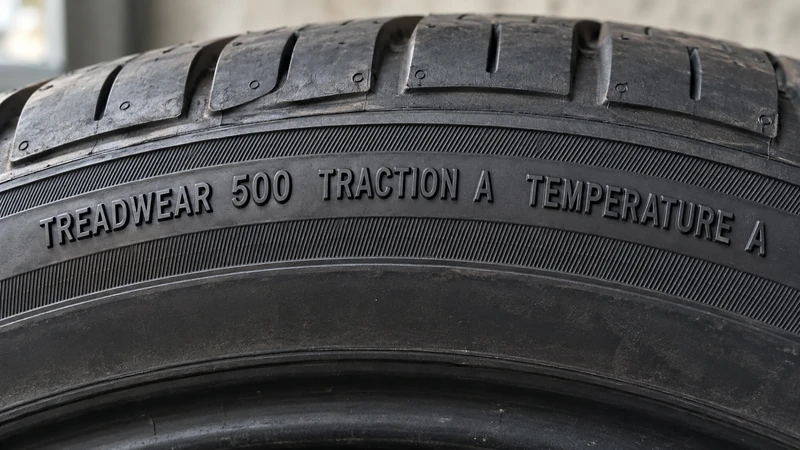
The government-required quality grades appear as something like "TREADWEAR 500 TRACTION A TEMPERATURE A". They're the only standardized comparison shoppers get — with real caveats:
| Grade | What it measures | The catch |
|---|---|---|
| Treadwear (e.g. 500) | Relative wear life vs a reference tire | 800 lasts ~2× a 400 — but brands self-grade, so compare within one brand |
| Traction (AA / A / B / C) | Wet straight-line braking on test surfaces | AA is highest; cornering, hydroplaning, and snow are NOT covered |
| Temperature (A / B / C) | Heat resistance at speed | A = above 115 mph, B = 100–115, C = 85–100 (legal minimum) |
Practical use: set minimums (Traction A, Temperature A for highway driving), then use treadwear to compare longevity within one brand's lineup — manufacturers grade their own tires on the government course, so a 600 from one brand isn't guaranteed to equal a 600 from another. Winter tires, deep-tread light-truck tires, and spares are exempt from UTQG entirely.
The Rest: M+S, the Snowflake, XL, and Arrows
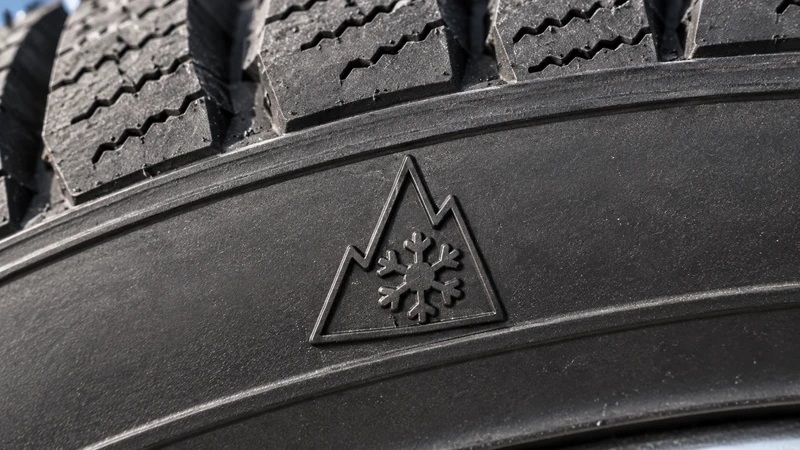
M+S (mud and snow) is a tread-geometry designation with no test behind it; the three-peak mountain snowflake (3PMSF) means the tire passed an actual snow-traction test — that's the mark that matters for winter. XL (Extra Load) and HL (High Load) mark reinforced construction for heavier vehicles — common on SUVs and EVs, and replacements must match. Rotation arrows mean a directional tread that must spin one way; "OUTSIDE" marks an asymmetric tread that must face out. Both are the tire shop's problem — but catching a mistake is easier when you know the marks exist.
Key takeaways
- ✓The sidewall is the tire's spec sheet in 5 groups: size, service description, DOT date code, max load/pressure, UTQG grades.
- ✓P215/65R16 = Passenger, 215 mm wide, 65% aspect ratio, Radial, 16-inch rim. Millimeters and inches mixed — that's normal.
- ✓95H = load index 95 (1,521 lbs) + speed rating H (130 mph). Never go below factory spec; H sits out of alphabetical order.
- ✓DOT's last 4 digits = week + year born. The full code is often on the inner sidewall only.
- ✓Sidewall MAX PRESS is the tire's ceiling — your target PSI is on the door jamb, always lower.
- ✓UTQG: traction A and temperature A as minimums; treadwear only compares within one brand (self-graded).
Frequently Asked Questions
What do the 3 numbers in a tire size mean?
In P215/65R16: 215 is the section width in millimeters, 65 is the aspect ratio (sidewall height = 65% of width), and 16 is the rim diameter in inches. The letter R between them means radial construction, which covers essentially every modern passenger tire.
Is the PSI on the sidewall the pressure I should use?
No — this is the most expensive misunderstanding on the sidewall. The number molded next to 'MAX PRESS' is the tire's maximum safe cold pressure, not your target. Your target is the vehicle manufacturer's number on the driver-side door jamb sticker, which is usually lower. Inflating to the sidewall max leaves you overinflated: harsh ride, center-tread wear, less grip.
Can I use a tire with a higher speed rating than my car came with?
Yes — a higher rating is always safe (it just means the tire was tested to a higher sustained speed). Going lower than factory spec is the problem: manufacturers match the rating to the car's capabilities, and a lower-rated tire can overheat at highway speeds the car considers normal. The one accepted exception is dedicated winter tires, where a lower rating is common practice.
What's the difference between M+S and the snowflake symbol?
M+S (mud and snow) is a designation based on tread pattern geometry — no performance test required. The three-peak mountain snowflake (3PMSF) means the tire actually passed a standardized snow-traction test. For real winter driving, the snowflake is the marking that matters; M+S alone is mostly marketing on modern all-seasons.
What does XL mean on a tire sidewall?
Extra Load — a reinforced version of that size that carries more weight at higher pressure. Many SUVs and EVs are factory-fitted with XL (or the newer HL, 'High Load', developed for heavy electric vehicles). If your car came with XL tires, replacements must be XL too — the load margin is part of the vehicle's design.
Where do I find the correct tire size and pressure for my car?
The driver-side door jamb sticker (or the owner's manual) — it lists the factory tire size, the recommended cold PSI, and the load specifications together. Everything on the tire's sidewall describes the tire; the placard is the vehicle's instruction for which tire to put on it. Look up your specific vehicle in our tire pressure database.
References
- Tire Industry Association — Reading a Tire Sidewall (size format breakdown, service description, TIN date code)
- Michelin — Tire load rating & speed rating explained (coded load index, H = 130 / V = 149 mph, never go below factory spec, XL/HL construction)
- Yokohama — UTQG explained (treadwear 100–1000 relative index, traction AA–C wet braking, temperature A/B/C speed bands)
- Discount Tire — Tire pressure guide (inflate to the door jamb placard, never the sidewall maximum)