
How Does TPMS Work? The Mechanics Behind the Warning Light
Last updated: September 17, 2026 · Reading time: 8 min
TPMS works one of two ways. Direct systems put a battery-powered sensor inside each wheel that measures real pressure and radios it to the car. Indirect systems skip sensors entirely — they use ABS wheel-speed data to spot a low tire by its faster spin. Either way, the light triggers at ~25% below spec.
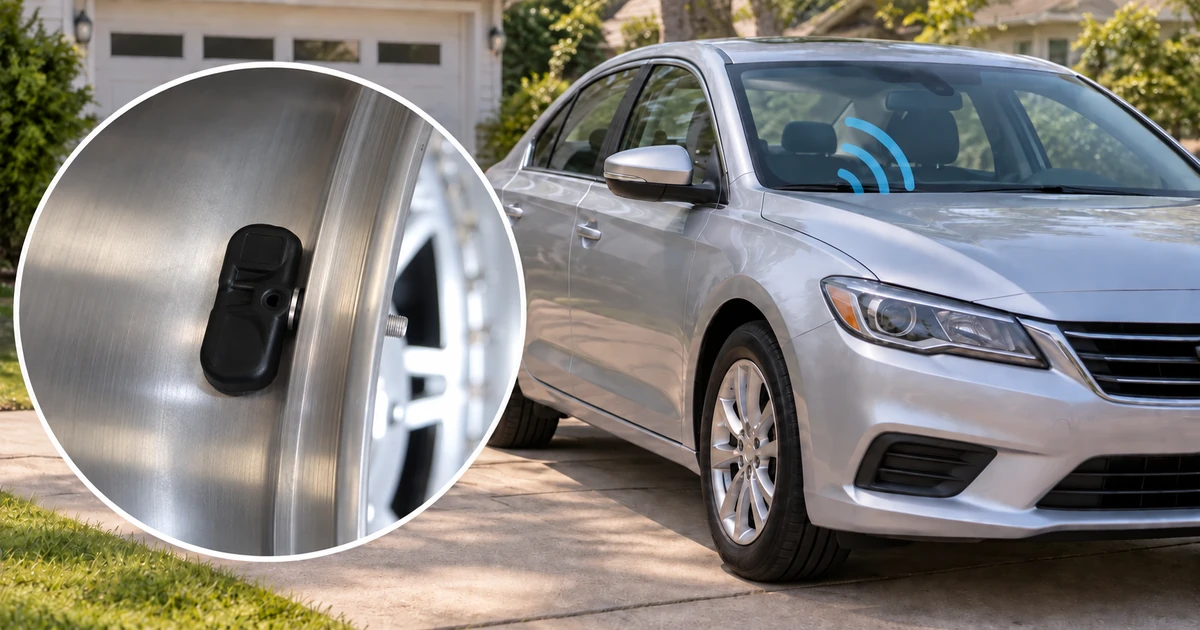
The Big Picture: Sense → Report → Warn
Whatever the flavor, every TPMS is the same three-stage pipeline. Sense: something at each wheel gathers evidence about tire pressure — a real pressure reading (direct) or wheel-spin behavior (indirect). Report: that evidence reaches the car's computer — by radio from inside the tire, or by wire from the ABS sensors. Warn: the computer compares the evidence against the placard spec, and at roughly 25% below target it lights the amber dashboard icon.
(What the acronym stands for and what the light means is covered in what does TPMS mean; sensor hardware, battery life, and failure modes are in the TPMS sensor guide. This article is the machinery in between.)
How Direct TPMS Works: A Radio Station in Every Wheel
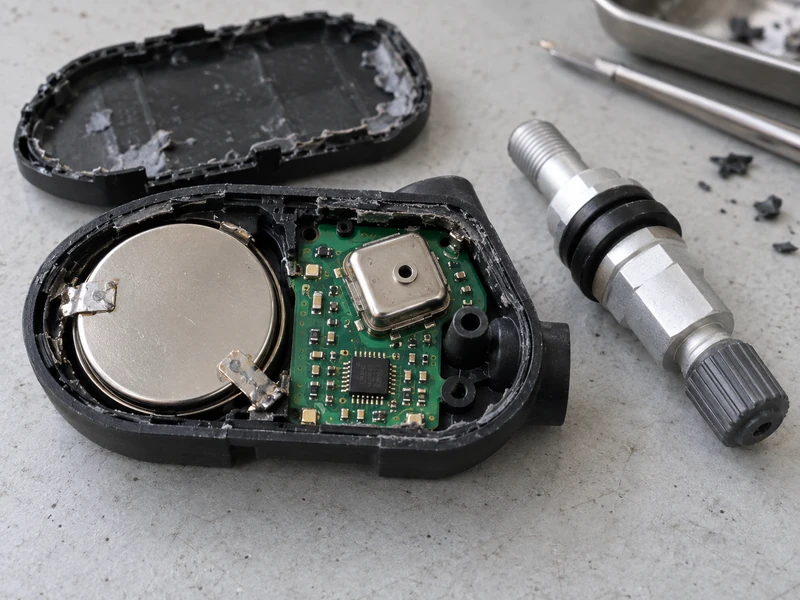
Each direct sensor is a self-contained measurement station strapped inside your wheel. Inside its thumbnail-sized housing: a pressure transducer reading the actual air pressure, a temperature sensor (pressure readings are temperature-compensated), an accelerometer that tells it whether the wheel is spinning, a coin-cell-sized battery, and a small UHF radio transmitter broadcasting at 315 or 433 MHz — the frequency depends on the car, which is why replacement sensors must match.
While you drive, each sensor transmits a packet roughly every 30–60 seconds: its unique ID, the pressure, the temperature, and a battery-status flag. The ID is how the car keeps four identical-looking sensors straight — and why new sensors or a rotation on some cars require a relearn procedure to re-map IDs to wheel positions (the reset-vs-relearn distinction is in the reset guide).
Because the reading is real, direct systems can do the nice things: show per-tire PSI on the dash, catch one slowly leaking tire among healthy ones, and warn at exact thresholds. The cost is literal — four batteries slowly dying inside four wheels.
How Indirect TPMS Works: No Sensors, Just Math
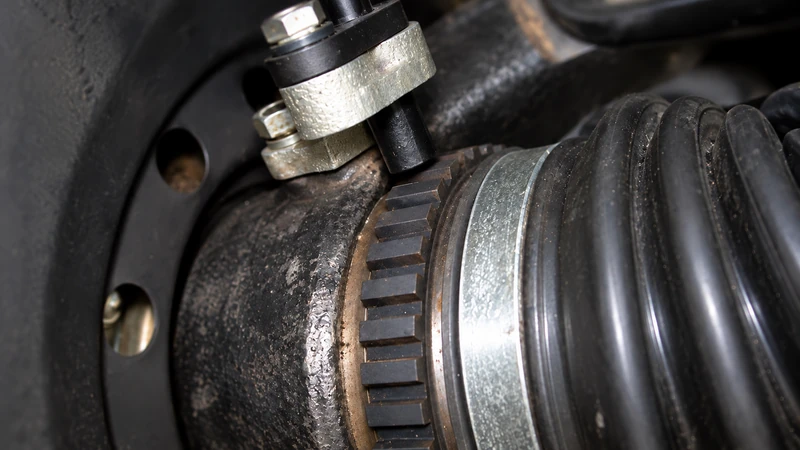
Indirect TPMS adds zero hardware — it reuses the ABS wheel-speed sensors your car already has. The physics it exploits: a tire low on air bulges at the contact patch, which slightly shrinks its effective rolling radius, which means it must spin fractionally faster to cover the same road. A tire 25% low rotates measurably quicker than its properly inflated twins.
The system continuously compares the four wheel speeds — typically looking at diagonally paired and axle-paired differences, filtered over distance to cancel out cornering and wheelspin. When one wheel's spin pattern drifts far enough from the stored baseline, the light comes on. It never knows a single PSI — it only knows relative difference.
That relativity explains the two quirks Honda and VW owners know well: you must recalibrate after any tire work so the baseline reflects today's tires, and the system is blind to all four tires losing air together — if everyone spins faster equally, there's no difference to detect.
From Signal to Dashboard: How the Car Decides
On direct systems, a receiver (often shared with the keyless-entry hardware) picks up the sensor packets and hands them to the TPMS module. The software then does three things: filters the readings so the display doesn't flicker with every bump, compares each wheel against the threshold, and supervises the system itself — if a sensor stops answering or reports impossible data, that's a malfunction, not a low tire.
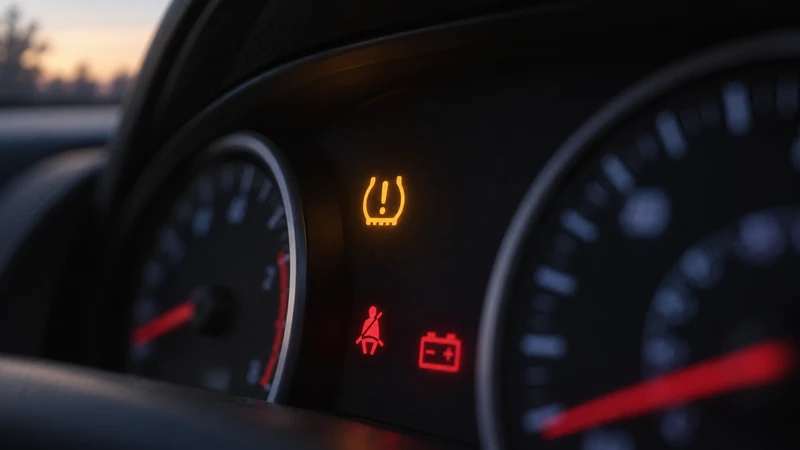
That supervision step is what produces the two light behaviors: pressure problem = steady light; system problem (dead sensor, missing ID, receiver fault) = flashing for 60–90 seconds at startup, then steady. The same icon, two opposite diagnoses — the full decode is in flashing vs steady.
Why the Warning Threshold Is 25%
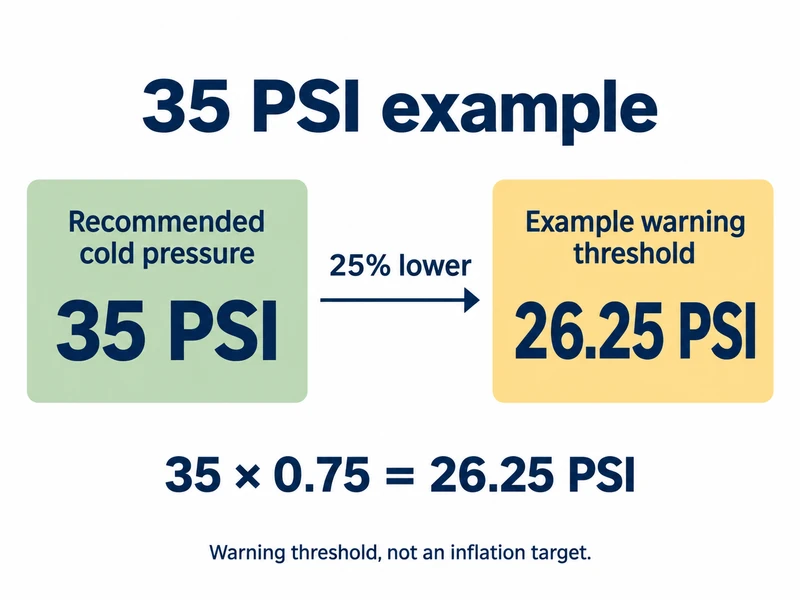
The 25% trigger isn't an engineering optimum — it's the legal floor. FMVSS 138 requires the warning at 25% or more below the placard pressure, a level chosen as the point where underinflation measurably degrades handling and heat margin. Many cars warn earlier (some direct systems flag at 10–15%), but none may warn later.
The practical consequence deserves its own line: a tire can be 10–20% low — wearing faster, braking longer, burning fuel — with the light completely dark. The legal threshold is a catastrophe net, not a maintenance target, which is why monthly manual checks remain the baseline habit even on TPMS cars.
Sleep, Wake, and Why Readings Lag
A direct sensor's battery must survive 5–10 years inside a spinning wheel with no service access — so the sensor spends most of its life asleep. Parked, the accelerometer sees no rotation and the radio goes nearly silent. Rolling, it wakes and broadcasts on its 30–60 second cadence, with an immediate burst if pressure changes fast (that's how it catches a puncture in progress).
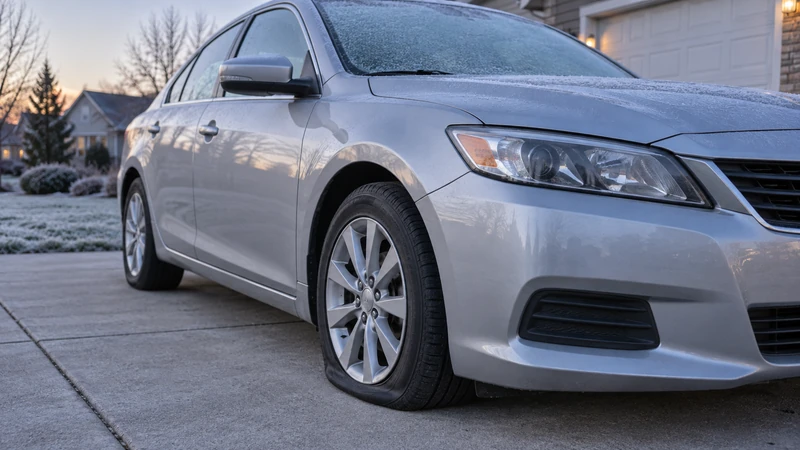
Two everyday symptoms of this design: a tire can go flat in the driveway overnight with no warning until you start driving (the sensors were asleep), and your dash display can lag a gas-station top-up by a few minutes (the next packet hasn't been sent or smoothed yet). Neither is a fault — it's the battery budget showing through. When the battery finally does die, the light tells you a different way: flashing at startup, and the fix is a new sensor (what that costs).
Each Type's Blind Spots
| System | Blind spot | What you see |
|---|---|---|
| Direct | Dead sensor battery (5–10 yr lifespan) silences that wheel | Flashing-then-steady light at startup |
| Direct | Radio interference or a shielded wheel can drop a reading | Temporary dashes on the per-tire display |
| Indirect | All four tires low together — nothing differs to detect | Nothing. The light stays off |
| Indirect | Stale baseline after rotation or pressure change | False warnings until recalibrated |
Neither architecture watches your tires continuously, absolutely, or forever. TPMS is a layered safety net with known holes — and the hole-free layer is still you, a gauge, and the first Saturday of the month.
Key takeaways
- ✓Every TPMS is a 3-stage pipeline: sense (pressure transducer or wheel-speed data) → report (radio or wire) → warn (light at ~25% below spec).
- ✓Direct = a battery radio station in each wheel, broadcasting ID + pressure every 30–60 seconds while driving, asleep while parked.
- ✓Indirect = pure math on ABS wheel speeds: a low tire has a smaller rolling radius and spins faster. No sensors, no PSI numbers, no absolute reference.
- ✓The 25% threshold is the legal floor (FMVSS 138), not a healthy target — a tire 10–20% low stays invisible to the light.
- ✓Known blind spots: direct dies with its sensor batteries; indirect can't catch all-four-low and needs recalibration after tire work.
Frequently Asked Questions
How does TPMS know which tire is which?
Each direct sensor broadcasts a unique ID along with its pressure reading. The car learns which ID sits at which corner through a relearn procedure — automatic while driving on many cars, manual with a TPMS tool on others (mostly Ford/GM). That's why a rotation on those vehicles without a relearn can make the dash show the right pressures at the wrong positions.
How often do TPMS sensors transmit?
While driving, typically every 30–60 seconds per wheel — often with an immediate burst when pressure changes fast. Parked, the motion sensor puts the sensor to sleep and it broadcasts rarely or not at all, which is why sensor batteries survive 5–10 years inside a wheel.
Why does my dashboard pressure lag behind my gauge reading?
Two filters stand between the tire and your screen: the sensor only transmits every 30–60 seconds (and only while moving on many systems), and the car's software smooths the incoming data so the display doesn't flicker. Air up a tire at the gas station and the dash may take minutes of driving to catch up — the gauge is real-time, the TPMS is periodic.
Does TPMS work when the car is parked?
Mostly no, by design. Direct sensors sleep when the wheels stop turning — that's what makes a coin-sized battery last a decade. So a tire can lose air overnight in the driveway and the light won't come on until you've driven far enough for the sensors to wake up and report. This is normal behavior, not a fault.
Can indirect TPMS miss all four tires being low at once?
Yes — that's its classic blind spot. Indirect systems compare wheels against each other: if all four lose pressure equally (a season of gradual permeation, or a cold snap hitting all four together), the relative differences stay small and the light can stay off. Newer indirect systems use finer vibration analysis to catch this, but it's not universal. One more reason for monthly gauge checks.
Does temperature affect how TPMS reads?
Direct sensors measure pressure directly and most also measure temperature, so their readings are honest in any weather — but the physics still applies: pressure drops ~1 PSI per 10°F, so a cold morning legitimately lowers every reading. Indirect systems dodge temperature entirely (they measure wheel spin, not air) but inherit a different weakness: they need recalibration to know what 'normal' is right now.
References
- NHTSA — Tire Safety (TPMS required on new cars since 2008)
- NHTSA — FMVSS No. 138 final rule (warning must trigger at 25% or more below placard pressure, within 20 minutes of driving)
- Tire Review — How TPMS sensors broadcast: unique ID, 315/433 MHz UHF, motion wake and sleep, immediate burst on rapid air loss
- Tomorrow's Technician — TPMS and Radio Waves: how sensor radio transmission works and why frequency must match the vehicle
- AUMOVIO — Tire Information System: measurement and transmission behavior while moving and stationary
- HELLA — Brake discs with wheel bearing and impulse ring: toothed rings and magnetic encoders