
How to Reset Your Tire Pressure Light (Step by Step)
Last updated: September 11, 2026 · Reading time: 8 min
First inflate all tires to the door jamb PSI, cold — a reset teaches the car to treat current pressure as normal. Then, depending on your car: drive 10–20 minutes above 50 mph (auto relearn), hold the TPMS button under the dash until the light blinks, or run TPMS calibration from the settings menu.
Before You Reset: Inflate First (This Is Not Optional)
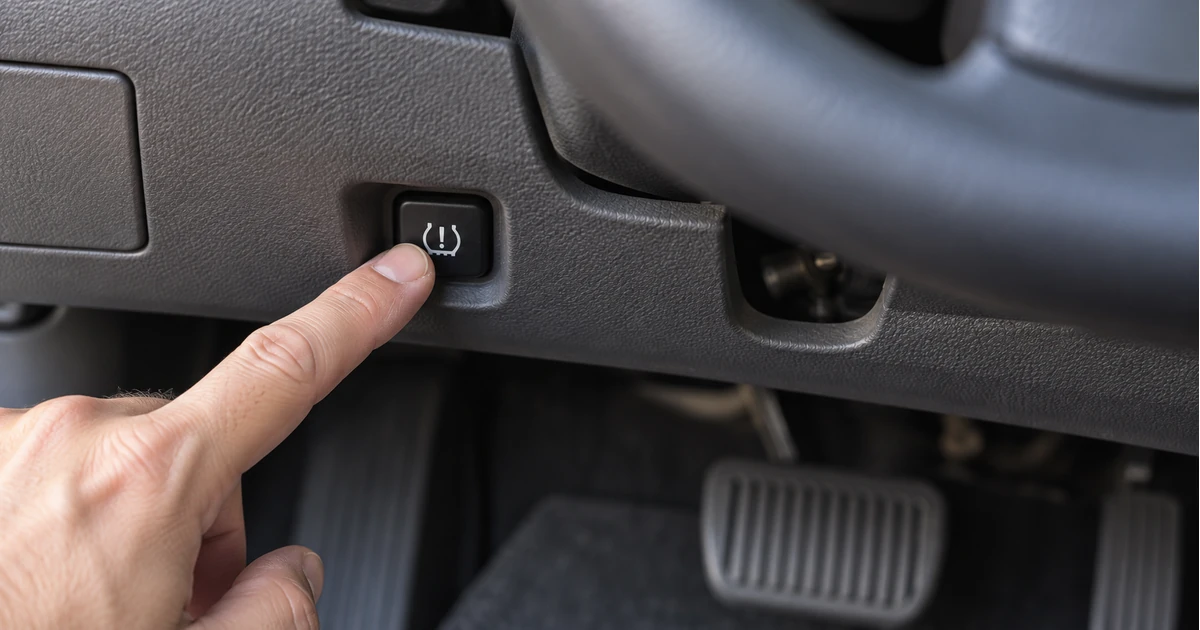
A TPMS reset doesn't measure anything — it tells the car “whatever the tires are right now is the new normal.” Reset with a low tire and you've just taught the car that underinflated is fine; the warning that was supposed to protect you is gone, and the tire is still low.
So the procedure always starts the same way: check all four tires with a gauge, cold (parked 3+ hours), and inflate every one to the number on the driver's door jamb sticker — not the sidewall maximum. The two-minute routine is in our tire pressure check guide. Don't forget the spare on vehicles that monitor it.
Only after every tire reads correct do you move on to the reset itself. Which of the three methods applies depends on one thing: what kind of TPMS your car has.
Know Your System: Direct vs Indirect
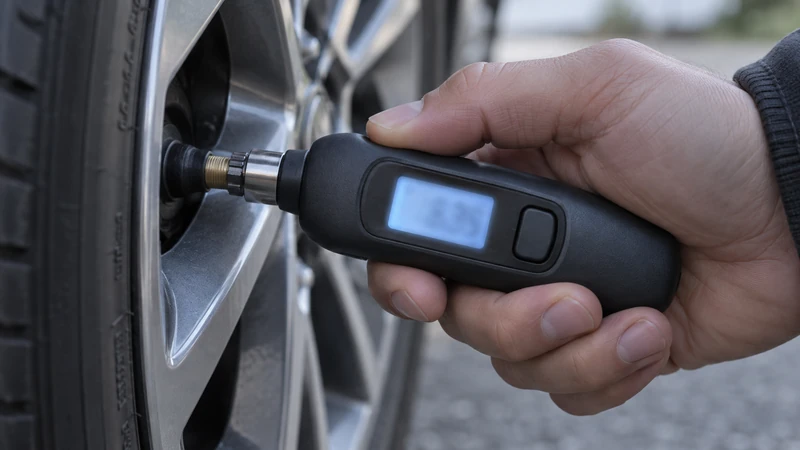
Direct TPMS has a pressure sensor inside each wheel (most Toyota, Ford, GM, Nissan, Hyundai, Tesla, BMW). It measures actual PSI, so it usually just needs you to fix the pressure and drive — the light clears itself. Indirect TPMS has no sensors; it watches wheel-speed data for a tire that's spinning faster because it's low (most Honda, VW, Audi). It knows nothing about PSI, so after every pressure change you must recalibrate it manually, or it will compare against a stale baseline and throw false warnings.
Quick way to tell which you have: if your dashboard or infotainment can show individual PSI per tire, it's direct. If you only ever get a warning light with no numbers, it's likely indirect. Your owner's manual settles it in one page. The hardware differences are covered in the TPMS sensor guide.
Method 1: Drive It Off (Auto Relearn)
The most common method on direct-TPMS cars — and the one people don't believe until it works. After inflating to spec, drive 10–20 minutes at a steady 50 mph or more. The sensors wake up at speed, report fresh readings, and once every wheel is above the threshold, the light turns itself off. No button, no menu, no tools.
This is the only method on Nissan, Hyundai, Kia, and Tesla — those cars have no reset button at all. If the light is still on after 20 minutes of highway driving with verified pressures, the problem isn't procedure; skip to when the light won't turn off.

Method 2: The TPMS Reset Button
The classic Toyota-style procedure, also found on Lexus, older Honda, and some other models:
1. Park, ignition ON, engine off
Key to the ON position (or two presses of the start button without the brake) so the dash lights up but the engine isn't running.
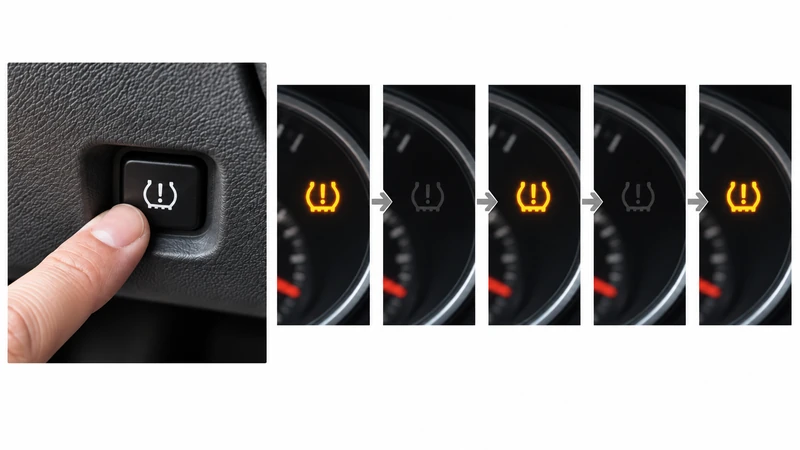
2. Press and hold the TPMS button
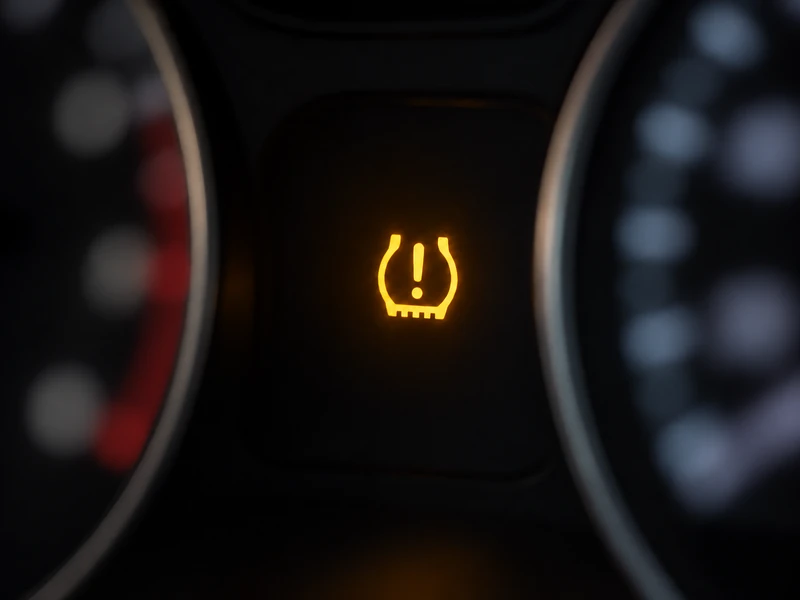
It's usually under the steering column or low on the dash to the left, marked with the tire-cross-section icon. Hold until the TPMS light blinks slowly three times, then release.
3. Drive to finish
The light may stay on for the first few minutes. Drive about 20 minutes at normal road speeds — the system stores the new baseline and the light goes out.
Method 3: Menu Calibration (Indirect Systems)
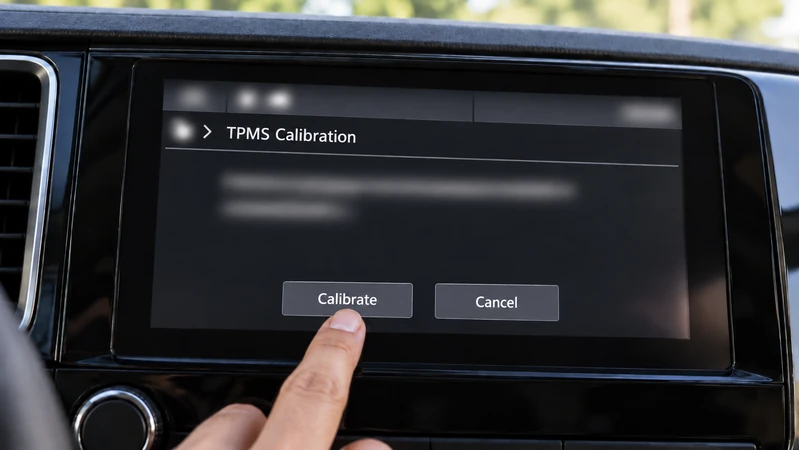
On indirect-TPMS cars the “button” lives in software. The path varies by brand but the logic is identical — you're telling the car to store today's wheel behavior as the healthy reference:
- Honda / Acura — Home → Settings → Vehicle → TPMS Calibration → Calibrate. (Older models: physical button left of the steering column.) Then drive 30–60 minutes; calibration completes in the background. Honda-specific triggers and troubleshooting: TPMS light on a Honda.
- Volkswagen / Audi — Infotainment → Vehicle → Tire pressure (or “Tyres”) → SET / Store. Confirms the current pressures as the reference.
- BMW / Mercedes — iDrive / MBUX → vehicle status → tire pressure → Reset or Confirm, then drive a few minutes.
Because these systems infer rather than measure, recalibrate every time you adjust pressures, rotate tires, or swap wheel sets — skip it and the next warning could be a false alarm or, worse, a missed real one.
Brand-by-Brand Cheat Sheet
The 60-second version for the most common brands. Procedures shift between generations — treat your owner's manual as the final word for your exact model.
| Brand | System | How to reset |
|---|---|---|
| Toyota / Lexus | Direct | Ignition ON, hold the TPMS button under the steering column until the light blinks 3 times, then drive ~20 min |
| Honda / Acura | Indirect (most models) | Vehicle Settings → TPMS Calibration → Calibrate (or button left of dash), then drive 30–60 min to complete |
| Ford / Lincoln | Direct | Inflate to spec and drive — most auto-clear; after rotation some models need a train sequence or TPMS tool |
| Chevrolet / GM | Direct | Newer models auto-learn while driving; older ones use the DIC menu → tire pressure → relearn |
| Nissan / Infiniti | Direct | No button — inflate to spec, drive above 25 mph; the light clears itself |
| Hyundai / Kia | Direct | No button — inflate to spec, drive 10–20 min at 50+ mph |
| Volkswagen / Audi | Indirect (most newer) | Infotainment → Vehicle → Tire pressure → SET/Store to save current pressure as the reference |
| BMW / Mercedes | Direct with menu | iDrive / MBUX → tire pressure menu → Reset or Confirm, then drive to finish |
| Tesla | Direct | Fully automatic — inflate to spec and drive; the car learns new sensors on its own |
After a Tire Rotation or New Sensors: Reset vs Relearn
Two procedures get confused here. A reset (what this article covers) re-baselines pressure — any driver can do it after inflating. A relearn registers each sensor's ID and position with the car — needed after new sensors, and on some Ford and GM models after a rotation, so the car knows which wheel is which.
Many cars auto-relearn while driving; some need a TPMS tool at each wheel, which is why shops sometimes charge a small fee for it (it's negotiable — details in the TPMS replacement cost guide). If your light appeared right after tire work, suspect a missed relearn before you suspect a dead sensor — the diagnostic split is in the flashing TPMS light guide.
When the Light Won't Turn Off
You inflated, you reset, you drove — and the light persists. Work down this list:
- Recheck with a real gauge, cold. Gas station gauges are notoriously off; a tire at 28 PSI when the sticker says 35 will keep the light on forever.
- Check the spare. Many trucks and SUVs monitor the spare — a flat spare keeps the light on no matter what you do to the four on the ground.
- Look for a slow leak. If one tire drops a few PSI every week, that's a nail or a valve stem issue, not a TPMS issue — see why tire pressure keeps dropping.
- Watch for flashing. A light that blinks for 60–90 seconds at startup, then stays solid, is a system malfunction — usually a dead sensor battery — and no reset will clear it. That road leads to flashing-light diagnosis.
The point worth repeating: the light is a messenger. When resets stop working, the car is telling you the problem is physical — air or hardware, not software.
Key takeaways
- ✓Never reset with low tires — a reset tells the car to treat current pressure as normal. Inflate to the door jamb spec, cold, first.
- ✓Three methods: drive 10–20 min at 50+ mph (auto relearn), hold the TPMS button until the light blinks 3 times, or run TPMS calibration from the settings menu.
- ✓Direct systems (most Toyota/Ford/GM/Hyundai) usually self-clear after driving. Indirect systems (most Honda/VW) must be recalibrated after every pressure change.
- ✓Reset ≠ relearn: reset re-baselines pressure (driver job); relearn registers sensor IDs after new sensors or some rotations (sometimes needs a shop tool).
- ✓A light that survives a correct reset means a real problem — slow leak, monitored spare, or a dead sensor (flashing light). The reset didn't fail; the diagnosis isn't done.
Frequently Asked Questions
Where is the TPMS reset button?
On cars that have one (Toyota, Lexus, older Honda, some Nissan and GM models), it's usually a small button under the steering column, on the lower dash to the left of the wheel, or inside the glove box — marked with the tire-cross-section TPMS icon. Many cars have no button at all: they reset through a settings menu (Honda, VW, BMW, Mercedes) or simply by driving (Tesla, Hyundai, Kia, most newer GM and Ford).
How long does it take for the tire pressure light to go off?
It depends on the method. A button press or menu calibration clears the light almost immediately, though indirect systems may need 20–60 minutes of driving to finish calibrating in the background. An auto-relearn system clears after 10–20 minutes of steady driving above roughly 50 mph. If the light is still on after a day of normal driving with correctly inflated tires, something else is wrong.
Why did the light come back on after I reset it?
Four usual reasons: a tire is still below the door jamb spec (recheck with a gauge, cold), you have a slow leak (one tire keeps dropping — see our guide to tires that keep losing pressure), a cold snap dropped every tire a few PSI overnight, or a sensor is failing (which produces a flashing light, not a steady one). A reset never fixes the underlying cause — it only re-baselines a healthy system.
Do I need to reset the TPMS every time I add air?
Indirect systems (most Honda, VW, Audi): yes — recalibrate after any pressure change so the car learns the new baseline, or you'll get false warnings. Direct systems (most Toyota, Ford, GM, Hyundai): usually no — once the tire is back above the threshold, the light clears itself after a few minutes of driving. When in doubt, a reset never hurts as long as pressures are correct first.
Will disconnecting the battery reset the TPMS light?
No — and it's not worth trying. The TPMS light isn't stored as a simple fault code; the system re-runs its self-check at every startup and will re-detect the same low tire or dead sensor within minutes. Disconnecting the battery also wipes your radio presets, clock, and learned engine adaptations for nothing. Fix the pressure (or the sensor), then reset properly.
What's the difference between a TPMS reset and a relearn?
A reset (or calibration) tells the car 'treat the current pressure as correct' — that's the driver-level procedure in this article, done after inflating tires. A relearn registers sensor IDs with the car's computer — that's needed after replacing sensors, and on some Ford and GM models after a tire rotation. Relearns on those vehicles need a TPMS tool, which is why shops may charge a small fee for it.
References
Brand reset procedures in this article reflect common factory procedures; your owner's manual is the authoritative source for your exact model and year.