
Why Your Toyota's Tire Pressure Light Is Blinking (and When It's Actually Normal)
Last updated: October 23, 2026 · Reading time: 8 min
On a Toyota, a blinking TPMS light means the monitoring system itself has a fault — not low tire pressure. Usually it's a dead sensor battery, an unregistered sensor ID after tire work, or a low spare that's also monitored. Check pressures with a gauge anyway, but don't hit reset while it blinks.
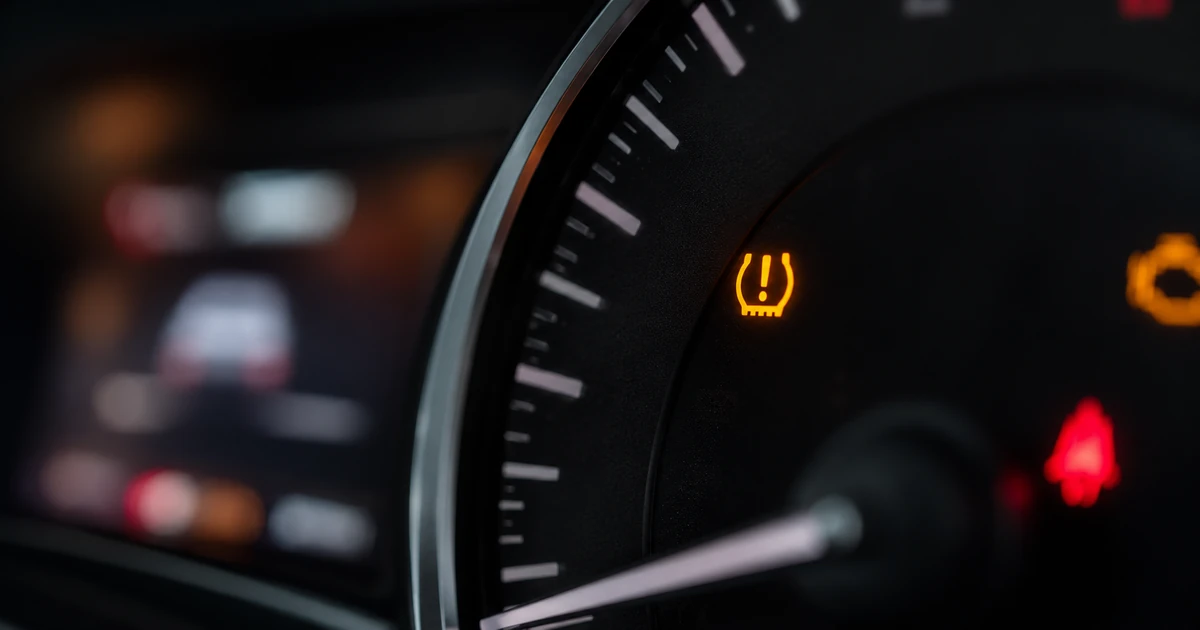
First: Read the Light's Pattern
Toyota uses one icon for four different messages. Before touching anything, watch what the light actually does at startup:
| Light behavior | Meaning | What to do |
|---|---|---|
| Solid light, no blinking | One or more tires below threshold | Check all tires cold with a gauge, inflate to door-jamb PSI, drive a few minutes |
| Blinks 60–90s at startup, then solid | System malfunction — ECU can't reach a sensor (a tire may also be low) | Gauge-check all tires + spare, then diagnose the sensor fault |
| Blinks slowly 3× after you hold a button | Reset/registration acknowledged — normal | Nothing; drive to complete the procedure |
| Blinks ~1 min during 'Change Wheel' setup, then solid with '--' | Registration in progress — normal on newer models | Drive 25+ mph for 10–30 min to finish |
The one that brings people here is row two: blinks for about a minute every startup, then stays solid. That's Toyota's malfunction pattern — the ECU ran its startup check and couldn't talk to at least one wheel sensor. A tire may also be low, which is why the first move is still a gauge check. (The generic flashing-light playbook — all brands, not just Toyota — is in TPMS light flashing; this article is the Toyota-specific layer.)
Can I Drive With It Blinking?
Yes, with one condition: verify the actual pressures with a handheld gauge first — all four tires, cold, against the door-jamb sticker (your model's number is in the Toyota tire pressure database). Blinking means the monitor is down, not that a tire is flat — the car drives fine. But you've lost your early-warning system: if a tire starts losing air tomorrow, nothing will tell you. Gauge-check, drive normally, and get the fault diagnosed within days. If any tire reads visibly low or the tire looks soft, treat that as the real problem and handle it first (how to add air).
The 4 Toyota-Specific Causes
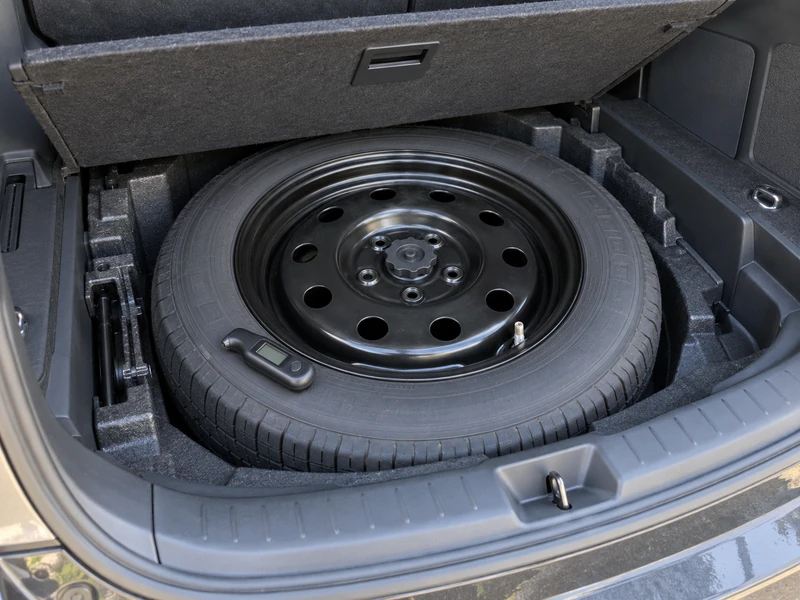
- The spare tire trap. On the RAV4, Highlander, 4Runner, and Tacoma, the spare carries a monitored sensor too. All four road tires can be perfect while the flat spare in the trunk keeps the light on. It's the single most-missed cause — check the spare before suspecting anything else.
- Unregistered sensor ID. After new sensors, a tire swap, or rotation on some models, the ECU doesn't know the new hardware's 7-digit ID codes. The sensor works; the car just doesn't recognize it. This is so common after tire work that it gets its own section below.
- Dead sensor battery. Each sensor runs on a sealed lithium battery rated about 5–10 years — it can't be recharged or swapped, so a dead battery means a new sensor. Cold snaps push aging batteries over the edge, which is why these faults cluster in the fall.
- Radio interference. Cheap USB chargers, aftermarket LED kits, and dash cams can jam the 315/433 MHz sensor signal. If the light started blinking right after you plugged something new in, unplug it and drive for a day before spending anything.
The 10-Minute Troubleshooting Order
- Gauge all four tires, cold — fix any real low pressure first so you're chasing one problem, not two.
- Check the spare (RAV4, Highlander, 4Runner, Tacoma) — it's monitored and it's the most-missed cause.
- Unplug anything new — USB chargers, LED kits, dash cams. Drive a day. Interference costs $0 to rule out.
- Recall recent tire work. New sensors, rotation, or a swap in the last weeks → it's registration (next sections), not hardware.
- Still blinking → scan it. A shop's TPMS tool reads codes C2121–C2126 and names the dead wheel. That's the diagnosis — and the end of guessing.
Don't Reset While It's Blinking
The internet's default advice — "just reset the TPMS" — backfires on a blinking Toyota. The reset procedure tells the ECU to learn a new pressure baseline; running it while the system is in a fault state can leave the whole system stuck, and the normal button dance won't recover it.
If it's already stuck, the shop-level recovery is: fix the underlying fault first, then connect a battery charger, jumper OBD-II pins 13 and 4, and leave the key on for at least 30 minutes. When a reset is appropriate (solid light after inflating), hold the TPMS button under the steering column until the light blinks three times, then drive — the full procedure is in how to reset the tire pressure light.
Sensor ID Registration (the Post-Tire-Work Fix)
Toyota's direct TPMS pairs each wheel's sensor to the ECU by a 7-digit ID code. Bolt on a new sensor and the light stays on until that ID is registered — installation alone does nothing. Two routes:
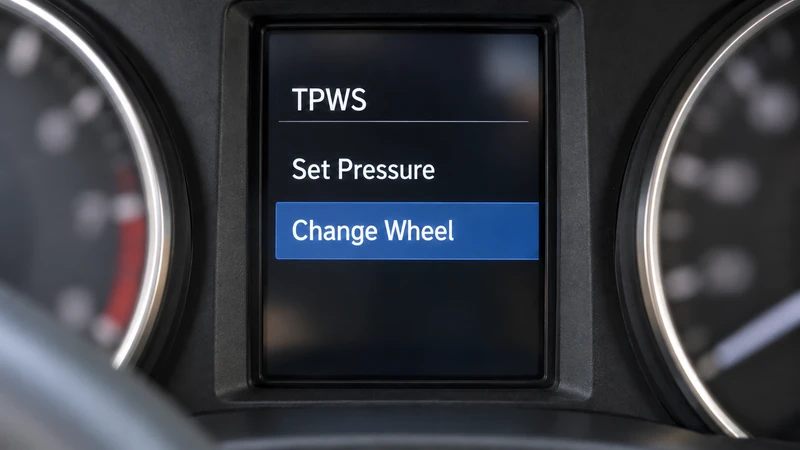
Newer models (2024+ Tacoma and similar): dashboard self-registration. Park ~20 minutes with tires correctly inflated, then Settings → Vehicle Settings → TPWS → "Change Wheel" and hold Enter. The light blinks slowly 3 times, blinks about a minute, then goes solid showing "--" per tire — that's normal, registration is running. Drive 25+ mph for 10–30 minutes and the pressures appear. Two gotchas straight from the owner's manual: reversing mid-procedure wipes the progress, and driving near other vehicles can interfere. Afterward, run the separate initialization step.
Older models: a scan tool does it. Pre-2020s Toyotas generally need a TPMS registration tool or Toyota's Techstream to write IDs into the ECU — a tire shop does this in minutes, free to ~$20. One more distinction that saves money: aftermarket "blank" sensors must be programmed (vehicle protocol written in) before they can be registered; OEM Toyota sensors arrive pre-programmed. If a shop quotes registration failure on aftermarket sensors, that's usually the missing step.
What the Fix Costs
| Job | Cost | Note |
|---|---|---|
| Re-registration / reset at a tire shop | Free–$20 | If sensors are fine, just unregistered |
| One sensor — aftermarket part | $25–$50 | Plus $50–$150 labor per wheel |
| One sensor — OEM Toyota part | $75–$90 | Plus labor; pre-programmed for Toyota |
| Full set of four (8+ year-old car) | $300–$600 | Batteries die together — often the smart move |
Diagnose before buying parts: a shop with a TPMS tool reads codes C2121–C2126, which name the exact wheel whose sensor stopped answering — no guessing, no replacing all four when one died. On a car past the 8-year mark the calculus changes: the batteries were all installed the same day, so when one dies the rest are months behind it, and a full set ($300–$600) beats four separate labor charges. Broader price context (all brands, OEM vs aftermarket, relearn fees) is in TPMS sensor replacement cost.
Key takeaways
- ✓Blinking = system fault, solid = low pressure. Blink 60–90s then solid means the ECU lost contact with a sensor.
- ✓Check the spare: RAV4, Highlander, 4Runner and Tacoma monitor a fifth sensor in the spare tire.
- ✓Never reset while the light blinks — it can stick the system; recovery needs OBD pins 13+4 jumpered for 30 minutes.
- ✓After tire work, the fix is usually sensor ID registration — new sensors do nothing until their 7-digit ID is in the ECU.
- ✓Sensor batteries last 5–10 years and die together; past 8 years, a $300–$600 full set often beats one-at-a-time repairs.
Frequently Asked Questions
Why is my Toyota tire pressure light blinking but the tires are fine?
Because blinking isn't about tire pressure — it's the system reporting a fault in itself. The usual suspects on a Toyota: a dead sensor battery (sealed, 5–10 year life), a sensor whose 7-digit ID was never registered after tire work, a monitored spare tire that's low (RAV4, Highlander, 4Runner, Tacoma), or radio interference from cheap USB chargers and aftermarket electronics.
Why does the light blink for a minute and then stay solid?
That's Toyota's malfunction pattern: roughly 60–90 seconds of blinking at startup, then solid. It means the ECU failed its startup check — it can't communicate with at least one wheel sensor — and a tire may also be below the pressure threshold. Fix the communication fault first; the light behavior tells you it's not just an inflation problem.
Can I drive my Toyota with the TPMS light blinking?
Short distances, yes — the car drives normally because blinking means the monitoring system is down, not that a tire is flat. But you've lost your early-warning system: the car can no longer alert you to a real pressure loss. Verify all four tires (and the spare, if monitored) with a handheld gauge, then get the fault diagnosed within days, not months.
Should I reset the TPMS when the light is blinking?
No — this is the Toyota-specific trap. Running the reset/initialization while the light blinks can leave the system stuck in a fault state. Repair the underlying problem first (sensor, ID registration, spare pressure), then reset. If it's already stuck, the known fix is a battery charger connected, OBD-II pins 13 and 4 jumpered, key on for 30+ minutes.
Why is the light blinking right after a tire change or rotation?
Almost always an unregistered sensor ID. Installing a new sensor doesn't clear the light — its 7-digit ID must be registered to the ECU. Newer Toyotas (2024+ Tacoma and similar) have a dashboard self-registration procedure; older models need a TPMS scan tool or Toyota Techstream at a shop. Ask whoever did the tire work whether IDs were registered — many shops skip it.
How much does it cost to fix a blinking TPMS light on a Toyota?
Depends on the cause: a re-registration or reset is free to ~$20 at a tire shop; one aftermarket sensor runs $25–$50 for the part ($75–$90 OEM) plus $50–$150 labor per wheel; a full set of four on an 8+ year-old car runs $300–$600. Diagnosis first — a shop with a TPMS tool can read codes C2121–C2126 to identify exactly which wheel's sensor failed.
References
- Haynes — Why is your Toyota tire pressure light blinking? (blinking = system fault; battery 5–10 yr; interference, rotation, module causes)
- Soloco Auto & Tire — Toyota tire pressure light blinking diagnostic guide (blink-then-solid pattern, spare-sensor trap, 7-digit ID, DTC C2121–C2126, repair costs)
- Art's Automotive — Tire pressure light (Toyota/Lexus): don't reset while blinking; OBD pins 13+4 unstick procedure; spare sensor
- 4th Gen Tacoma Forum — 2024 Tacoma TPMS sensor ID registration (owner's manual pp. 537–543: menu paths, blink patterns, 25 mph × 10–30 min, reversing resets progress)