Tire Speed Rating Chart: What the Letters Actually Mean
Last updated: November 8, 2026 · Reading time: 8 min
A tire's speed rating is the letter after its load index: in 95H, H means 130 mph (210 km/h) under specified test conditions. Use the chart below to decode the letter. It is not a recommended driving speed—match the vehicle manufacturer's replacement specification.
Tire Speed Rating Chart (mph & km/h)
Find the final letter of the service description, then read its rated speed. The sequence is not completely alphabetical: H sits between U and V, while W and Y extend the high-speed range.
| Speed symbol | mph | km/h |
|---|---|---|
| A1 | 3 | 5 |
| A2 | 6 | 10 |
| A3 | 9 | 15 |
| A4 | 12 | 20 |
| A5 | 16 | 25 |
| A6 | 19 | 30 |
| A7 | 22 | 35 |
| A8 | 25 | 40 |
| B | 31 | 50 |
| C | 37 | 60 |
| D | 40 | 65 |
| E | 43 | 70 |
| F | 50 | 80 |
| G | 56 | 90 |
| J | 62 | 100 |
| K | 68 | 110 |
| L | 75 | 120 |
| M | 81 | 130 |
| N | 87 | 140 |
| P | 93 | 150 |
| Q | 99 | 160 |
| R | 106 | 170 |
| S | 112 | 180 |
| T | 118 | 190 |
| U | 124 | 200 |
| H | 130 | 210 |
| V | 149 | 240 |
| Z | 149+ | 240+ |
| W | 168 | 270 |
| Y | 186 | 300 |
| (Y) | 186+ | 300+ |
These are standardized rating equivalents, not exact unit conversions. Z and (Y) are open-ended categories; read the ZR section below before interpreting a high-speed size.
Where to Find the Speed Rating on a Tire
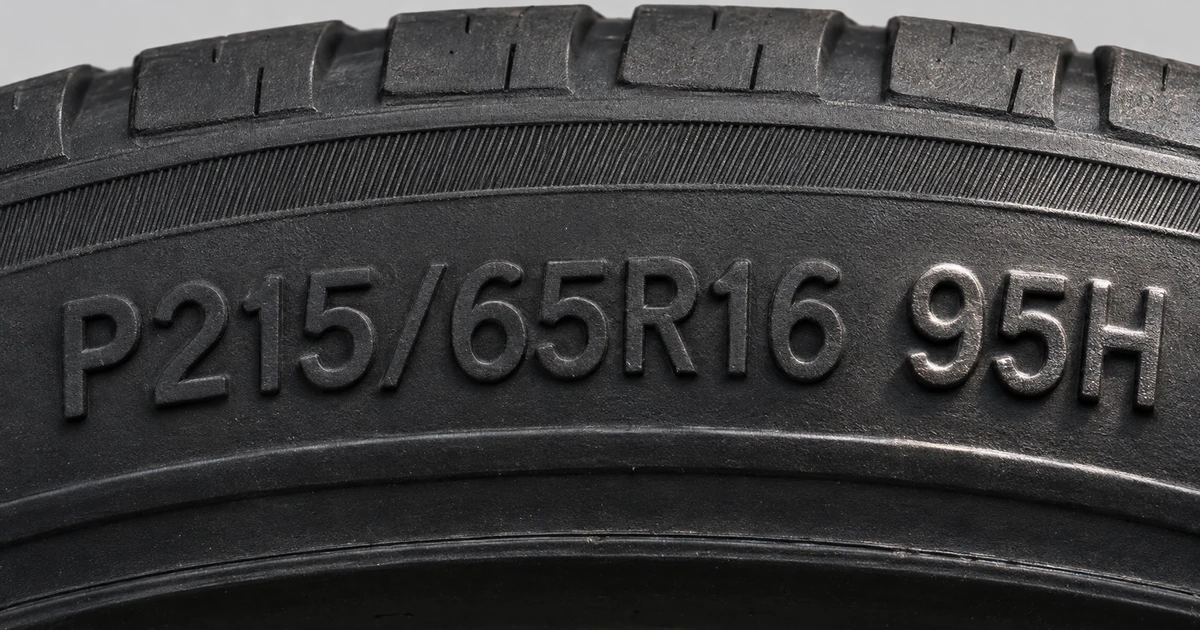
Look at the end of the size and service description molded into the sidewall. In P215/65R16 95H, the first R means radial construction, 95 is the load index, and H is the speed rating.
The current sidewall describes the installed tire, not necessarily the vehicle's original specification. For a replacement, also check the owner's manual and vehicle manufacturer's requirements. For the rest of the size code, see how to read tire size and sidewall markings.
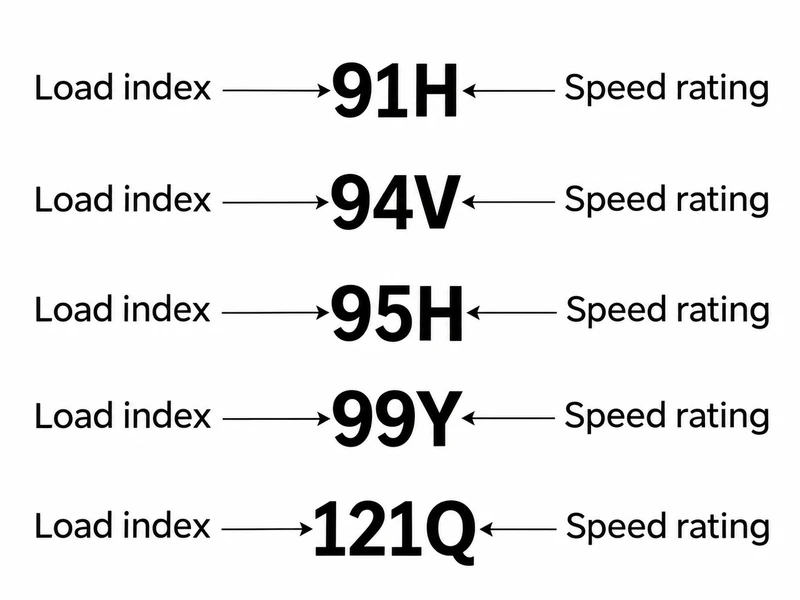
What Do 91H, 94V, 95H, 99Y and 121Q Mean?
These codes combine two independent ratings. The number is a coded load index; the final letter is the speed rating. Do not read 91H as "91 mph" or assume the number is a weight in pounds.
| Code | Load index | Speed rating |
|---|---|---|
| 91H | 91 = 1,356 lb per tire | H = 130 mph / 210 km/h |
| 94V | 94 = 1,477 lb per tire | V = 149 mph / 240 km/h |
| 95H | 95 = 1,521 lb per tire | H = 130 mph / 210 km/h |
| 99Y | 99 = 1,709 lb per tire | Y = 186 mph / 300 km/h |
| 121Q | 121 = 3,197 lb per tire | Q = 99 mph / 160 km/h |
The load figures are maximum per-tire capacities under specified conditions—not vehicle payload, axle-weight limits or recommended PSI. Look up other values in the tire load index chart. A code such as 121Q is common in higher-load applications, but the full size and the vehicle or trailer manufacturer's specification still decide fitment.
What Does ZR Mean on a Tire?
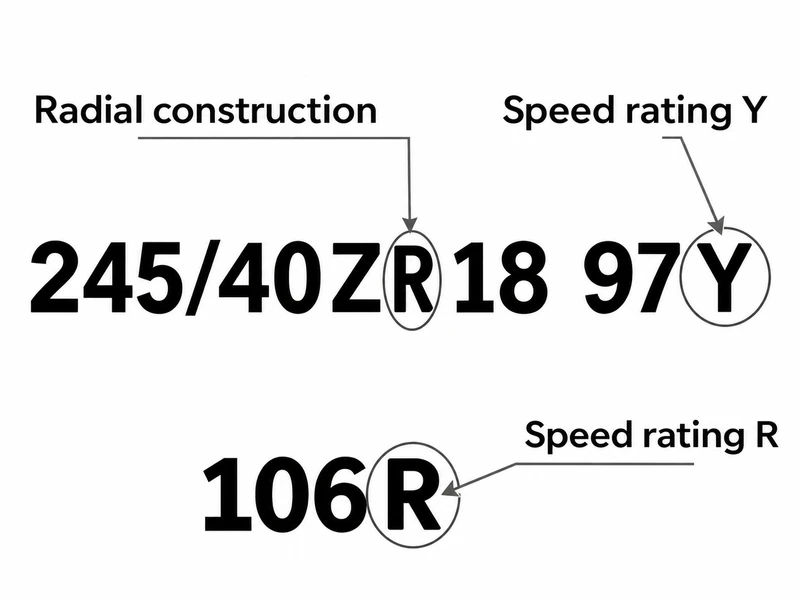
ZR is a high-speed designation in the size, not a precise stand-alone speed limit. It may appear on tires with capability above 149 mph (240 km/h). Above 186 mph (300 km/h), ZR is used with a bracketed Y service description.
In a size such as 245/40ZR18 97Y, ZR identifies the high-speed radial construction, while Y = 186 mph is the actual speed symbol. For capability above Y, a service description such as (91Y) uses parentheses to denote the (Y) category.
The R inside ZR still means radial. It is separate from an R appearing as the final speed symbol in a code such as 106R, where that final R corresponds to 106 mph (170 km/h).
H vs V Speed Rating: Is a Higher Letter Better?
V is the higher rating: 149 mph versus 130 mph for H. But "higher" does not mean "better for every car." Higher-speed designs often emphasize steering response, grip and heat resistance; depending on the model, that can come with tradeoffs in tread life or ride.
Do not choose between H and V on speed alone. Start with the vehicle manufacturer's requirement, then compare the specific tires' wet performance, treadwear warranty, noise, ride and price. A V-rated model is not guaranteed to stop shorter or last less than every H-rated model.
What Speed Rating Do Replacement Tires Need?
Follow the vehicle manufacturer's specification. Michelin says an equal or greater speed rating than original equipment can be used; fitting a lower rating is discouraged and may change the vehicle's speed limitation or handling. Check the owner's manual for any restrictions before making a change.
A matching speed letter alone does not prove fitment. Size, load index, load capacity, tire type and the vehicle's other requirements must also match. Avoid mixing speed ratings; if a mixed set already exists, the lowest-rated tire limits the set and a tire professional should assess it against the vehicle manufacturer's guidance.
What the Speed Rating Does Not Tell You
- It is not a safe or legal driving speed. Weather, traffic, road condition and speed laws still govern real driving.
- It is not a guarantee for a damaged or neglected tire.Age, wear, repairs, underinflation and overloading can reduce capability.
- It does not set recommended PSI. Use the vehicle's door-placard cold pressure or the applicable manufacturer load-inflation guidance, not the speed letter.
- It does not prove fitment. The complete size, load specification and vehicle or trailer requirements still matter.
For the pressure side of the sidewall code, use how to check tire pressure or find your vehicle's recommended PSI.
Key takeaways
- ✓The speed rating is the final letter after the load index: 95H = load index 95 + speed rating H.
- ✓H = 130 mph / 210 km/h; V = 149 / 240; W = 168 / 270; Y = 186 / 300 under specified test conditions.
- ✓H sits between U and V—the speed-rating sequence is not completely alphabetical.
- ✓ZR is a high-speed radial designation, not an exact maximum speed; use the W, Y or (Y) service description for the specific rating.
- ✓A higher rating is not automatically better; follow the vehicle manufacturer's replacement specification and compare complete tire models.
- ✓Speed rating is not a driving recommendation, vehicle payload, proof of fitment or recommended PSI.
Frequently Asked Questions
What does an H speed rating mean?
H corresponds to 130 mph (210 km/h) under the rating's specified test conditions. It appears after the load index in a service description such as 91H or 95H. H is not a recommended driving speed, and it sits between U and V in the speed-rating sequence rather than following G alphabetically.
Is a V-rated tire better than an H-rated tire?
V has the higher laboratory speed rating: 149 mph versus 130 mph for H. That does not make V automatically better for your vehicle. Higher-rated tires often emphasize handling and grip, but tread life and ride comfort vary by model. Match the vehicle manufacturer's specification and compare the complete tire, not just its speed letter.
Does speed rating matter if I never drive fast?
Yes, because it is part of the replacement-tire specification and reflects high-speed heat capability under test conditions. But you do not need to buy the highest letter available. Follow the vehicle manufacturer's requirement, then choose among suitable tires by the qualities you actually need.
Can I replace H-rated tires with V-rated tires?
Michelin says replacement tires can have an equal or greater speed rating than the original equipment, but the size, load capacity and other specifications must also be suitable. Check the owner's manual or vehicle manufacturer before changing ratings; do not treat a higher speed letter as permission to ignore the rest of the fitment.
What does ZR mean on a tire?
ZR is a high-speed designation used in the size for tires with capability above 149 mph (240 km/h); the R still means radial construction. It is not a precise stand-alone maximum speed. Look for the service description—such as 91W, 91Y or (91Y)—to identify the actual W, Y or (Y) rating.
Is speed rating the same as load index?
No. In 95H, 95 is the load index and H is the speed rating. The load index is a numerical code for maximum load capacity per tire under specified conditions; the speed letter denotes high-speed capability. Neither number-letter pair tells you the vehicle's recommended cold PSI.
Can I mix tires with different speed ratings?
Avoid mixing ratings when possible because the tires can differ in grip and handling, and the lowest-rated tire limits the set. Follow the vehicle and tire manufacturers' guidance and consult a tire professional if a mixed set is unavoidable; the replacement must still meet the vehicle's requirements.
References
- Michelin — Changing Tire Size or Specifications (speed chart, H's non-alphabetical position, and replacement-rating guidance)
- Pirelli — Tire Speed Rating (service-description location, controlled-test basis, safety and tire-condition limitations)
- Continental — Speed Index (speed-symbol locations and standard mph/km/h equivalents)
- Les Schwab — Tire Speed Rating and Why It Matters (full rating sequence, ZR designation and real-world limitations)
- Pirelli — Tire Load Index & Chart (load-index capacities for 91, 94, 95, 99 and 121)
Related Guides
- → How to Read Tire Size: Sidewall Numbers & Letters
- → Tire Load Index Chart: lbs, kg & Load Range Explained
- → Tire Date Code: How to Read It & When Tires Are Too Old
- → Tire Treadwear Rating: What the Number Actually Means
- → How to Check Tire Pressure: Step-by-Step Guide
- → Find Your Vehicle's Tire Pressure