
Tire Load Index Chart: Find the Weight Your Tire Can Carry
Last updated: November 18, 2026 · Reading time: 10 min
In 94W, 94 is the load index: 670 kg (1,477 lb) per tire under specified conditions. W is the separate speed rating. Use the chart to look up the number—but never treat it as vehicle payload, axle capacity or recommended PSI.
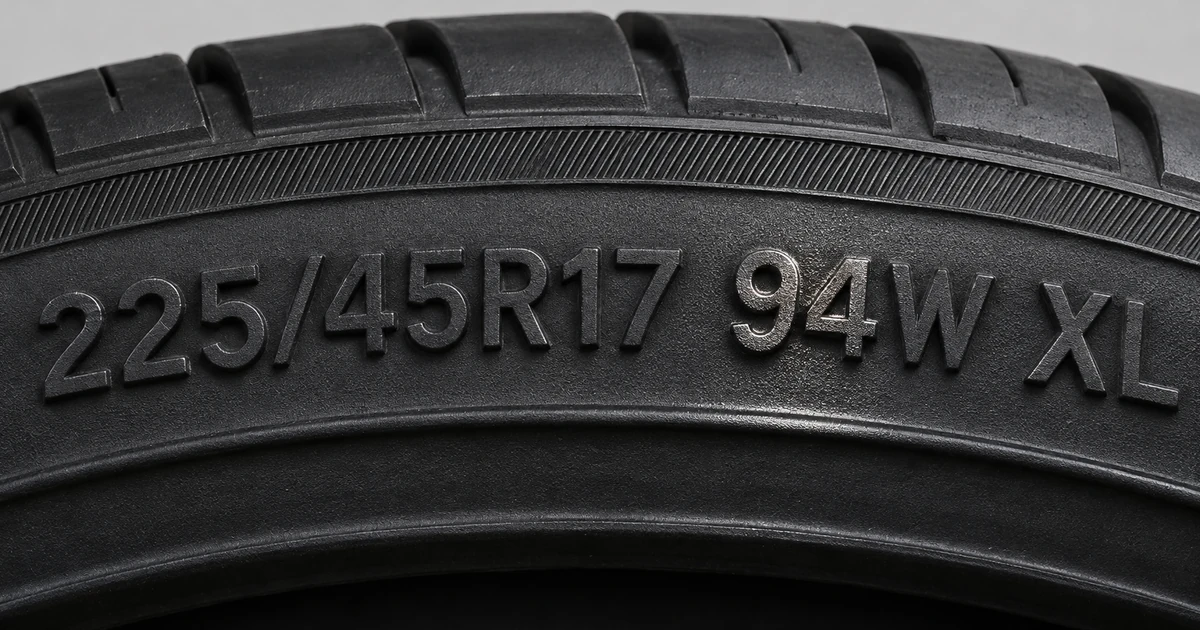
Tire Load Index Chart in kg and lbs
Find the two- or three-digit number immediately before the final speed letter. Each value below is the maximum rated capacity of one tire under specified conditions, including proper inflation. Kilograms are the rating basis; pound values are rounded equivalents.
| Load index | kg per tire | lb per tire (approx.) |
|---|---|---|
| 70 | 335 | 739 |
| 71 | 345 | 761 |
| 72 | 355 | 783 |
| 73 | 365 | 805 |
| 74 | 375 | 827 |
| 75 | 387 | 853 |
| 76 | 400 | 882 |
| 77 | 412 | 908 |
| 78 | 425 | 937 |
| 79 | 437 | 963 |
| 80 | 450 | 992 |
| 81 | 462 | 1,019 |
| 82 | 475 | 1,047 |
| 83 | 487 | 1,074 |
| 84 | 500 | 1,102 |
| 85 | 515 | 1,135 |
| 86 | 530 | 1,168 |
| 87 | 545 | 1,201 |
| 88 | 560 | 1,235 |
| 89 | 580 | 1,279 |
| 90 | 600 | 1,323 |
| 91 | 615 | 1,356 |
| 92 | 630 | 1,389 |
| 93 | 650 | 1,433 |
| 94 | 670 | 1,477 |
| 95 | 690 | 1,521 |
| 96 | 710 | 1,565 |
| 97 | 730 | 1,609 |
| 98 | 750 | 1,653 |
| 99 | 775 | 1,709 |
| 100 | 800 | 1,764 |
| 101 | 825 | 1,819 |
| 102 | 850 | 1,874 |
| 103 | 875 | 1,929 |
| 104 | 900 | 1,984 |
| 105 | 925 | 2,039 |
| 106 | 950 | 2,094 |
| 107 | 975 | 2,149 |
| 108 | 1,000 | 2,205 |
| 109 | 1,030 | 2,271 |
| 110 | 1,060 | 2,337 |
| 111 | 1,090 | 2,403 |
| 112 | 1,120 | 2,469 |
| 113 | 1,150 | 2,535 |
| 114 | 1,180 | 2,601 |
| 115 | 1,215 | 2,679 |
| 116 | 1,250 | 2,756 |
| 117 | 1,285 | 2,833 |
| 118 | 1,320 | 2,910 |
| 119 | 1,360 | 2,998 |
| 120 | 1,400 | 3,086 |
| 121 | 1,450 | 3,197 |
| 122 | 1,500 | 3,307 |
| 123 | 1,550 | 3,417 |
| 124 | 1,600 | 3,527 |
| 125 | 1,650 | 3,638 |
| 126 | 1,700 | 3,748 |
| 127 | 1,750 | 3,858 |
| 128 | 1,800 | 3,968 |
| 129 | 1,850 | 4,079 |
| 130 | 1,900 | 4,189 |
| 131 | 1,950 | 4,299 |
| 132 | 2,000 | 4,409 |
| 133 | 2,060 | 4,542 |
| 134 | 2,120 | 4,674 |
| 135 | 2,180 | 4,806 |
| 136 | 2,240 | 4,938 |
| 137 | 2,300 | 5,071 |
| 138 | 2,360 | 5,203 |
| 139 | 2,430 | 5,357 |
| 140 | 2,500 | 5,512 |
| 141 | 2,575 | 5,677 |
| 142 | 2,650 | 5,842 |
| 143 | 2,725 | 6,008 |
| 144 | 2,800 | 6,173 |
| 145 | 2,900 | 6,393 |
| 146 | 3,000 | 6,614 |
| 147 | 3,075 | 6,779 |
| 148 | 3,150 | 6,945 |
| 149 | 3,250 | 7,165 |
| 150 | 3,350 | 7,385 |
This reference covers indexes 70–150, spanning common passenger, light-truck, trailer and commercial applications. The number does not establish tire type, vehicle fitment or pressure by itself.
Where to Find the Load Index on a Tire
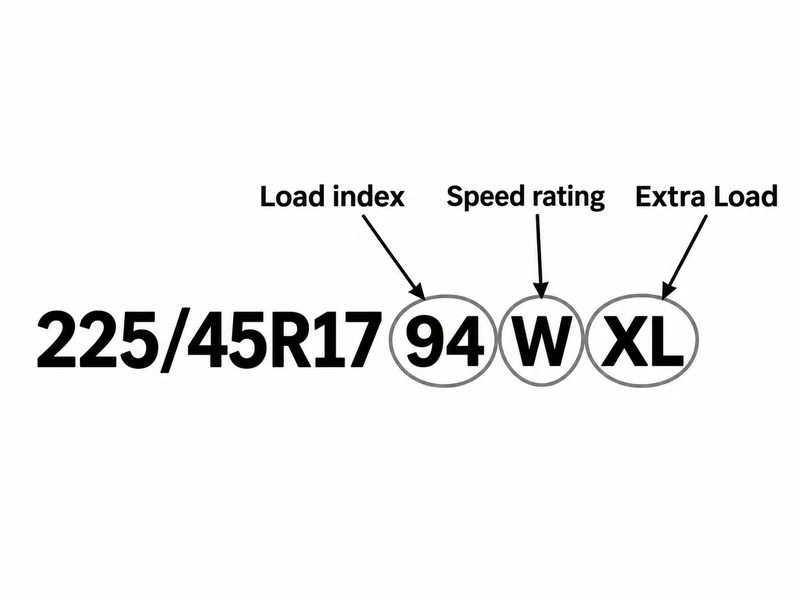
Read the sidewall from left to right. In 225/45R17 94W XL, the load index is 94. It sits after the size and before the final speed letter; XL is a separate load designation.
| Marking | Meaning |
|---|---|
| 225 | Approximate section width in millimeters |
| 45 | Nominal aspect ratio |
| R17 | Radial construction; 17-inch wheel diameter |
| 94 | Load index: 670 kg / 1,477 lb per tire |
| W | Speed rating: 168 mph / 270 km/h |
| XL | Extra Load construction |
For the complete size code, see how to read tire size and sidewall markings. For the final letter, use the tire speed rating chart.
Compare Common Load Indexes: 91 vs 94 vs 98 vs 100
The number is a code, not a direct weight. Moving from 91 to 94 adds 55 kg (121 lb) of rated capacity per tire; moving from 94 to 98 adds 80 kg (176 lb). These differences describe tire capacity, not how much more cargo the vehicle may legally carry.
| Index | kg per tire | lb per tire |
|---|---|---|
| 91 | 615 | 1,356 |
| 94 | 670 | 1,477 |
| 98 | 750 | 1,653 |
| 100 | 800 | 1,764 |
Two tires can share the same nominal size and still have different load indexes. That is why "same size" is not enough when comparing replacements such as 91W and 94W XL.
What Load Index Do Replacement Tires Need?
Start with the vehicle manufacturer's specification on the tire-information placard or in the owner's manual. USTMA says replacement tires should not have a smaller size or lower load-carrying capacity than originally specified.
An equal or higher load index is generally permitted, but only as part of a suitable complete specification. Check size, speed rating, tire type and any SL/XL/HL or load-range requirement. Michelin specifically says vehicles originally equipped with XL tires need XL replacements; the same applies to original HL equipment.
Do not choose a lower index merely because the tire size matches, and do not assume a higher index is a universal upgrade. If the wheel size or tire category is changing, confirm the complete fitment with the vehicle manufacturer or a qualified tire professional.
Load Index vs Load Range, Ply Rating and SL/XL/HL
Load index maps a number to a per-tire maximum load under specified conditions. Load range is a separate strength and inflation classification. Ply rating is a historical strength equivalent—not necessarily the number of physical layers in a modern tire.
Passenger-tire load designations
| Marking | Meaning | What to check |
|---|---|---|
| SL | Standard Load | Baseline passenger-tire designation; read the actual load index. |
| XL | Extra Load | Reinforced; can carry more than same-size SL at higher specified pressure. |
| HL | High Load | Carries more than XL at the same inflation pressure; used on some heavier vehicles and EVs. |
Common LT, trailer and commercial load ranges
| Load range | Historical ply-rating equivalent |
|---|---|
| C | 6-ply rated |
| D | 8-ply rated |
| E | 10-ply rated |
| F | 12-ply rated |
| G | 14-ply rated |
| H | 16-ply rated |
There is no universal Load Range E weight or recommended PSI. Capacity still depends on the exact tire size, load index, inflation specification and single/dual use. Two tires with the same load range can have different capacities, so use the sidewall and manufacturer data rather than treating this letter table as a weight chart.
What Does 121/118 Mean on a Tire?
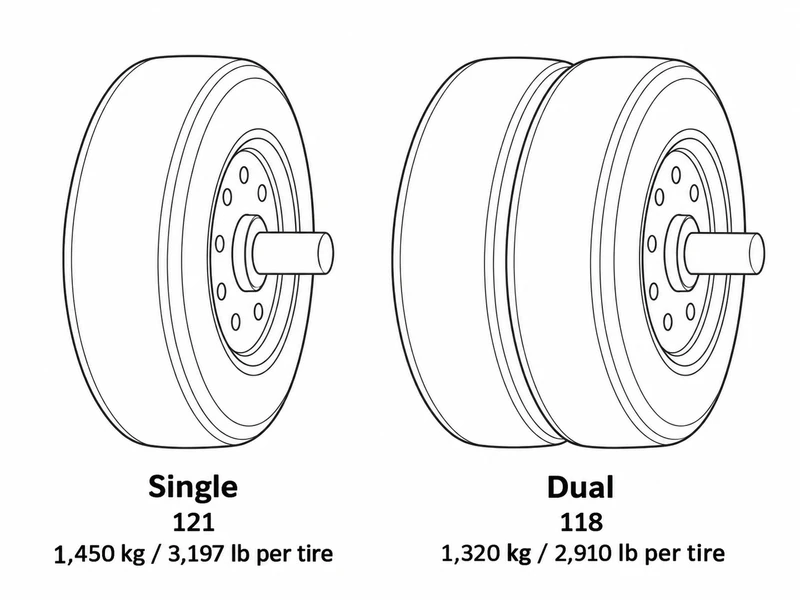
On applicable light-truck tires, two slash-separated load indexes distinguish single-tire and dual-tirefitments. In 121/118R, use 121 for a single position and 118 for each tire in a side-by-side dual arrangement; the final R is the speed rating.
| Fitment | Index to use | Capacity per tire |
|---|---|---|
| Single | 121 | 1,450 kg / 3,197 lb |
| Dual | 118 | 1,320 kg / 2,910 lb |
The dual value is a separate, lower per-tire rating for that configuration. It is not the combined capacity of the pair, and it is not permission to keep driving after one dual tire fails. Wheel, axle and vehicle limits still apply.
What the Chart Does Not Tell You About Payload or PSI
- Do not multiply one tire's rating by four to get payload.The vehicle has its own weight, passengers, GVWR, front/rear GAWR, uneven load distribution and wheel limits.
- A higher load index does not raise vehicle limits.Michelin states that the vehicle's maximum allowable load and axle ratings still govern, regardless of a higher tire rating.
- The rated load does not apply at any arbitrary pressure.Proper inflation is part of the rating's conditions. For exact capacity at a particular pressure, use the manufacturer's load-inflation table for that tire and application.
- The chart cannot calculate everyday PSI. Use the vehicle's door-placard cold pressure; never substitute the sidewall maximum or a generic load-range pressure.
Look up your vehicle in the tire pressure database, then verify the door placard. Heavy-duty truck pressure and load conditions are covered in average PSI for truck tires.
Key takeaways
- ✓Load index is a numerical code for maximum capacity per tire under specified conditions: 91 = 615 kg / 1,356 lb; 94 = 670 kg / 1,477 lb.
- ✓In 225/45R17 94W XL, 94 is load index, W is speed rating and XL is Extra Load—three separate specifications.
- ✓Replacement tires must meet the vehicle manufacturer's complete specification; a higher load index alone does not prove fitment.
- ✓Load range and ply rating are strength classifications, not universal weight capacities or recommended PSI values.
- ✓In 121/118, 121 applies to single fitment and 118 to each tire in dual fitment; each figure remains a per-tire capacity.
- ✓Tire capacity × 4 is not vehicle payload, and higher-rated tires do not raise GVWR, GAWR or manufacturer load limits.
Frequently Asked Questions
What does a 94 load index mean?
Load index 94 corresponds to 670 kg (1,477 lb) per tire under the rating's specified conditions. In 94W, 94 is the load index and W is the separate speed rating. The figure is not a vehicle payload rating or a recommended tire pressure.
Can I use a tire with a higher load index?
A higher load index is generally permitted when the complete tire specification remains suitable for the vehicle. Size, speed rating, SL/XL/HL or load-range requirements, tire type and manufacturer guidance still matter. Do not assume a higher number alone proves fitment, and do not use it to raise the vehicle's payload limit.
Is the load index chart for one tire or all four?
The chart gives the rated maximum capacity for one tire under specified conditions. It is not the capacity of a four-tire set, the vehicle's GVWR, an axle rating or the amount of cargo you can add.
Can I multiply one tire's capacity by four to calculate payload?
No. That arithmetic does not account for the vehicle's own weight, passengers, front/rear axle limits, uneven weight distribution, wheel limits or manufacturer ratings. Use the vehicle's payload label, GVWR, GAWR and loading instructions instead.
Does a higher load index mean I should use more PSI?
Not automatically. A load-index capacity applies under specified conditions, including proper inflation, but the chart does not prescribe everyday PSI. Use the vehicle manufacturer's door-placard pressure; for applications that require load-inflation tables, use the table for the exact tire and axle load.
Does Load Range E always have 10 actual plies?
No. E corresponds to a historical 10-ply strength rating, not necessarily ten physical layers. Modern materials can provide equivalent strength with fewer plies. Load Range E also does not have one universal weight capacity or recommended PSI across all tire sizes.
What does 121/118 mean on a tire?
It is a dual load-index marking used on applicable light-truck tires. Use 121 (1,450 kg / 3,197 lb per tire) for single-tire fitment and 118 (1,320 kg / 2,910 lb per tire) when the tire is used in a side-by-side dual configuration. Follow the vehicle manufacturer's configuration and axle limits.
Does a higher load index guarantee a stiffer ride?
No. Load index alone does not determine ride quality. Construction, tire model, size, load range, suspension and inflation pressure all matter. Compare complete tires rather than assuming every higher-index tire will feel harsher.
References
- Pirelli — Tire Load Index & Chart (per-tire pound capacities, sidewall location, replacement and single/dual guidance)
- Westlake Tire — Tire Load and Speed Index (load-index table in pounds and kilograms)
- Bridgestone — Tire size and load-index knowledge (kilogram capacities and prescribed-condition definition)
- Your Auto Vision — Tire Load Rating Chart (supplementary kilogram cross-check for indexes 133–150)
- Michelin — Tire Load Rating & Speed Rating (replacement requirements, SL/XL/HL and vehicle/axle load limits)
- U.S. Tire Manufacturers Association — Replacing Tires (vehicle-manufacturer size, load and speed specifications)
- Burnett Family Tire — Ply Rating, Load Range and Load Index (historical ply equivalents and why equal load ranges can have different capacities)