What PSI Should Truck Tires Be? From Half-Ton to Semi
Last updated: October 23, 2026 · Reading time: 7 min
Half-ton pickups average 35 PSI cold (range 30–40). Heavy-duty 2500/3500 trucks run about 60 front / 70–80 rear — the rear goes up when loaded or towing. Box trucks run 70–95, semis 85–130. Your door-jamb placard beats every average; the sidewall number is a maximum, not a target.
The Short Answer: PSI by Truck Class
"Truck" covers a Tacoma and an 18-wheeler, so one number can't answer the question. Here's the ladder — half-ton figures from our own placard-verified vehicle database, heavier classes from industry guides:
| Truck class | Examples | Typical cold PSI |
|---|---|---|
| Midsize / half-ton pickup | Tacoma, Ranger, F-150, Silverado 1500, Ram 1500 | 30–40 PSI (most: 35) |
| Heavy-duty pickup (2500/3500), unloaded | Sierra 2500, Ram 2500, Silverado HD | 60 front / 65–70 rear |
| Heavy-duty pickup, loaded / towing | Same trucks, Load Range E tires | 60–75 front / 75–80 rear |
| Dually (3500-class) | Sierra 3500 Dually, Ram 3500 Dually | 65–80 front / 65 rear (flipped!) |
| Cargo van / box truck | Ram ProMaster, delivery trucks | 65–95 PSI |
| Semi (loaded) | Steer / drive & trailer | 100–130 / 85–120 PSI |
These are general operating ranges, not specs. The pattern underneath them is one rule: pressure follows weight. More load on an axle → more PSI needed to carry it. That rule explains every row, including the weird one (the dually — below).
Half-Ton Pickups: Real Placard Numbers
Every half-ton we've verified lands in a tight 30–40 band, and unlike cars, most trucks spec the same pressure front and rear when unloaded:
| Model | Front | Rear | Details |
|---|---|---|---|
| Toyota Tacoma | 30 PSI | 30 PSI | Full spec → |
| Ford Ranger | 30 PSI | 30 PSI | Full spec → |
| Ford F-150 | 35 PSI | 35 PSI | Full spec → |
| Chevrolet Silverado 1500 | 35 PSI | 35 PSI | Full spec → |
| GMC Sierra 1500 | 35 PSI | 35 PSI | Full spec → |
| Toyota Tundra | 35 PSI | 35 PSI | Full spec → |
| RAM 1500 | 36 PSI | 36 PSI | Full spec → |
| Jeep Gladiator | 36 PSI | 36 PSI | Full spec → |
| RAM 1500 Classic | 40 PSI | 40 PSI | Full spec → |
Two outliers worth knowing: the RAM 1500 Rebel specs 55 front / 45 rear — off-road trims ship with LT tires that run higher pressures. And any half-ton wearing aftermarket Load Range E tires may need more than the placard says, because the placard was written for the stock P-metric tires.
Heavy-Duty: Why the Rear Runs Higher
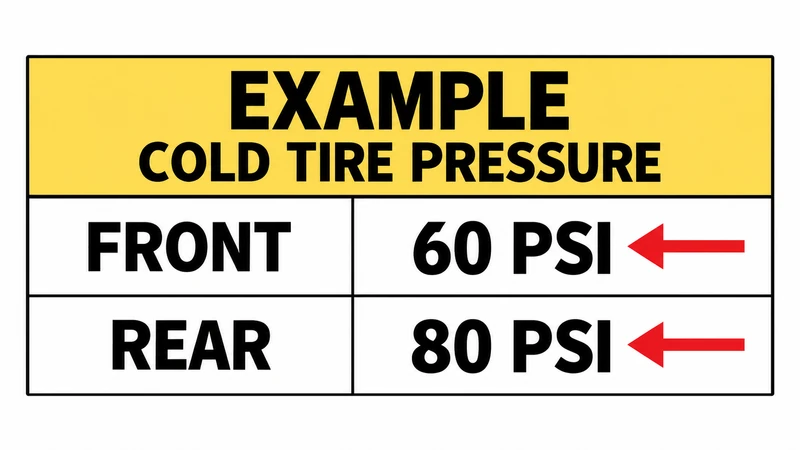
A tire's load capacity rises with its pressure — that's physics, not a brand claim. A heavy-duty pickup puts the engine over the front axle and the payload over the rear, so the placard splits: our verified data shows the GMC Sierra 2500 and Sierra 3500 at 60 front / 80 rear, the RAM 2500 at 75 front / 80 rear, and the Silverado HD at 60 front / 70 rear. Michelin's own F-250 Super Duty fitment data tells the same story — 15 factory tire options, every one spec'd between 55–75 front and 65–80 rear, none of them symmetric.
The rear number assumes a load. Running 80 PSI rear on an empty bed gives you a bouncing, harsh ride and center-tread wear; running the empty-load figure with a trailer's tongue weight on the hitch is the dangerous direction — underinflated, overloaded rear tires are the classic highway blowout recipe. Adjust with the load, and measure cold (pressure climbs ~1 PSI per 10°F and more with driving heat — cold vs hot readings).
The Dually Flip
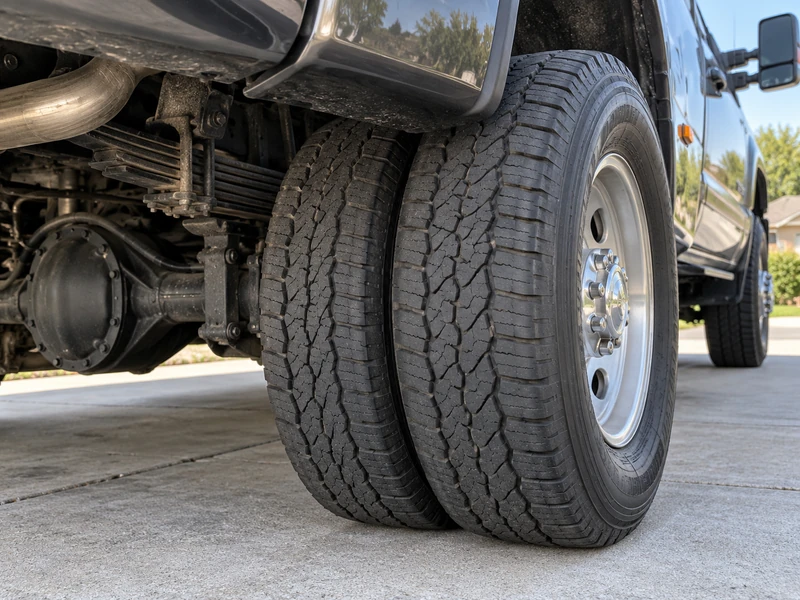
Dual-rear-wheel trucks break the rear-is-higher pattern: our data shows the Sierra 3500 Dually at 80 front / 65 rear and the RAM 3500 Dually at 70 front / 65 rear. The logic is the same rule — pressure follows weight — but four rear tires share the load, so each one needs less air than the single fronts carrying the diesel engine. If you take one thing from this article: never assume front and rear match on an HD truck, in either direction.
Placard vs Sidewall vs Load Range
Three numbers compete for your attention, and only one is the daily answer:
- Door placard — the engineered spec for your truck as sold. Use this. (Full decoding: how to read a tire sidewall.)
- Sidewall "MAX PRESS" — the tire's limit at full rated load, not a suggestion. A Load Range E tire marked 80 PSI max doesn't want 80 on your empty truck.
- Load range letters (C/D/E/F) — how much weight the tire can carry and at what max pressure, within its size. E-rated tires unlock the 75–80 PSI territory HD trucks need when loaded; they don't require it when empty.
How to Find the Correct PSI for Your Truck
Averages get you within range; your truck's spec gets you exact. The path depends on what you drive:
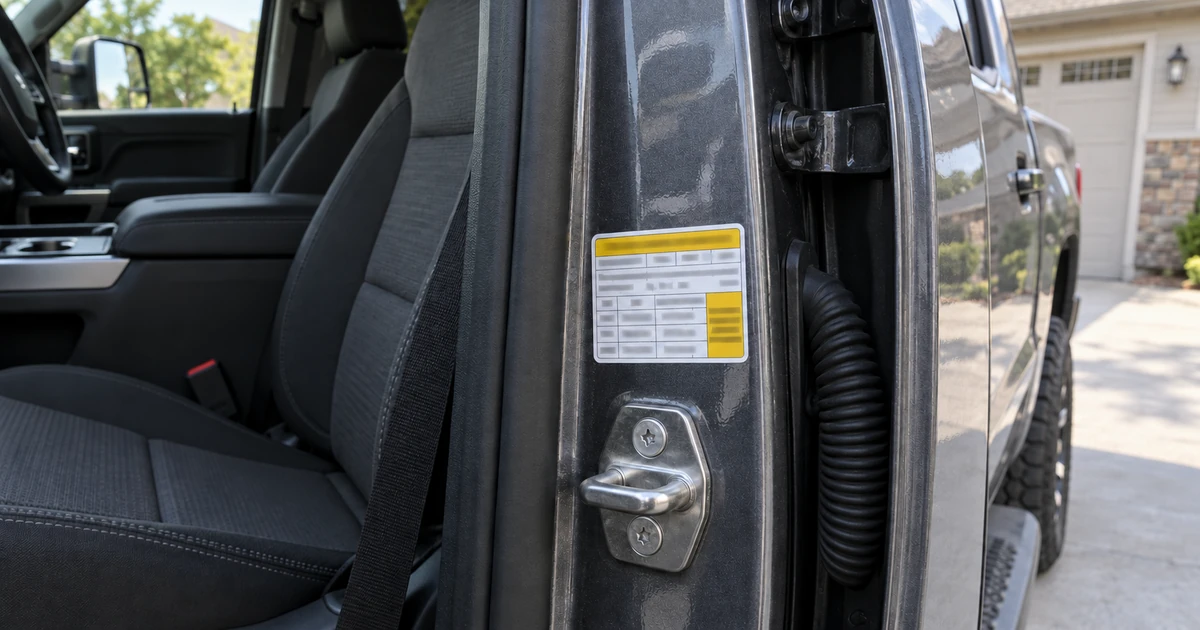
- Pickups (half-ton and HD): read the tire-and-loading placard on the driver's door jamb — it lists front and rear cold PSI separately, and they're often different on HD trucks. The owner's manual repeats it. NHTSA's guidance is the same: use the vehicle's placard or manual, not the tire sidewall. Measure cold — parked 3+ hours.
- Commercial trucks: there is no placard shortcut. Pressure comes from the actual load on each axle plus the tire's load-inflation table, set per position (steer, drive, trailer) and per single/dual fitment. That's why fleets weigh axles instead of guessing.
Changed tire size or load range from stock? The placard no longer strictly applies — recalculate from the tire maker's load-inflation table for your axle weight.
We keep placard-verified pressures for Ford F-150, Silverado, Sierra, RAM 1500– 3500, Tacoma, Tundra and more in the vehicle database — and whatever you drive, check monthly, cold, with a gauge you've verified.
Key takeaways
- ✓Half-ton pickups average 35 PSI cold (30–40 range), same front and rear when empty — Tacoma 30, F-150 35, RAM 1500 36.
- ✓Heavy-duty 2500/3500 trucks split: ~60 front / 70–80 rear, because pressure follows weight and the load sits on the rear axle.
- ✓Duallies flip the pattern (80 front / 65 rear): four rear tires share the load, so each needs less air.
- ✓The sidewall MAX PRESS is a limit, not a target; the door placard is the daily answer. Load Range E enables 75–80 PSI, it doesn't demand it.
- ✓Semis run 85–130 PSI by position; box trucks 70–95. 'Truck PSI' only means something per truck class.
Frequently Asked Questions
What is the average PSI for a pickup truck tire?
For a half-ton pickup (F-150, Silverado 1500, Ram 1500, Tundra), the door placard typically says 30–40 PSI cold, front and rear — 35 PSI is the most common number. Heavy-duty pickups (2500/3500) run much higher: roughly 50–65 PSI front and 60–80 PSI rear, with the rear climbing toward 80 when loaded or towing.
Is 40 PSI too high for truck tires?
On a half-ton pickup with P-metric tires, 40 PSI is above most placard specs (30–36) — fine only if your placard or a load calls for it. On a heavy-duty truck with Load Range E tires, 40 PSI is actually too low for a loaded rear axle. "Too high" only has meaning against your door sticker and your load, not as a universal number.
Should truck rear tires have more PSI than the front?
When the bed is loaded or you're towing, yes — that's why HD trucks spec something like 60 front / 80 rear: tire load capacity rises with pressure, and the load sits over the rear axle. Empty, many trucks run symmetric pressures. Exception: dually pickups often spec the opposite (e.g., 80 front / 65 rear) because four rear tires share the load. Always follow your placard's split, not a generic rule.
What PSI should I run when towing with my truck?
Use the placard's loaded/towing figures if it lists them — typically the rear goes up: half-tons to around 40–45 PSI, heavy-duty trucks to 75–80 PSI with Load Range E tires. Never exceed the tire sidewall's max, and never tow on the empty-load rear pressure if the placard says otherwise — underinflated rear tires under a trailer's tongue weight are a classic blowout setup.
Is the PSI on the tire sidewall what I should use?
No. The sidewall number is the maximum pressure at the tire's full rated load — a limit, not a recommendation. Your truck's door-jamb placard is the engineered answer for daily driving. Running a Load Range E tire at its 80 PSI sidewall max on an empty half-ton gives you a harsh ride and center-tread wear for zero benefit.
What PSI do semi-truck (18-wheeler) tires run?
Loaded semis run far higher than pickups: steer tires typically 100–130 PSI, drive and trailer tires 85–120 PSI. The correct figure comes from the actual axle load and the tire maker's load-inflation table, not a single average — which is why fleets weigh axles and set pressure per position.
Does my truck's TPMS tell me the correct target PSI?
No. TPMS is a warning system, not a target display — federal rules only require it to warn when a tire drops about 25% below the placard pressure. A silent TPMS light means you're somewhere above that floor, not that you're at the right number. Set pressure with a gauge against the placard, and use the TPMS as a safety net.
References
- Axle Spindle — Truck tire pressure by truck type (half-ton 35–40; HD 50–80; box 70–95; semi steer 100–130, drive/trailer 85–120; load-inflation relationship; sidewall = limit)
- TireGrades — Truck tire pressure front vs rear (weight distribution drives the split; light trucks 30–35, loaded rear ~40; HD front 50–65, rear 60–80 loaded/towing)
- Michelin — F-250 Super Duty factory tire pressure data (every one of 15 LT fitments spec'd asymmetric: 55–75 PSI front, 65–80 PSI rear)
- Michelin — Commercial truck tire pressure (set pressure from actual axle load + load-inflation table, per position and single/dual fitment; sidewall max ≠ operating pressure)
- NHTSA — TireWise (recommended pressure comes from the vehicle placard or owner's manual, not the tire sidewall; check cold, parked 3+ hours)