Cold vs Hot Tire Pressure: Why the Reading Changes
Last updated: September 5, 2026 · Reading time: 7 min
A hot tire reads 4–6 PSI higher than a cold one. That's normal and by design — the door jamb number is a cold pressure, measured before driving. Never bleed air from a hot tire to “fix” a high reading; once it cools, it will be underinflated.
Cold vs Hot: How Much Difference Is Normal?
Two forces move your tire pressure, and both are pure physics — the air inside expands when it warms and contracts when it cools:
- Air temperature: about 1 PSI per 10°F of ambient change, in either direction. A 50°F morning vs a 100°F afternoon is a 5 PSI swing without driving at all.
- Driving friction: flexing sidewalls generate heat, adding 4–6 PSI after sustained highway driving. City driving adds less, roughly 2–3 PSI.
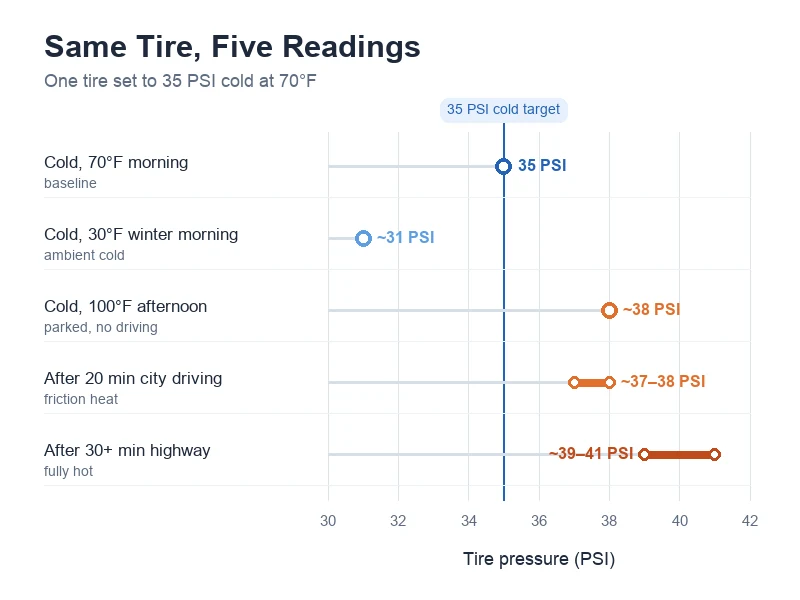
Here's what that looks like for a tire set to 35 PSI cold on a 70°F morning:
| Condition | Reading | Why |
|---|---|---|
| Cold, 70°F morning (baseline) | 35 PSI | This is the number that matters |
| Cold, 30°F winter morning | ~31 PSI | Ambient cold: −1 PSI per 10°F |
| Cold, 100°F summer afternoon | ~38 PSI | Ambient heat: +1 PSI per 10°F |
| After 20 min city driving | ~37–38 PSI | Friction heat builds |
| After 30+ min highway driving | ~39–41 PSI | Fully hot — never adjust here |
Notice the range: the same tire, with the exact same amount of air, can read anywhere from 31 to 41 PSI depending on when you measure. That's why when you measure matters more than the number you happen to see.
Weather Heat vs Driving Heat: Two Different Things
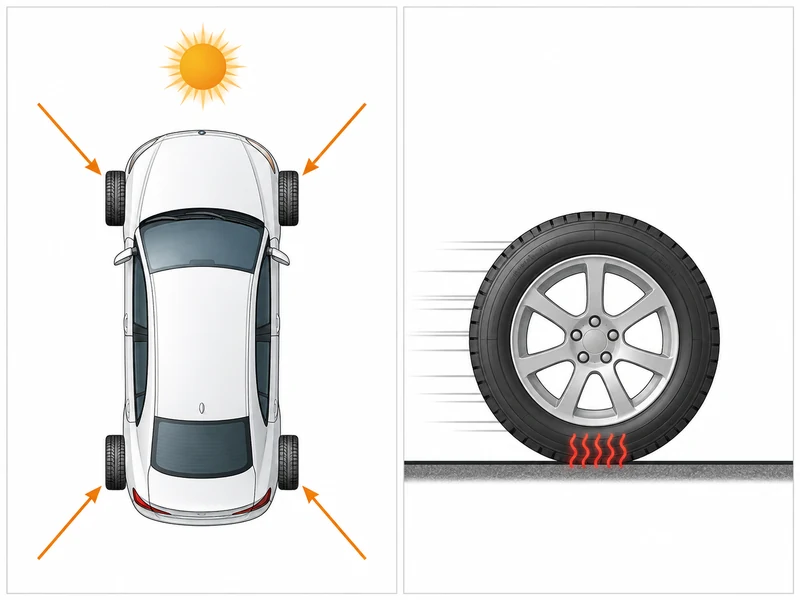
“Hot” gets used for two separate situations, and mixing them up causes most of the confusion around tire pressure:
- Weather heat (ambient): slow, seasonal, affects all four tires equally. Summer afternoons read higher; winter mornings read lower. This is the 1 PSI per 10°F effect.
- Driving heat (friction): fast, temporary, gone after a few hours parked. This is the 4–6 PSI rise that makes a gas station reading on the highway useless for calibration.
Both are normal. Neither means you have too much air. The only reading worth acting on is the cold one — which is exactly why the spec is written that way.
Why the Recommended PSI Is a Cold Number
Vehicle manufacturers define the recommended pressure as a cold inflation pressure: measured before driving, or after the car has sat for at least 3 hours. This isn't arbitrary — it solves two problems at once.
First, it gives every driver the same measuring conditions. A cold reading in Alaska and a cold reading in Arizona are comparable; two hot readings after different drives are not. Second, the engineers already built the driving rise into the design: a tire at the correct cold pressure will run at the correct hot pressure on the highway. The system is calibrated around the cold number.
That's why the winter advice is “inflate to the door jamb number even when it's freezing” — and the summer advice is identical. The target never changes; only your readings do.
Why You Should Never Bleed Air from Hot Tires
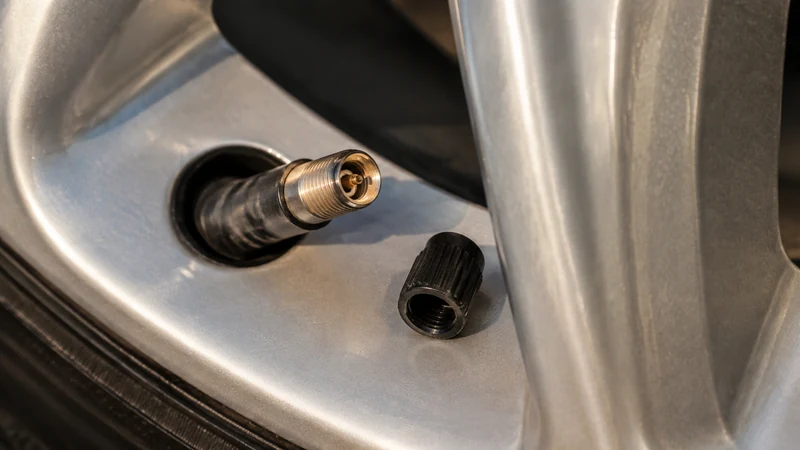
It's the most common mistake born from a reasonable instinct: you stop for gas after an hour on the highway, check a tire, see 40 PSI against a 35 PSI spec, and let some air out. Here's what actually happens:
- The tire was at 40 PSI because it was hot — the cold pressure was the correct 35.
- Bleeding it to 35 while hot means the tire now holds less air than it should.
- Tomorrow morning, that tire reads about 29–31 PSI — genuinely underinflated, with all the handling, wear, and heat problems that brings.
The rule is absolute: only adjust pressure when the tires are cold. If a hot reading looks high, leave it alone. If it looks low compared to the spec, add air to reach the spec plus roughly 4 PSI for the heat — or better, re-check properly the next morning.
What a Hot Reading Actually Tells You
Hot readings aren't useless — they're just not for calibration. They're genuinely useful for two things:
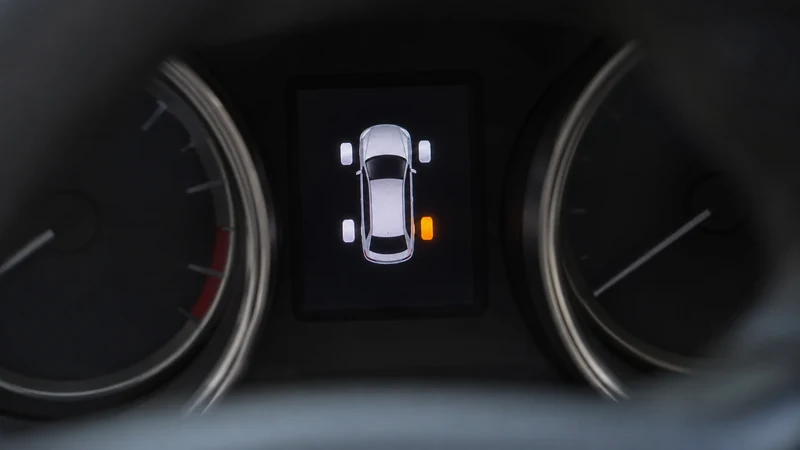
- Spotting a problem tire. On the highway, all four tires should rise by a similar amount. If your TPMS shows one tire running 6+ PSI hotter than its twins on the same axle, that tire is working harder — usually because it started underinflated. A hot imbalance is a warning; a uniformly high hot reading is not.
- Emergency top-ups. If a tire is clearly low and the only air available is at a highway gas station, inflate to the door jamb number plus ~4 PSI to roughly compensate for the heat — then re-check cold as soon as you can. The gas station guide has the full procedure.
How to Get a True Cold Reading
The mechanics take two minutes; the timing is what makes it accurate:
1. Measure before driving
First thing in the morning is ideal. Failing that, wait until the car has been parked at least 3 hours. Even 1–2 miles of driving starts skewing the reading.
2. Watch out for direct sun
A tire sitting in full sun can read 1–2 PSI higher than its shaded twin on the same car. For the most honest comparison, check in shade or before the sun hits the driveway.
3. Compare against the door jamb, not the sidewall
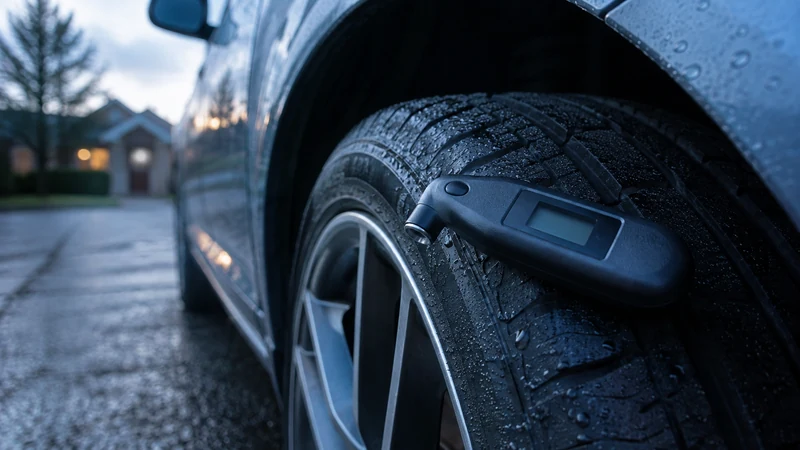
The “max press” number on the tire sidewall is the tire's structural limit — not your car's recommendation. Set the cold reading to the door jamb sticker value. Full walkthrough in our step-by-step checking guide.
4. Keep the rhythm
Monthly at minimum, every 2 weeks when temperatures swing, and always before a long highway trip. More detail in how often to check tire pressure.
Key takeaways
- ✓Hot tires read 4–6 PSI higher than cold — that's by design, not a problem.
- ✓The door jamb number is a COLD pressure: measure before driving or after 3+ hours parked.
- ✓Never bleed air from a hot tire — it will be 4–6 PSI underinflated once it cools.
- ✓Ambient weather moves pressure too: ~1 PSI per 10°F, in both directions.
- ✓Use hot readings only to compare tire-to-tire balance, never to calibrate.
Frequently Asked Questions
Is it normal for tire pressure to increase while driving?
Yes, completely normal. Driving flexes the tire's sidewalls thousands of times per mile, and that friction generates heat. As the air inside warms up, pressure rises — typically 4–6 PSI above the cold reading after highway driving. Manufacturers know this and design the recommended (cold) pressure with that rise built in.
Should I let air out of my tires when they're hot?
No — never bleed air from hot tires. A hot reading is supposed to be higher than the door jamb number. If you bleed a hot tire down to the sticker value, it will be significantly underinflated once it cools: typically 4–6 PSI low. Always wait until the tires are cold, then measure and adjust against the door jamb spec.
What if my tire pressure reads above the door jamb number after driving?
That's expected, not a problem. The door jamb number is a cold pressure — it's meant to be measured before driving. A reading 4–6 PSI above the sticker after highway driving is the system working as designed. Only be concerned if the COLD reading (morning, before driving) is above the sticker, in which case bleed it down to spec.
How long should I wait to check tire pressure after driving?
At least 3 hours for a full cool-down — that's the industry standard definition of a cold tire. If that's not practical, check first thing in the morning before driving anywhere. Even 1–2 miles of driving starts warming the tires and inflating the reading.
Does hot weather alone raise tire pressure?
Yes. Air temperature affects pressure by about 1 PSI per 10°F, in both directions. A tire that reads 35 PSI on a 50°F spring morning will read about 38 PSI on a 95°F summer afternoon without the car moving an inch. This is why pressure should always be checked and set at the coolest part of the day.
Is 40 PSI too high for tires?
It depends on your vehicle and when you measured. If 40 PSI is a hot reading after highway driving and your cold spec is 33–35 PSI, that's perfectly normal. If 40 PSI is a cold morning reading and your door jamb says 33, it's overinflated — bleed it down to spec. Some vehicles (EVs, trucks) legitimately spec 40+ PSI cold, so always check your own sticker first.
References
- AAA Exchange — Tire Safety & Maintenance (check monthly, before trips; warm tires read ~5 PSI high)
- Michelin — How to Check Tire Pressure (monthly incl. spare; cold tires, 3+ hours parked; door sticker, not sidewall)
- NHTSA — Tire Safety (check pressure monthly and when cold; TPMS required on US vehicles since 2008)
Related Guides
- → Does Tire Pressure Drop in Cold Weather? (How Much)
- → Winter Tire Pressure: What PSI Should You Run?
- → Summer Tire Pressure: Should You Let Air Out?
- → Do Tires Deflate in Cold Weather? (No — Here's Why)
- → How to Check Tire Pressure: The Complete Step-by-Step Guide
- → How Often Should You Check Tire Pressure?
- → More guides on the Blog