Summer Tire Pressure: What Changes in the Heat
Last updated: September 6, 2026 · Reading time: 7 min
Keep your summer tire pressure at the door jamb number — don't let air out. Heat raises your readings(~1 PSI per 10°F, plus 4–6 PSI from driving), but your target doesn't change. The real summer danger is the opposite: underinflated tires overheating.
What Should Your Tire Pressure Be in Summer?
The same as every other season: the cold inflation pressure on your driver-side door jamb sticker — usually 32–36 PSI for sedans, a bit higher for SUVs and EVs. There is no separate summer spec, just as there's no separate winter spec. The sticker number is engineered to be correct across the full temperature range your car will see.
What summer changes is your readings, not the target. A tire at the correct cold pressure on a 70°F morning will show 2–3 PSI more on a 100°F afternoon without a single molecule of air added — and several PSI more again after highway driving. All of that is normal.
If you remember one rule, make it this: set and judge pressure only on cold morning readings. Everything you see on a hot afternoon is the system working as designed. For the exact spec on your vehicle, use our vehicle tire pressure database.
How Much Does Heat Raise Tire Pressure?
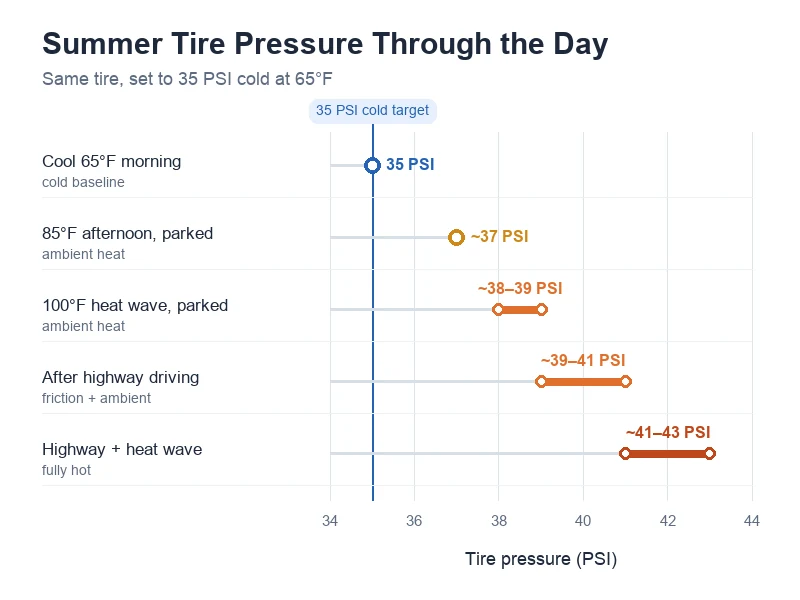
Two heat sources stack on top of each other in summer — ambient air temperature and driving friction. Here's a tire set to 35 PSI cold on a mild 65°F morning:
| Condition | Reading | Why |
|---|---|---|
| Cool 65°F morning (baseline) | 35 PSI | The number that matters |
| 85°F afternoon, parked | ~37 PSI | Ambient heat only |
| 100°F heat wave, parked | ~38–39 PSI | Still normal — don't bleed |
| After highway driving | ~39–41 PSI | Friction heat on top of ambient |
| Highway + heat wave | ~41–43 PSI | Expected; re-check cold next morning |
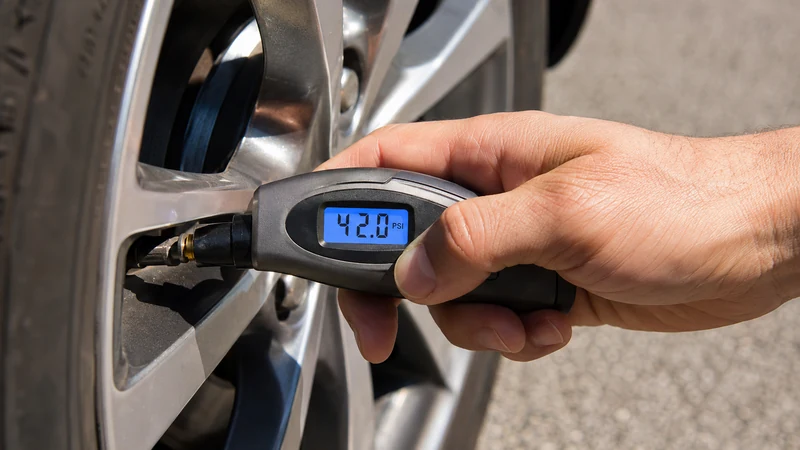
So on the hottest day of the year, after an hour on the interstate, a correctly inflated tire can read 41–43 PSI against a 35 PSI spec. That feels alarming — and it's completely expected. The full physics of both effects is in cold vs hot tire pressure.
Should You Let Air Out in Hot Weather?
Almost never. This is the biggest summer tire myth, and it survives because the logic feels right: heat expands air, so surely you should bleed some off to compensate? No — because the door jamb number already assumes your tires will run hot.
Bleeding a hot tire down to the sticker number guarantees it will be underinflated the next cool morning — typically 4–6 PSI low. And underinflation in summer is precisely the condition that destroys tires, as the next section explains.
There is exactly one legitimate case for letting air out in summer: a cold morning reading genuinely above the door jamb spec — usually because someone overfilled during a heat wave. Then, and only then, bleed down to the sticker value. Hot reading high? Leave it alone.
Why Summer Is Blowout Season
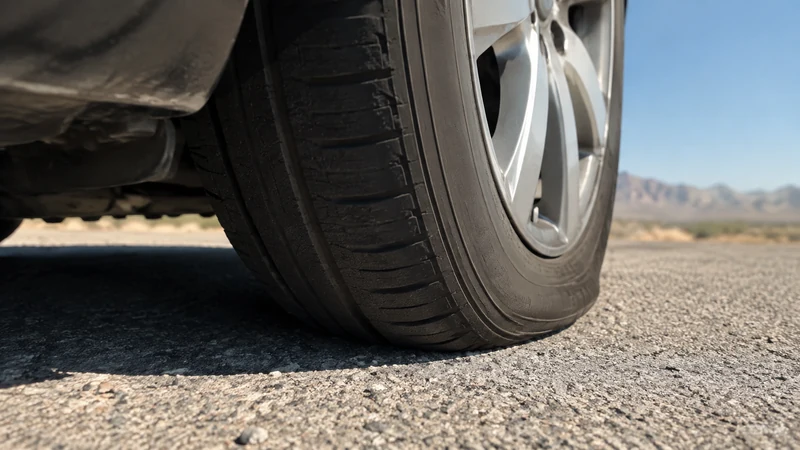
It sounds backwards — shouldn't overinflation be the summer risk? In practice, tire failures peak in hot weather because of underinflation, and the physics are worth understanding:
- An underinflated tire flexes more with every revolution, and flexing generates internal heat.
- Summer raises the baseline: hot air, hot pavement, long highway runs — often with a car fully loaded for vacation.
- A soft tire in these conditions builds heat faster than it can shed it. The internal structure degrades, and in the worst cases the tire fails — the classic highway blowout.
The practical takeaway: in summer, a few PSI over spec is a minor issue (slightly firmer ride, slightly less grip), while a few PSI under spec is a genuine safety risk. If you haven't checked since spring, your tires are likely a couple of PSI down from natural seepage alone — check them before the next long drive.
Summer Road Trip Tire Checklist
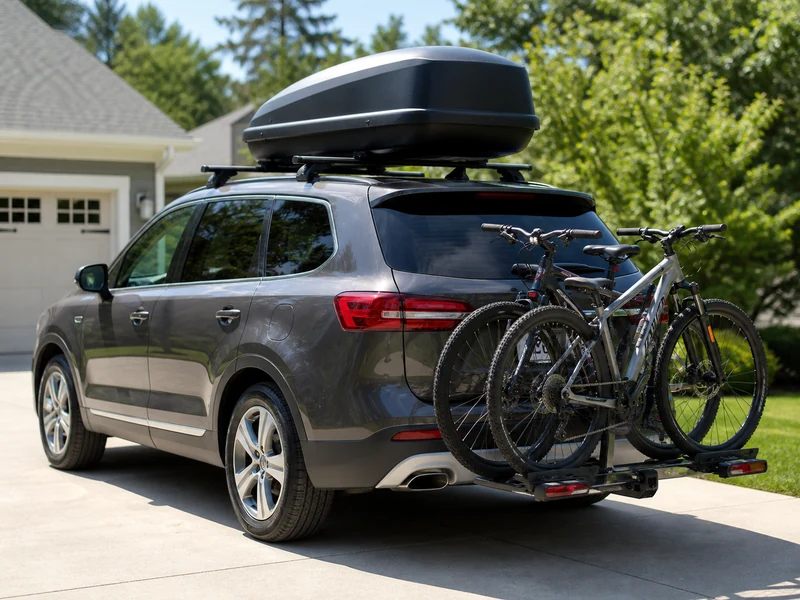
Long highway runs in peak heat are the most demanding conditions your tires see all year. Five minutes of prep before departure:
1. Check all four tires cold, the morning you leave
Before driving, before loading. Set each to the door jamb number. The full procedure is in our step-by-step checking guide.
2. Look for a loaded-vehicle spec
Many door jamb stickers list a second, slightly higher pressure for a fully loaded car. Use it when the trunk is full — never the tire sidewall “max” number.
3. Check the spare
A compact spare sits at 60 PSI and still seeps ~1–2 PSI a month. A flat spare on the shoulder of a hot highway is a miserable discovery.
4. Glance at the tread and sidewalls
Bulges, cracks, or cords showing are a do-not-drive flag in summer heat. Pressure won't save a structurally damaged tire.
How Often to Check Tire Pressure in Summer
Summer is more forgiving than winter — pressure rises with heat rather than crashing with cold snaps — but the stakes of being low are higher. The routine:
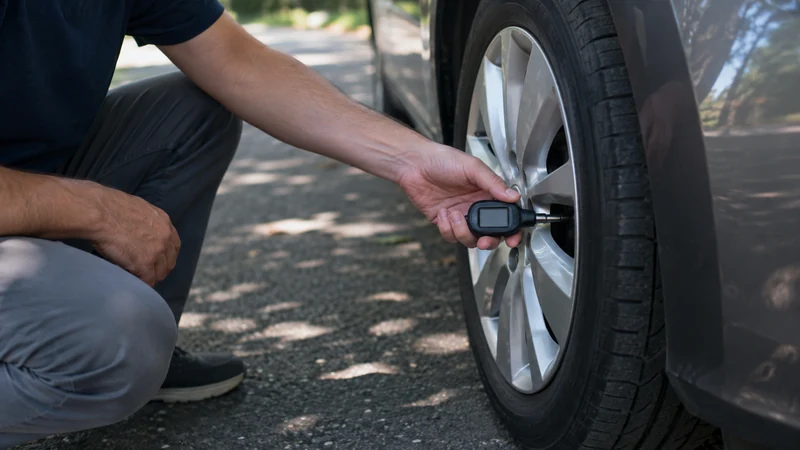
- Monthly at minimum, cold, in the morning. Tires seep 1–2 PSI per month regardless of season.
- Before every long highway trip — non-negotiable in hot weather, especially loaded.
- During heat waves, check that you haven't drifted low — but don't bleed a hot or sun-warmed tire that's reading high.
- In the morning or shade — a sun-baked tire can read 1–2 PSI above its shaded twin.
That's the whole summer strategy: same target, cold morning checks, and no panic-bleeding when the gauge reads high at 3 PM. For the year-round schedule, see how often to check tire pressure.
Key takeaways
- ✓Summer target = the same door jamb cold PSI as always — there is no summer spec.
- ✓Heat raises readings ~1 PSI per 10°F plus 4–6 PSI from driving. High hot readings are normal.
- ✓Never bleed a hot tire to the sticker number — it will be underinflated the next cool morning.
- ✓Summer blowouts come from UNDERinflation + heat, not overinflation — slightly high beats slightly low.
- ✓Check monthly, cold, in the morning — and always before a loaded highway trip.
Frequently Asked Questions
My tires read 2–3 PSI over spec on hot afternoons. Is that dangerous?
No — that's the normal ambient-heat effect: about 1 PSI per 10°F. If your cold morning reading is at the door jamb number, a higher afternoon reading is expected and safe. Only act on cold readings: if the tire reads over spec first thing in the morning, bleed it down to the sticker value.
Do tires gain pressure just from sitting in the sun?
Yes, a little. Direct sun can add 1–2 PSI to a parked tire compared to its shaded twin, and hot ambient air adds about 1 PSI per 10°F across all four. Neither is a problem by itself — the pressure comes back down as temperatures fall. Check in the morning or in shade for an honest reading.
Is it safe to drive with slightly high tire pressure in summer?
A few PSI over spec is far less risky than a few PSI under. Overinflation slightly reduces grip and ride comfort; underinflation in summer heat is what actually kills tires — it causes excessive flexing, heat buildup, and in extreme cases blowouts. If you must err, err slightly high on the cold reading, never low.
What's the best time of day to check tire pressure in summer?
First thing in the morning, before driving and before the sun heats the tires. That's the coolest, most consistent part of the day and the condition the door jamb spec is written for. If mornings aren't possible, wait until the car has been parked in shade for at least 3 hours.
Does hot pavement damage tires?
Hot pavement itself doesn't damage a healthy, properly inflated tire — tires are engineered for summer road temperatures. The damage happens when heat meets underinflation: a soft tire flexes more, builds internal heat faster than it can shed it, and the internal structure starts to break down. Keep pressure at spec and hot pavement is a non-issue.
Should I inflate to the max PSI on the sidewall for a loaded road trip?
No. The sidewall max is the tire's structural limit, not a recommendation. Check your door jamb sticker — many vehicles list a separate, slightly higher pressure for fully loaded driving. Use that loaded spec if it's listed; otherwise the normal cold spec applies. Never exceed it to the sidewall max.
References
- NHTSA — Tire Safety (check pressure monthly and when cold; TPMS required on US vehicles since 2008)
- AAA Exchange — Tire Safety & Maintenance (check monthly, before trips; warm tires read ~5 PSI high)
- Michelin — How to Check Tire Pressure (monthly incl. spare; cold tires, 3+ hours parked; door sticker, not sidewall)