Are Your Tires Overinflated? How to Tell and What to Do About It
Last updated: November 1, 2026 · Reading time: 8 min
Your tires are overinflated only if a cold reading (parked 3+ hours) is above the door-placard PSI — a hot reading after driving proves nothing. A few PSI over is a minor fix; 10+ over hurts wet grip and invites pothole damage. Press the valve pin in short bursts to bleed down, then re-measure.
How to Tell If Yours Are Overinflated
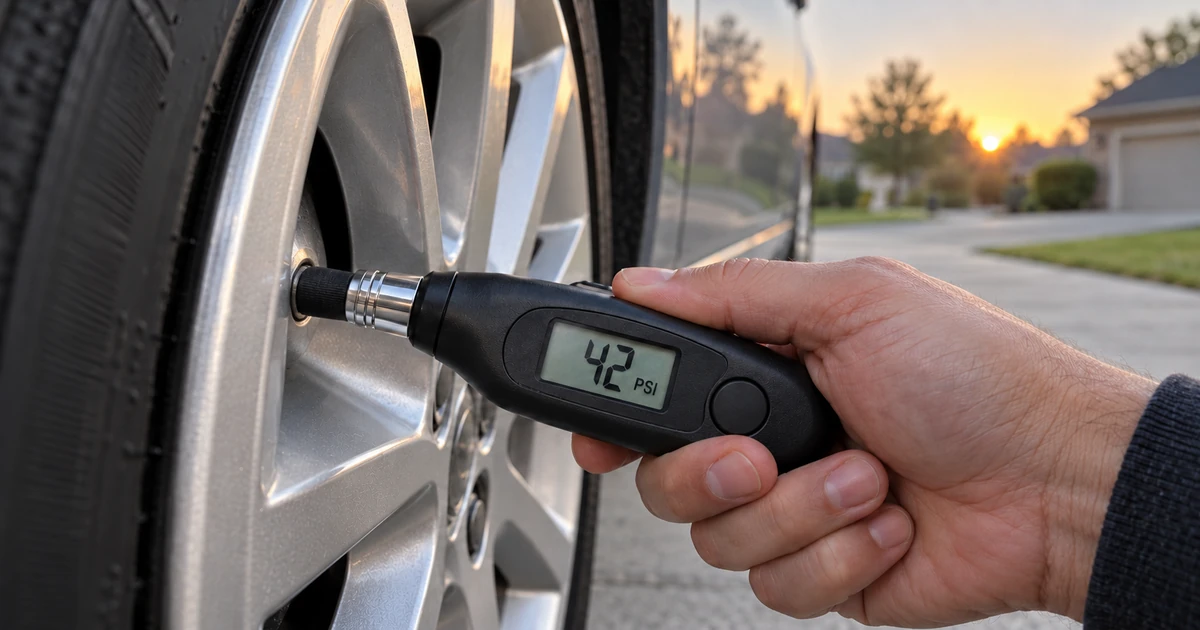
There's exactly one reliable test: measure cold, compare to the placard. Parked 3+ hours (or before driving a mile), gauge on the valve, number vs the sticker in your driver's door jamb. Cold reading above the placard = overinflated. That's the whole test.
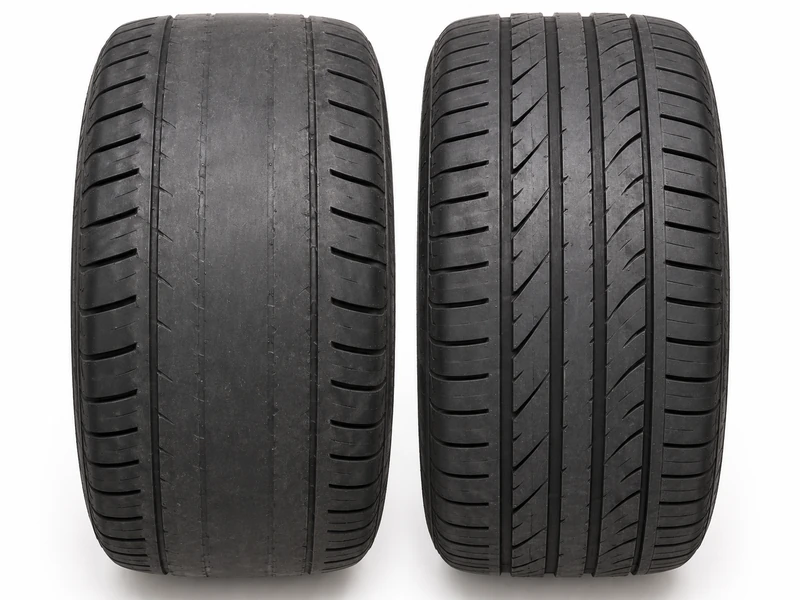
Symptoms can hint but never convict: a harsh, bouncy ride and "light" steering are consistent with too much air — and with worn shocks and a dozen other things. The classic physical sign is center tread wear (middle of the tread bald, shoulders fresh), which Michelin attributes to chronic overinflation — but it develops over months, so it tells you about history, not today's reading. Suspect it, then confirm with a gauge (one you can trust).
Already on the road and worried? A hot reading 4–6 PSI above placard after highway driving is normal physics, not overinflation — see the false-alarm section before you touch anything.
How Much Over Is Too Much?
No standard answers this, so here's our rule of thumb — editorial guidance, not an official spec:
| Cold reading vs placard | Verdict | What to do |
|---|---|---|
| 1–3 PSI over placard | Minor | Fix when convenient — normal gauge and pump error live here |
| 4–9 PSI over | Correct soon | Bleed down this week; don't load up or road-trip first |
| 10+ PSI over, or near sidewall MAX | Fix before highway | Bleed down now — impact damage and wet grip suffer most here |
One special case jumps the queue: if someone inflated your road tires to a donut spare's pressure (~60 PSI), don't drive on them — bleed them down before leaving the driveway. More on that trap in how it happens.
Is It Safe to Drive on Overinflated Tires?
Short distances at moderate speeds — yes, drive to the air pump without panic. But understand what's actually at stake, because it's not what most articles claim:
- Center tread wear — the crown of the tire carries the load, the middle wears first, and you're buying tires sooner (Michelin lists this as the signature of chronic overinflation).
- Less grip, especially wet — overinflation shrinks the contact patch; Michelin calls wet-road handling "hazardous" on overinflated tires.
- Impact damage — an over-hard tire can't absorb potholes; the hit goes to the sidewall, wheel, and suspension.
- Ride quality — every expansion joint telegraphs into the cabin.
And the blowout fear? Mostly misplaced. The sidewall MAX PRESS is a limit with engineering margin, and the research record points the other way: a GAO report to Congress cites underinflation as the single most common factor in tire failure — soft tires flex, overheat, and let go. Overinflation degrades your tire slowly; underinflation is the one that kills it fast. Neither is a target — the placard is.
Rule Out a False Alarm: Hot Readings
Driving heats tires and raises pressure roughly 4–6 PSI — by design. A reading taken after driving that's a few PSI over placard is normal, not overinflation. And the trap that follows: never bleed a hot tire down to the cold spec — it will be underinflated once it cools (Michelin is explicit on this; if you must adjust warm, their rule is +0.3 bar / ~4 PSI over the placard value). Full hot-vs-cold physics: cold vs hot tire pressure.
Where the Right Number Comes From
Two numbers compete on every tire, and only one is your target. The door placard (driver's door jamb, sometimes front and rear differ) is the operating spec engineered for your vehicle. The sidewall MAX PRESS is the tire's structural limit at full rated load — Michelin puts it bluntly: don't look for your recommended pressure on the sidewall, it isn't there. Full decoding of every sidewall marking: how to read a tire sidewall.
How Tires End Up Overinflated
- The shop effect — fresh from a tire shop, readings often run high: some techs fill to the sidewall MAX, some set pressure on tires still warm from your drive in, some overfill slightly to seat beads. Check cold the next morning and correct it yourself.
- The seasonal swing — pressure rises ~1 PSI per 10°F. Tires topped up in a January cold snap can read 4–6 PSI high by late spring. That's a genuine slow-developing overinflation worth bleeding off. (The reverse direction: does tire pressure drop in cold weather.)
- The donut trap — temporary spare tires spec ~60 PSI, roughly double a normal tire. People read the spare's sidewall and copy the number onto their road tires. Never do this: 60 PSI on a tire placarded at 33 is firmly in fix-before-highway territory.
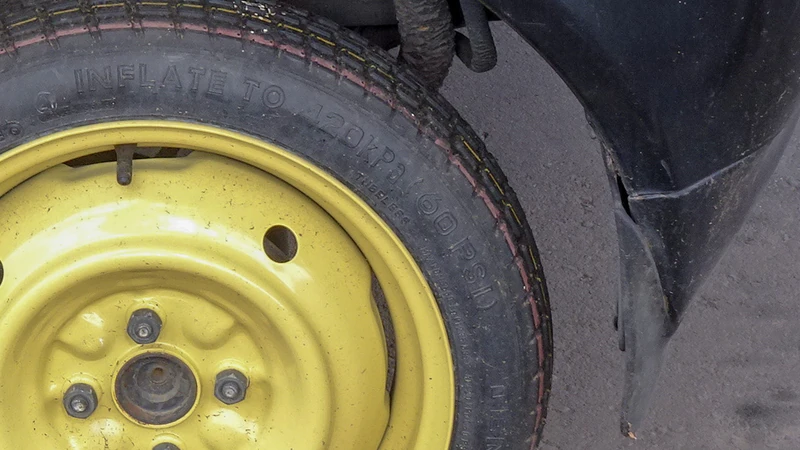
Photo: Spare Wheel by Michael Coghlan, licensed under CC BY-SA 2.0. Cropped and resized.

How to Let Air Out Safely
- Do it cold — parked 3+ hours, so the number you hit is the number that lasts.
- Press the valve pin — the small metal pin in the center of the valve stem; a gauge tip or key works. Short bursts of a second or two.
- Re-measure after every burst — air leaves faster than intuition says. Repeat until you hit the placard number.
- Overshot? Top back up — a minute at a gas-station pump, then verify again. Never judge by squeezing the sidewall.
The whole job hinges on a gauge that reads true — a $3 pencil gauge that's 4 PSI off turns this into guesswork. Our top-tested pick:
JACO ElitePro Digital Tire Pressure Gauge — 100 PSI
approximately $30 · ~4.7 stars · ~6,400+ · PrimePRIME
- •Accuracy: ±0.50% FS (ANSI B40.7 Grade 2A)
- •Range: 5–100 PSI (also bar, kPa, kg/cm²)
- •Resolution: 0.1 PSI on a 2.5" backlit LCD
- •Build: Solid brass and steel, rubber-armored
- •Bleed valve, 10" HybridFlex hose, 360° swivel
- •Locking readout — number stays on screen after removal
- •Battery: 2× AAA (replaceable), 150s auto-off
Pros
- Shop-grade accuracy at a consumer price
- Bleed valve for fine-tuning pressure
- Locking readout — number stays on screen after removal
- Flexible hose reaches awkward valve stems
- Lifetime warranty from a US-based company
Cons
- At ~$30, it is 2–3× the price of budget digitals
- Bulkier than a pencil gauge — won't fit in a small glove box
- 100 PSI max is fine for passenger cars but borderline for trucks
Best for: Drivers who want professional accuracy and long-term durability
As an Amazon Associate we earn from qualifying purchases. Prices and availability are approximate and may vary.
Verified by: Project Farm — #1 out of 23 gauges tested · Car and Driver — "Best Overall" · Road & Track — Top Pick
Full technique and how often to do it: how to check tire pressure.
Why Your TPMS Won't Warn You
Federal rules require TPMS to warn only when pressure falls about 25% below the placard — there is no overinflation alert at all, in any car. A silent warning light means "nothing is critically low," never "everything is correct." You can be 15 PSI over with a happy dashboard. That's why overinflation is a gauge-check problem, not a light-watching problem — monthly, cold (the full checking routine, and what the light actually means).
Key takeaways
- ✓Overinflated = cold reading above the door placard. A hot reading after driving is normal (+4–6 PSI) — never bleed a hot tire to the cold spec.
- ✓Rule of thumb: 1–3 PSI over, fix when convenient; 4–9, correct this week; 10+ or near sidewall MAX, fix before highway driving.
- ✓Real risks are slow ones: center tread wear, less wet grip, pothole damage. Blowouts trace to underinflation, not moderate overinflation.
- ✓TPMS never warns about high pressure — it only triggers ~25% below placard. Only a gauge catches overinflation.
- ✓Fix: press the valve pin in short bursts, re-measure with a gauge, repeat. And never copy the donut spare's ~60 PSI onto road tires.
Frequently Asked Questions
Is 40 PSI too high for my tires?
It depends on your door placard, not the number itself. If your placard says 33–35 PSI and 40 is a cold reading, you're 5–7 PSI over — correct it soon. If 40 is a hot reading after highway driving, it's probably normal heat buildup; recheck cold. Some vehicles (EVs, trucks, vans) legitimately spec 40+ PSI cold, so the placard is always the judge.
Can overinflated tires cause a blowout?
Moderate overinflation by itself rarely causes blowouts — the sidewall's MAX PRESS is a limit with engineering margin, and government research points to underinflation as the single most common factor in tire failure. The real overinflation risks are different: center tread wear, reduced wet grip, harsher ride, and more damage from pothole impacts. Overinflation is a slow problem, not an explosive one.
Will my TPMS warn me if my tires are overinflated?
No. Federal rules only require TPMS to warn when pressure drops about 25% below the placard value — there is no overinflation warning at all. A silent TPMS light tells you nothing about being too high. The only way to catch overinflation is a gauge.
How do I let air out of an overinflated tire?
Press the small pin in the center of the valve stem with a gauge tip, key, or similar tool — short bursts of a second or two, then re-measure with a gauge. Repeat until you hit the placard number. Don't judge by feel or by squeezing the tire. If you overshoot, top back up; air is free at most gas stations.
Why did the tire shop overinflate my tires?
Common reasons: they inflate to the sidewall MAX instead of your placard, they set pressure on warm tires fresh off your drive in, or they overfill slightly to seat beads after mounting. None are malicious — but check your pressures cold the next morning and correct to the door sticker yourself. It takes two minutes.
Can hot weather make my tires overinflated?
Partly. Pressure rises about 1 PSI per 10°F, so a winter top-up can read 4–6 PSI high by late spring — worth correcting. But a high reading right after driving is normal heat expansion, not overinflation. Only cold readings (parked 3+ hours) count for judging. And never bleed a hot tire down to the cold spec — it will be underinflated once it cools.
References
- Michelin — How to inflate tires (placard not sidewall, never deflate a warm tire, +0.3 bar rule for warm checks, valve-pin deflation, center wear and wet-handling risks)
- Michelin — Tire FAQs (overinflation makes tires prone to pothole damage; underinflation → heat → blowout; 1 PSI per 10°F)
- Michelin — Tire wear problems (center tread wear = chronic overinflation)
- GAO report to Congress (GAO-07-246R) — underinflation is the single most common factor in tire failure; TPMS required to warn at 25% below placard
- Consumer Reports — NHTSA study on underinflated tires (overheating → failure risk; TPMS 25% threshold is no substitute for gauge checks)
- Meineke — Spare tire guide (most donut spares call for 60 PSI, well above a standard tire)