
How to Use a Tire Pressure Gauge the Right Way — and Actually Read It
Last updated: November 5, 2026 · Reading time: 8 min
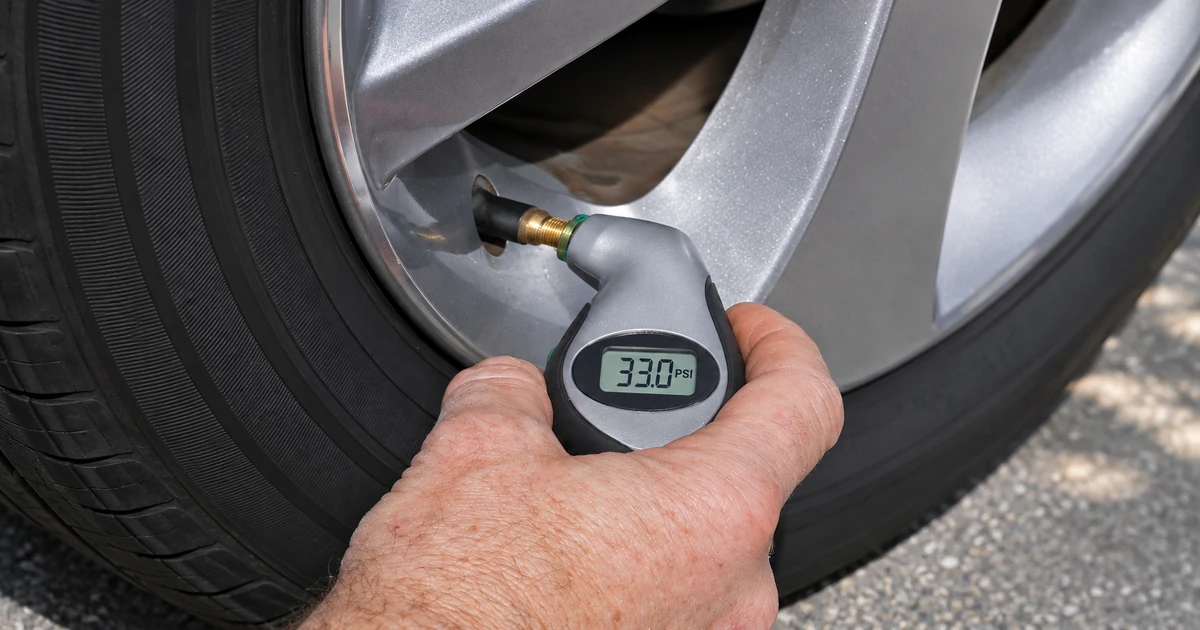
Remove the valve cap, press the gauge straight and firm onto the valve stem until the hissing stops, then read it: the rod on a pencil gauge, the needle on a dial, the screen on a digital. Take 2–3 readings on cold tires and compare to your door placard.
How a Gauge Works (in 30 Seconds)
Every gauge does the same first move: its chuck presses the little pin in the center of the valve stem, opening the valve. Tire air then pushes against a mechanism — a calibrated spring and sliding rod (pencil), a curved Bourdon tube that moves a needle (dial), or an electronic sensor (digital). The harder the air pushes, the higher the reading.
One thing that trips people up before they start: units. In the US everything is PSI, but many digital gauges can show bar or kPa — if yours boots into the wrong unit, find the MODE button.
| Unit | What to know | Same pressure as 33 PSI |
|---|---|---|
| PSI | US standard — your door placard uses this | 33 PSI |
| bar | Metric; 1 bar ≈ 14.5 PSI | ≈ 2.3 bar |
| kPa | Metric; 1 bar = exactly 100 kPa | ≈ 230 kPa |
The Press Technique: Square, Firm, Sealed
Technique is 90% of gauge problems. Three rules:
- Come in straight — chuck square onto the valve stem, not at an angle. An angled chuck leaks past the seal.
- Press firmly and evenly — AAA's wording: enough force to stop all air leakage. The chuck has to depress the valve pin fully.
- Listen — a brief hiss as you press on and pull off is normal (the valve opening and closing). A continuous hiss while attached means a bad seal: adjust the angle, press harder, and the hiss should stop. That leak also corrupts the reading.
Take 2–3 readings per tire. Each press releases a whisper of air and seals a little differently, so readings should cluster within about 1 PSI — that's also the typical accuracy band of a decent gauge. And don't sweat the hiss itself: Michelin notes the escaping air in a normal press doesn't meaningfully change your tire pressure. Finish by screwing the valve cap back on — it keeps dust out of the valve and helps seal it.
How to Read a Pencil (Stick) Gauge
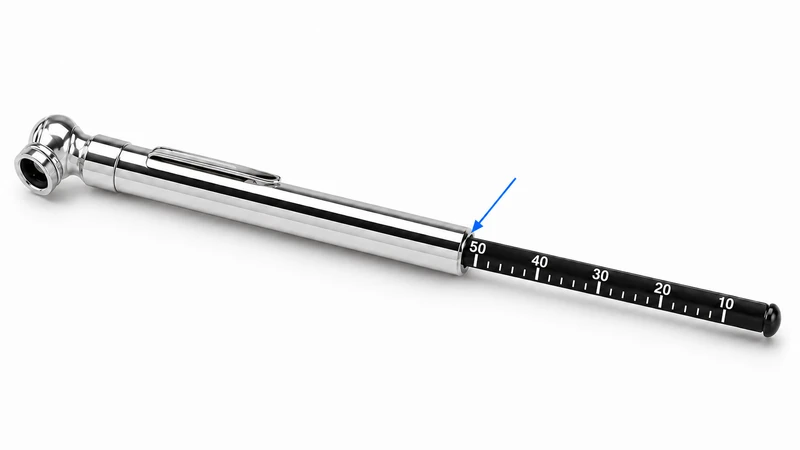
The $4 classic confuses everyone the first time, because the display is invisible until you use it. Here's what actually happens: tire air pushes a piston against a calibrated spring, and a marked indicator rod slides out of the body. The rod is deliberately friction-fit — it stays extended after you pull the gauge off, so you can read it in your hand instead of bent over the wheel.
The reading is the number on the rod exactly where it exits the edge of the metal body — not the biggest number you can see, not the end of the rod. If the rod shows 32 at the body edge, the tire is at 32 PSI.
When you're done, push the rod back in. That's the reset — leave it out and next time you'll misread the starting point.
How to Read a Dial Gauge
Press the chuck on, watch the needle sweep up, and read where it settles. Two features worth knowing on many models (JACO documents both on its own gauges):
- The needle holds after you remove the gauge, so you can read it comfortably — not every dial gauge does this, but most mid-range ones do.
- The side button resets it — pressing it bleeds the trapped air and returns the needle to zero. That same button doubles as a fine deflator while attached: overfilled slightly? Tap the button to walk the reading down to the placard number.
How to Read a Digital Gauge
The easiest to read, with two quirks:
- Turn it on first. Press the ON button — the display wakes and auto-zeros — then press onto the valve. Pressing a sleeping gauge onto the valve is the #1 cause of "my digital gauge reads zero."
- The display holds after removal, so read it in comfort. Most units shut themselves off after a minute or so.
If the numbers ever look absurd (a 230 on the screen), you're in kPa — hit MODE to get back to PSI. And when readings get flaky over time, suspect the coin/AAA batteries before the sensor.
Using a Gas Station Inflator Gauge
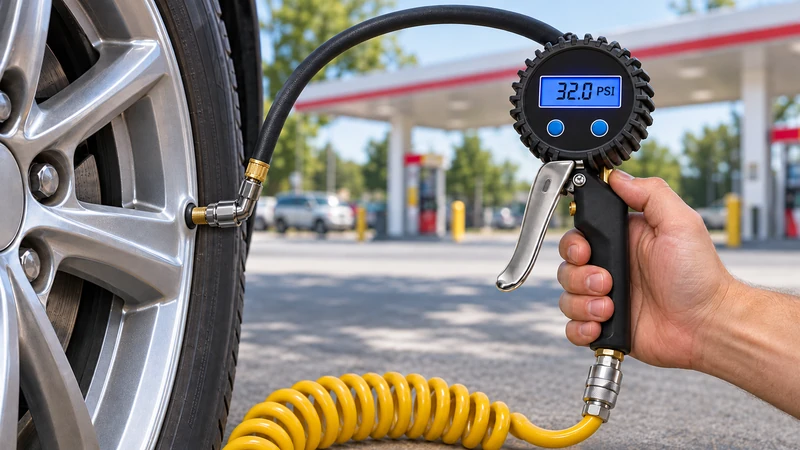
The chuck-with-gauge on a station air hose works on the same principle, with one behavior that confuses everyone: read the pressure with the trigger released. While you're squeezing, the gauge shows pump line pressure or zero — not your tire. Squeeze a few seconds, release, read, repeat until you hit your number.
And treat that number as approximate. A NHTSA study of station air pumps found 16–20% of the gauges over-read by 4 PSI or more — and they skew high, which quietly steers you into underinflation. Weather and constant public use beat these gauges up; Michelin and AAA both warn they're not reliably calibrated.
Best practice: inflate with the station's pump, verify with your own gauge. Our tested pick:
JACO ElitePro Digital Tire Pressure Gauge — 100 PSI
approximately $30 · ~4.7 stars · ~6,400+ · PrimePRIME
- •Accuracy: ±0.50% FS (ANSI B40.7 Grade 2A)
- •Range: 5–100 PSI (also bar, kPa, kg/cm²)
- •Resolution: 0.1 PSI on a 2.5" backlit LCD
- •Build: Solid brass and steel, rubber-armored
- •Bleed valve, 10" HybridFlex hose, 360° swivel
- •Locking readout — number stays on screen after removal
- •Battery: 2× AAA (replaceable), 150s auto-off
Pros
- Shop-grade accuracy at a consumer price
- Bleed valve for fine-tuning pressure
- Locking readout — number stays on screen after removal
- Flexible hose reaches awkward valve stems
- Lifetime warranty from a US-based company
Cons
- At ~$30, it is 2–3× the price of budget digitals
- Bulkier than a pencil gauge — won't fit in a small glove box
- 100 PSI max is fine for passenger cars but borderline for trucks
Best for: Drivers who want professional accuracy and long-term durability
As an Amazon Associate we earn from qualifying purchases. Prices and availability are approximate and may vary.
Verified by: Project Farm — #1 out of 23 gauges tested · Car and Driver — "Best Overall" · Road & Track — Top Pick
(How we verified it and the alternatives: accurate tire pressure gauges, evidence-ranked.)
Troubleshooting: Hissing, Zero, Inconsistent Readings
Continuous hissing while attached
Bad seal — re-seat the chuck straighter and firmer. If air hisses from the valve even with no gauge attached, the valve core is the problem, not your technique: the soapy-water test will confirm it in seconds.
Zero reading or nothing moves
The valve pin never opened — repress straighter and harder. Still zero? Digital: battery. Pencil: rod stuck — push it in and out a few times. Any type: dirt clogging the chuck, blow it out.
Different readings every press
Normal spread is about 1 PSI across 2–3 presses. Wider than that: your press angle is varying, or the gauge is drifting. Cross-check it against a second gauge — the full verification ladder is in how to verify your gauge. A $4 gauge that can't repeat has earned retirement.
Got the reading? Compare it to your vehicle's placard PSI, then inflate or bleed to match — the full routine (when to check, cold readings, how much to add) lives in how to check tire pressure.
Key takeaways
- ✓Press straight and firm until the hissing stops — a brief hiss on press/release is normal, a continuous one is a bad seal and a bad reading.
- ✓Pencil gauge: the rod slides out and STAYS out. Read it where it exits the body edge, then push it back to reset.
- ✓Digital: press ON first (auto-zeros), then measure; the display holds after removal. Weird number like 230? You're in kPa — hit MODE.
- ✓Gas station inflators: read with the trigger RELEASED; NHTSA found 16–20% of station gauges over-read by 4+ PSI, so verify with your own gauge.
- ✓2–3 readings should cluster within ~1 PSI. Bigger spread = technique or a dying gauge.
- ✓Screw the valve cap back on — it keeps dust out and helps the valve seal.
Frequently Asked Questions
Is the hissing sound normal when using a tire pressure gauge?
A brief hiss as you press the gauge on and pull it off is normal — that's the valve pin opening and closing. A continuous hiss while the gauge is on the valve means the chuck isn't sealed: you're not pressing hard enough or the angle is off. Straighten up, press firmly, and the hiss should stop. That continuous leak also makes the reading wrong.
Why does my tire pressure gauge read zero?
Almost always a seal problem: the chuck isn't depressing the valve pin far enough, so no air reaches the mechanism. Repress, straighter and firmer. If it still reads zero, check for a clogged chuck (dirt in the fitting), a dead battery on a digital gauge, or a pencil gauge rod that's stuck — push it back in and try again.
How do I read a pencil (stick) tire pressure gauge?
Press it on the valve and the calibrated rod slides out of the body — then it stays out, held by friction, after you remove the gauge. Read the number on the rod exactly where it exits the edge of the metal body. When you're done, push the rod back in to reset it for next time.
Why do I get different readings on the same tire?
Two reasons: every press lets a tiny bit of air out, and seal quality varies press to press. Take 2–3 readings and expect them to cluster within about 1 PSI — typical gauge accuracy is around ±1 PSI. If one gauge can't repeat within that spread on the same tire, either your press technique is inconsistent or the gauge itself is drifting.
PSI, bar, or kPa — which unit should I use?
In the US, use PSI — it's what your door placard and every spec uses. Digital gauges often cycle through PSI / bar / kPa with a MODE button; if yours shows bar or kPa by accident, switch it back. For reference: 1 bar = 100 kPa ≈ 14.5 PSI, so a 33-PSI placard is about 2.3 bar or 230 kPa.
Can I trust the gauge on a gas station air pump?
Treat it as a rough estimate. A NHTSA study found 16–20% of station gauges over-read by 4 PSI or more — and they tend to read high, which tricks you into underinflating. Weather exposure and constant use beat them up. Best practice: inflate with the station's pump, but verify the final number with your own gauge.
References
- Bob Vila — How to use a tire pressure gauge (hissing = adjust angle; typical gauge accuracy ±1 PSI from 10× repeat testing)
- iFixit — How to check tire pressure (brief hiss on press/release is normal; continuous hiss means press harder)
- AAA — How to check and correct tire pressure (press firmly enough to stop all air leakage; screw the cap back on; station gauges damaged by weather and overuse)
- Michelin — How to inflate tires (the hiss is harmless to your pressure; valve caps keep out dust and ensure tightness; station gauges not always calibrated)
- Oppedahl (patent attorney deep-dive) — How pencil tire pressure gauges work (friction-held indicator rod stays out for reading; read the rod markings; push back to reset)
- JACO — How tire pressure gauges work (pencil: calibrated spring + rod; dial: Bourdon tube; digital: sensor) and gauge FAQs (dial holds reading, reset button doubles as bleeder)
- JACO — FlowPro inflator FAQ (display shows 0 PSI while the trigger is squeezed; tire pressure shows on release)
- Harbor Freight — Digital inflator manual (press ON, gauge auto-zeros; MODE switches units; read pressure with trigger released)
- NHTSA study DOT HS 809 366 — gas station air pump gauge accuracy (16–20% over-read by ≥4 PSI; station gauges skew high, encouraging underinflation)